 Ozali dino nini? Kwizi
 Etumba ya badino
 Mbangu ya badino
 Masano mike ya badino
 Albumu ya bastika
 Bilisti TOP ya badino
 Kamwisa ngai!
Azalaki na bomoi ntango nini?

Azalaki monene boni?
Azalaki molai boni?
Azalaki molai boni na likolo?
Azalaki kilo boni?
 molai lokola bamotuka 2 oyo batelemi na molongo🍌molai lokola matoko 56 oyo balandani
 kilo lokola bambwa 190🍉kilo lokola bapasteke 760🎒kilo lokola bakelasi 5 mobimba ya bana🐻❄️kilo lokola ba-urs ya pembe 8🏃akokaki kopota metele 100 na sekonde 18 (moto oyo aleki mbangu asalelaka 9,6)
Camelotia azalaki monene boni soki tokokanisi na YO?
Kaka matematiki na navigatere na yo. Eloko moko te ebombami to etindami esika moko.
Azalaki na mbangu boni?


Makambo ya kosepelisa
Camelotia lived about 205 to 201 million years ago, during the Rhaetian stage of the Late Triassic.3
Its thigh bone (femur) is about 1 metre (3.3 feet) long, which helped scientists guess its size.1
Camelotia is named after Camelot, the legendary castle of King Arthur, because its fossils were found in Somerset, near where the stories take place.1
It was one of the largest sauropodomorphs from the Triassic, weighing about 3.8 tonnes (8,400 pounds).1
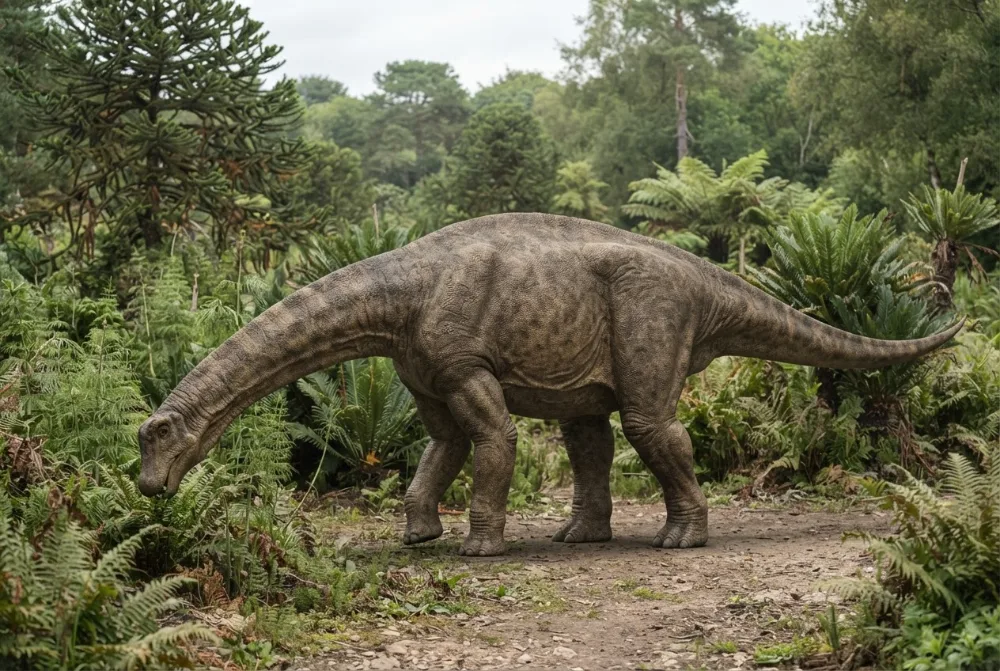
Scientists think Camelotia walked on all four legs, like later sauropods, because its relatives were becoming more quadrupedal.1
The first fossils of Camelotia were discovered in 1894 in a quarry in Wedmore, but they were not named until 1985.1
Some large dinosaur footprints found in Wales might have been made by Camelotia, but scientists are not sure.1
Mituna oyo batunaka mingi na ntina na Camelotia
?How big was Camelotia?
Camelotia was about 8 to 10 metres long and weighed around 3.8 tonnes. That is about as long as a school bus.1
?What did Camelotia eat?
Camelotia was a plant-eater. Its teeth were leaf-shaped and serrated, perfect for eating plants.1
?Did Camelotia walk on two legs or four?
Scientists think Camelotia walked on all four legs, like later sauropods. Its relatives were becoming more quadrupedal.1
?Where was Camelotia found?
Camelotia's fossils were found in a quarry in Wedmore, Somerset, England. That is near the legendary castle of King Arthur, Camelot.1
Mobuki masapo
Lisapo: Camelotia was a meat-eater because its teeth were found near its bones.
Solo: The teeth found with Camelotia actually belong to a different dinosaur, a theropod called Newtonsaurus. Camelotia itself was a plant-eater.1
Mpo na bayebi ya badino
- Nkombo ya siansi
- Camelotia
- Nkombo epesamaki na
- Galton 19853
- Lisanga
- Nkingo milai
- Libota / klade
- Sauropodiformes3
- Klasifikasio
- Sauropodomorpha3
- Mbula ya mabanga
- mbula milio 206 kino 201 (Rhaetian)3
- Milongo ya mabanga
- Westbury3
- Bikolo
- Angeletere3
- Bafosile oyo ekomami
- 2 na The Paleobiology Database3
- Ntango bamonaki yango
- The first fossils were found in 1894 in a quarry near Wedmore, England. They were named Camelotia borealis by Peter M. Galton in 1985.1
- Naino bazali kowelana
- Scientists are not sure exactly where Camelotia fits on the dinosaur family tree. Some think it is a close relative of Melanorosaurus, while others think it is a very early sauropod.1
Esika makambo euti
- Camelotia (en.wikipedia.org)
- Camelotia - Justapedia (justapedia.org)
- Camelotia in The Paleobiology Database (CC BY 4.0): mbula, bisika, milongo ya mabanga, klasifikasio.
Likambo nyonso na lokasa oyo ezali na nimero oyo elakisi liziba na yango. Soki tosali libunga, limbisa biso, tozali bato balingaka badino, zulunalo ya siansi te. Yebisa biso na [email protected] mpe tokobongisa yango.
 Rex azali na nzala! Dino Wiki ezali mosala ya tata moko mpo na mwana na ye ya mobali oyo alingaka badino, ofele, piblisite te mpe batrakere te. Bato bakolo bakoki kopesa Rex biskwi mpo na kosalisa ete etikala na internet.Leisa Rex
 Brachiosaurus
 Diplodocus
 Brontosaurus
 Argentinosaurus
 Camarasaurus
 Morosaurus
 Nothosaurus
 Coelophysis
 Podokesaurus
 Simosaurus
 Eudimorphodon
 Herrerasaurus