 Ozali dino nini? Kwizi
 Etumba ya badino
 Mbangu ya badino
 Masano mike ya badino
 Albumu ya bastika
 Bilisti TOP ya badino
 Kamwisa ngai!
Compsognathus
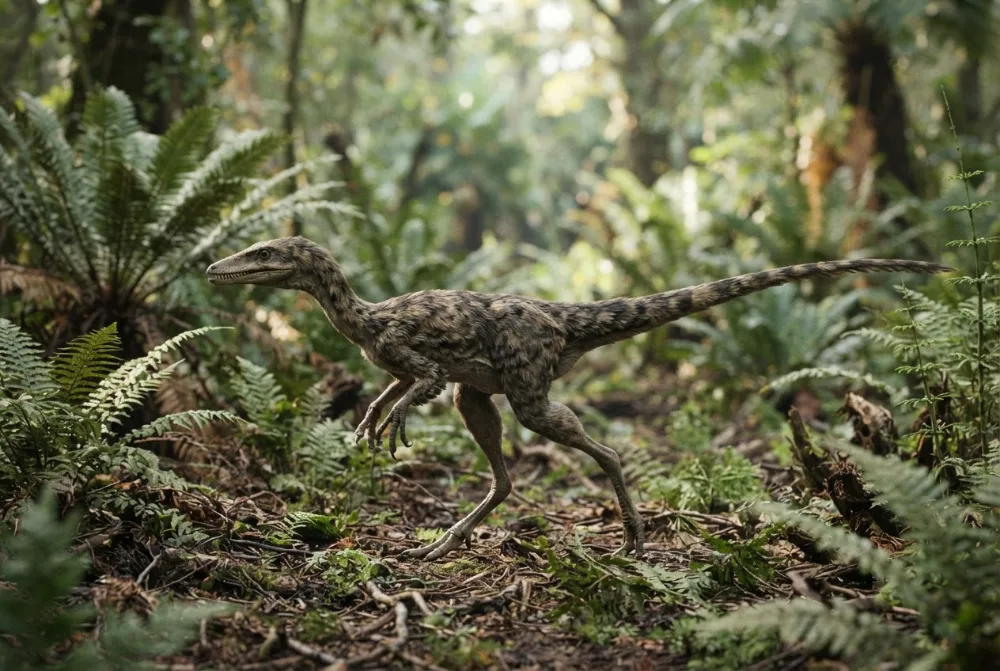
Compsognathus was a tiny, speedy dinosaur about the size of a chicken. It ran on two legs and hunted small lizards and insects. This little predator lived in Europe during the Late Jurassic period, around 150 million years ago.1
Azalaki na bomoi ntango nini?
Azalaki monene boni?
Azalaki molai boni?
Azalaki molai boni na likolo?
Azalaki kilo boni?
 molai lokola bapusu 3 ya ndako zolo kino mokila🍌molai lokola matoko 8 oyo balandanipene kilo lokola pusu ya ndako🍌kilo lokola matoko 25🪑moke ete akoka koleka na nse ya kiti🏃akokaki kopota metele 100 na sekonde 5,6 (moto oyo aleki mbangu asalelaka 9,6)
Compsognathus azalaki monene boni soki tokokanisi na YO?
Kaka matematiki na navigatere na yo. Eloko moko te ebombami to etindami esika moko.
Azalaki na mbangu boni?


Makambo ya kosepelisa
Compsognathus was one of the smallest dinosaurs ever discovered. Until the 1990s, it was the smallest known non-bird dinosaur.1
Scientists know exactly what Compsognathus ate because both fossils have the remains of lizards in their bellies.1
The first Compsognathus fossil was found in Germany in the 1850s. It was originally thought to be a lizard, not a dinosaur.1
Compsognathus lived on islands in a warm, tropical sea. Its fossils were preserved in fine limestone that was once lagoon mud.1
The German specimen of Compsognathus is only about 0.7 metres (2.3 feet) long. Scientists think it was a juvenile.21
Compsognathus had small, sharp teeth. The front teeth had no serrations, but the back teeth had fine serrations on the rear edge.1
Mituna oyo batunaka mingi na ntina na Compsognathus
?How big was Compsognathus?
The smaller German specimen was about 0.7 to 0.9 m (2.3 to 3 ft) long and weighed around 0.3 to 0.6 kg (0.7 to 1.3 lb). The larger French specimen reached about 1.25 to 1.4 m (4.1 to 4.6 ft) and weighed up to 3.5 kg (7.7 lb).12
?Was Compsognathus a dinosaur?
Yes, Compsognathus was a small, bipedal, carnivorous theropod dinosaur. It is one of the first theropod dinosaurs known from a nearly complete skeleton.1
?What did Compsognathus eat?
Compsognathus was a carnivore that ate small vertebrates, especially lizards. Both known fossils have lizard remains preserved in their stomachs.12
?How fast could Compsognathus run?
Maybe up to about 64 km/h (40 mph), almost as fast as a galloping horse! A computer model of its legs and muscles worked this out, though some scientists think that is too fast. It was small, light and very quick.3
?Did Compsognathus have feathers?
No direct feather fossils have been found with Compsognathus. It lived in the same environment as the feathered dinosaur Archaeopteryx, so some scientists think it may have had simple feathers, but there is no proof yet.1
?Was Compsognathus smaller than a chicken?
The German specimen was roughly chicken-sized, about 0.7 m (2.3 ft) long. The French specimen was larger, about 1.25 to 1.4 m (4.1 to 4.6 ft).12
?When did Compsognathus live?
Compsognathus lived about 150 million years ago, during the late Jurassic period. Its fossils are from the Tithonian age.12
?Where was Compsognathus found?
Two nearly complete fossils have been found: one in Bavaria, Germany, discovered in the 1850s, and one in Canjuers near Nice, France, discovered in the 1970s. Possible teeth have also been found in Portugal.12
?Could Compsognathus swim?
There is no evidence that Compsognathus could swim, but it lived on tropical islands near lagoons and may have occasionally entered shallow water.1
?Was Compsognathus the smallest dinosaur?
Until the 1990s, it was the smallest known non-bird dinosaur, but later discoveries like Microraptor and Mahakala are even smaller.1
Mobuki masapo
Lisapo: Compsognathus is often shown as a tiny dinosaur that hunted in packs.
Solo: There is no evidence that Compsognathus lived or hunted in groups. The fossils found are of single animals.1
Mpo na bayebi ya badino
- Nkombo ya siansi
- Compsognathus
- Nkombo epesamaki na
- Wagner 18614
- Lisanga
- Badino ya kolia mosuni
- Libota / klade
- Compsognathidae4
- Klasifikasio
- Theropoda > Compsognathidae4
- Mbula ya mabanga
- mbula milio 155 kino 145 (Kimmeridgian / Tithonian)4
- Milongo ya mabanga
- Alcobaça, Painten4
- Bikolo
- Falansa, Portigale, Alemani4
- Bafosile oyo ekomami
- 4 na The Paleobiology Database4
- Ntango bamonaki yango
- The first Compsognathus fossil was found in Germany in the 1850s by a doctor named Joseph Oberndorfer. He lent it to paleontologist Johann A. Wagner, who named it Compsognathus longipes in 1859.1
- Naino bazali kowelana
- Scientists are not sure if the smaller German specimen is a juvenile or a different species. Some think both fossils belong to the same species, Compsognathus longipes.1
Esika makambo euti
- Compsognathus (en.wikipedia.org)
- Compsognathus | Natural History Museum (nhm.ac.uk)
- Compsognathus- Enchanted Learning Software (enchantedlearning.com)
- Compsognathus in The Paleobiology Database (CC BY 4.0): mbula, bisika, milongo ya mabanga, klasifikasio.
Likambo nyonso na lokasa oyo ezali na nimero oyo elakisi liziba na yango. Soki tosali libunga, limbisa biso, tozali bato balingaka badino, zulunalo ya siansi te. Yebisa biso na [email protected] mpe tokobongisa yango.
 Rex azali na nzala! Dino Wiki ezali mosala ya tata moko mpo na mwana na ye ya mobali oyo alingaka badino, ofele, piblisite te mpe batrakere te. Bato bakolo bakoki kopesa Rex biskwi mpo na kosalisa ete etikala na internet.Leisa Rex
 Allosaurus
 Carnotaurus
 Dilophosaurus
 Giganotosaurus
 Paronychodon
 Megalosaurus
 Brachiosaurus
 Diplodocus
 Brontosaurus
 Camarasaurus
 Morosaurus
 Apatosaurus