 Ozali dino nini? Kwizi
 Etumba ya badino
 Mbangu ya badino
 Masano mike ya badino
 Albumu ya bastika
 Bilisti TOP ya badino
 Kamwisa ngai!
Livyatan
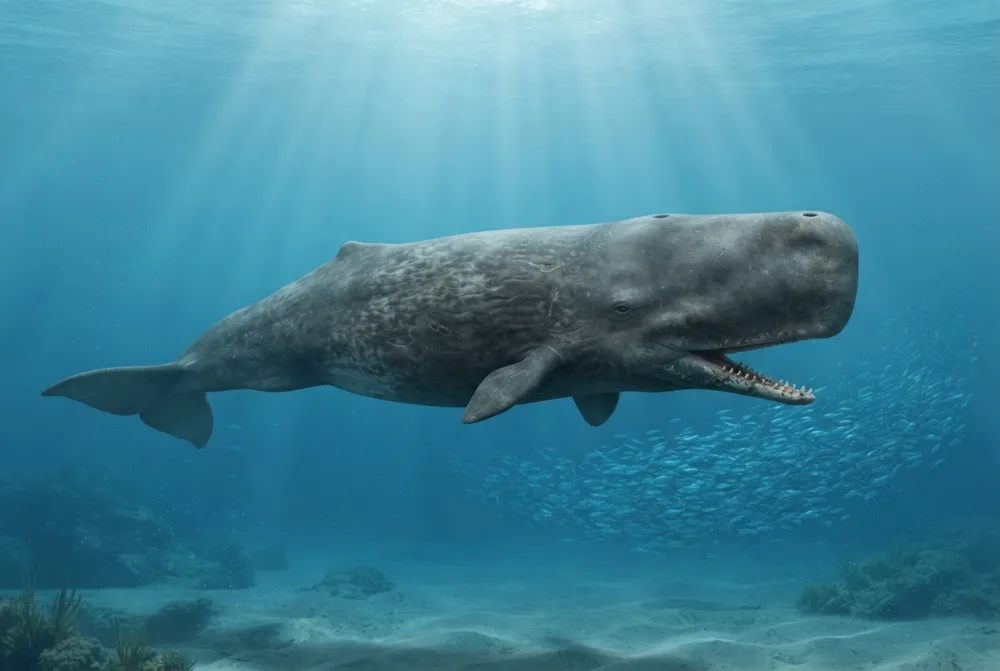
Livyatan was a giant sperm whale that lived in the ocean millions of years ago. It had huge teeth and was one of the biggest hunters in the sea. It was not a dinosaur, but a mammal like whales today.1
Azalaki na bomoi ntango nini?
Azalaki monene boni?
Azalaki molai boni?
Azalaki kilo boni?

 molai lokola bamotuka 4 oyo batelemi na molongo🍌molai lokola matoko 97 oyo balandani🍉kilo lokola bapasteke 11000🎒kilo lokola bakelasi 71 mobimba ya bana🐻❄️kilo lokola ba-urs ya pembe 130🏊akokaki kobeta mai bolai ya pisine monene (50 m) na sekonde 5,1
Livyatan azalaki monene boni soki tokokanisi na YO?
Kaka matematiki na navigatere na yo. Eloko moko te ebombami to etindami esika moko.
Azalaki na mbangu boni?


Makambo ya kosepelisa
Livyatan had teeth up to 36 centimeters (over 14 inches) long, bigger than any other sperm whale.1
Its skull was about 3 meters (10 feet) long, making it the largest fossil sperm whale skull known.1
Livyatan lived at the same time as the giant shark Carcharocles megalodon, and both were top predators.1
Scientists think Livyatan could bite harder than any other four-legged animal ever found.1
Unlike modern sperm whales that suck in food, Livyatan used its teeth to hunt and tear large prey.1
The name Livyatan comes from a Hebrew word for a sea monster, and the species name melvillei honors the author of Moby-Dick.1
Mituna oyo batunaka mingi na ntina na Livyatan
?How big was Livyatan?
About 13.5 to 17.5 meters (44 to 57 feet) long, similar to a modern sperm whale.2
?What did Livyatan eat?
It hunted large prey like medium-sized baleen whales, using its huge teeth to bite and tear flesh.12
?Did Livyatan live at the same time as megalodon?
Yes, Livyatan and the giant shark megalodon lived in the same oceans and may have competed for food.23
?Why did Livyatan go extinct?
It probably died out because of a cooling event at the end of the Miocene that reduced its food supply.2
?Is Livyatan a dinosaur?
No, Livyatan was a mammal, a giant sperm whale, not a dinosaur.2
?How long were Livyatan's teeth?
Its teeth were up to 36.2 centimeters (14.3 inches) long, the largest biting teeth of any known animal.21
?Where was Livyatan discovered?
Its fossil skull was found in the Pisco Formation of Peru, in a coastal desert near Ica.21
Mobuki masapo
Lisapo: Some people think Livyatan was a dinosaur.
Solo: Livyatan was a whale, a mammal, not a dinosaur.1
Mpo na bayebi ya badino
- Nkombo ya siansi
- Livyatan
- Nkombo epesamaki na
- Lambert et al. 20104
- Lisanga
- Banyama ya lokumu ya kala-kala
- Libota / klade
- Physeteroidea4
- Klasifikasio
- Mammalia > Cetacea > Physeteroidea4
- Mbula ya mabanga
- mbula milio 23 kino 3,6 (Aquitanian / Zanclean)4
- Milongo ya mabanga
- Pisco4
- Bikolo
- Afrika ya Sudi, Peru, Arzantine, Shili, Amerika4
- Bafosile oyo ekomami
- 6 na The Paleobiology Database4
- Ntango bamonaki yango
- Scientists found a skull with teeth in the Pisco desert of Peru, and they named it Livyatan melvillei in 2010.1
- Naino bazali kowelana
- Scientists are still debating what the big basin on its head was for, like echolocation or display.1
Esika makambo euti
- The giant bite of a new raptorial sperm whale from the Miocene epoch of Peru (nature.com)
- Livyatan (en.wikipedia.org)
- Behold Livyatan: the sperm whale that killed other whales | National Geographic (nationalgeographic.com)
- Livyatan in The Paleobiology Database (CC BY 4.0): mbula, bisika, milongo ya mabanga, klasifikasio.
Likambo nyonso na lokasa oyo ezali na nimero oyo elakisi liziba na yango. Soki tosali libunga, limbisa biso, tozali bato balingaka badino, zulunalo ya siansi te. Yebisa biso na [email protected] mpe tokobongisa yango.
 Rex azali na nzala! Dino Wiki ezali mosala ya tata moko mpo na mwana na ye ya mobali oyo alingaka badino, ofele, piblisite te mpe batrakere te. Bato bakolo bakoki kopesa Rex biskwi mpo na kosalisa ete etikala na internet.Leisa Rex
 Megalodon
 Sabre-toothed cat
 Dimetrodon
 Woolly mammoth
 Arthropleura
 Helicoprion