 Ozali dino nini? Kwizi
 Etumba ya badino
 Mbangu ya badino
 Masano mike ya badino
 Albumu ya bastika
 Bilisti TOP ya badino
 Kamwisa ngai!
Placodus
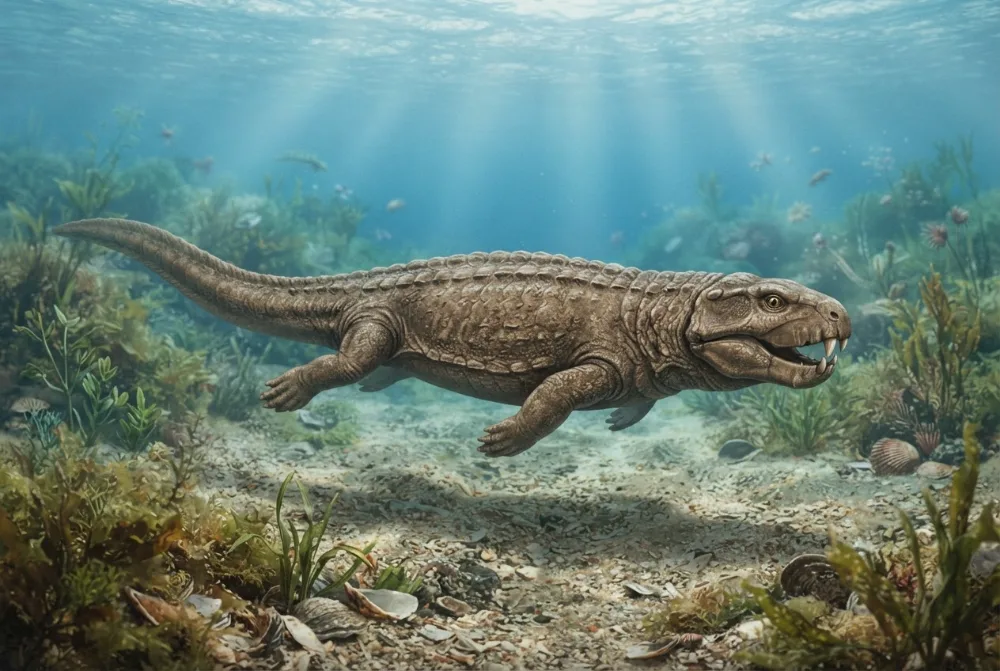
Placodus was a marine reptile that lived about 240 million years ago, during the Middle Triassic. It had a stocky body, a long tail, and a heavy skull with flat teeth for crushing shellfish. It swam in shallow seas and probably spent most of its time on the seafloor looking for food.1
Azalaki na bomoi ntango nini?
Azalaki monene boni?
Azalaki molai boni?
 molai lokola bambwa 3 zolo kino mokila🍌molai lokola matoko 17 oyo balandani🏊akokaki kobeta mai bolai ya pisine monene (50 m) na sekonde 11
Placodus azalaki monene boni soki tokokanisi na YO?
Kaka matematiki na navigatere na yo. Eloko moko te ebombami to etindami esika moko.
Azalaki na mbangu boni?


Makambo ya kosepelisa
Placodus had a rigid body because the bones in its spine were dovetailed together, making its trunk stiff.1
Its belly was covered with special armor made of bent, right-angled abdominal ribs, and it had a row of bony knobs above its backbone.1
Placodus was negatively buoyant, meaning it was heavy and could easily stay on the seafloor without floating up.1
Before scientists knew what Placodus looked like, its teeth were mistaken for fish teeth.1
Placodus was slow and clumsy on land because of its heavy body armor, so it probably only came ashore to lay eggs.1
Its short legs probably ended in webbed feet, and it used its flattened tail to push through the water.1
Mituna oyo batunaka mingi na ntina na Placodus
?How big was Placodus?
About 2.5 to 3 metres (8.2 to 9.8 ft) long.1
?What did Placodus eat?
Shellfish like bivalves, plus other hard-shelled prey such as molluscs, brachiopods and crustaceans. It used its chisel-like front teeth to pluck them from the sea floor and its broad, flat back teeth to crush their shells.1
?Was Placodus a dinosaur?
No, Placodus was a marine reptile called a placodont, not a dinosaur. It lived in the sea during the Triassic period.12
?Could Placodus swim?
Yes, it swam using its flattened tail and short legs that probably ended in webbed feet. It was not as good at swimming as later marine reptiles like plesiosaurs, but it was comfortable in the water.1
?Why did Placodus have a rigid body?
Its spine had dovetailed bones that locked together, making its trunk stiff. This helped it stay heavy on the sea floor so it could feed without floating up.1
?When did Placodus live?
About 240 million years ago, in the Middle Triassic period.1
Mpo na bayebi ya badino
- Nkombo ya siansi
- Placodus
- Nkombo epesamaki na
- Agassiz 18333
- Lisanga
- Bareptile ya mbu
- Libota / klade
- Placodontidae3
- Klasifikasio
- Placodontia > Sauropterygia3
- Mbula ya mabanga
- mbula milio 251 kino 227 ()3
- Milongo ya mabanga
- Jena, Wellenkalk, Vossenveld3
- Bikolo
- Alemani, Isalaele, Poloni, Holande, Itali, Sina3
- Bafosile oyo ekomami
- 34 na The Paleobiology Database3
- Bayebi ye mpe na nkombo
- Anomosaurus, Crurosaurus (bankombo ya kala oyo sikoyo batangaka lokola nyama moko)3
- Ntango bamonaki yango
- Placodus was named by the Swiss naturalist Louis Agassiz in 1833. He originally thought the fossils were fish teeth.13
Esika makambo euti
- Placodus (en.wikipedia.org)
- Fossil Focus: Placodonts – PALAEONTOLOGY[online] (palaeontologyonline.com)
- Placodus in The Paleobiology Database (CC BY 4.0): mbula, bisika, milongo ya mabanga, klasifikasio.
Likambo nyonso na lokasa oyo ezali na nimero oyo elakisi liziba na yango. Soki tosali libunga, limbisa biso, tozali bato balingaka badino, zulunalo ya siansi te. Yebisa biso na [email protected] mpe tokobongisa yango.
 Rex azali na nzala! Dino Wiki ezali mosala ya tata moko mpo na mwana na ye ya mobali oyo alingaka badino, ofele, piblisite te mpe batrakere te. Bato bakolo bakoki kopesa Rex biskwi mpo na kosalisa ete etikala na internet.Leisa Rex
 Nothosaurus
 Lariosaurus
 Cyamodus
 Cymatosaurus
 Proneusticosaurus
 Simosaurus
 Chonespondylus
 Cymbospondylus
 Phalarodon
 Mixosaurus
 Chaohusaurus
 Chensaurus