 Ozali dino nini? Kwizi
 Etumba ya badino
 Mbangu ya badino
 Masano mike ya badino
 Albumu ya bastika
 Bilisti TOP ya badino
 Kamwisa ngai!
Stenopterygius
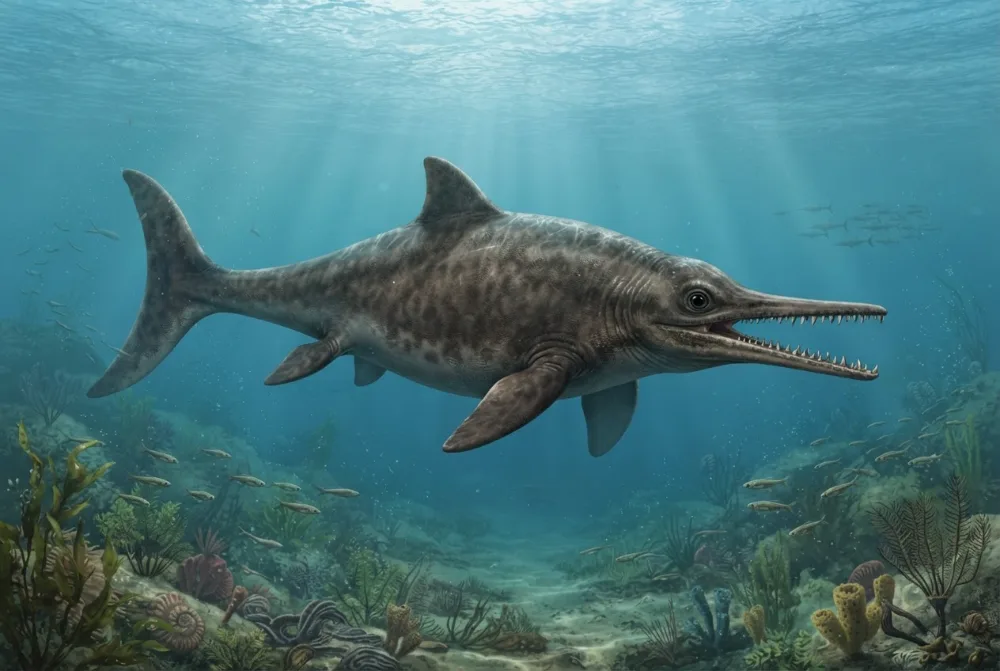
Stenopterygius was a fast-swimming marine reptile that lived in the Jurassic seas. It looked a bit like a dolphin but was actually an ichthyosaur, not a dinosaur. It had a long beak full of teeth and chased after fish and squid.1
Azalaki na bomoi ntango nini?
Azalaki monene boni?
Azalaki molai boni?
 molai lokola bambwa 4 zolo kino mokila🍌molai lokola matoko 22 oyo balandani🏊akokaki kobeta mai bolai ya pisine monene (50 m) na sekonde 3,8
Stenopterygius azalaki monene boni soki tokokanisi na YO?
Kaka matematiki na navigatere na yo. Eloko moko te ebombami to etindami esika moko.
Azalaki na mbangu boni?


Makambo ya kosepelisa
Stenopterygius had a small skull and narrow flippers compared to its relative Ichthyosaurus.1
One well-preserved fossil shows traces of skin, revealing that Stenopterygius was countershaded: darker on the back and lighter on the belly.1
Fossils of Stenopterygius often contain the remains of its last meal in the stomach area.1
The tail ended in a large, semicircular, leathery vertical fin, and it also had a triangular dorsal fin on its back.1
Stenopterygius lived during the Early and Middle Jurassic, about 183 to 173 million years ago.1
The type specimen of Stenopterygius quadriscissus is a complete skeleton that even preserved a very large embryo inside.1
Mituna oyo batunaka mingi na ntina na Stenopterygius
?How big was Stenopterygius?
Stenopterygius was a medium sized ichthyosaur, with most species reaching about 3.5 metres long, while the largest, S. uniter, could exceed 4 metres.1
?What did Stenopterygius eat?
Stenopterygius hunted fish, cephalopods, and other animals in the open sea. Fossils often contain the remains of its last meal in the stomach area.1
?Was Stenopterygius a dinosaur?
No, Stenopterygius was an ichthyosaur, a marine reptile, not a dinosaur. It looked a bit like a dolphin but was actually a different group of reptiles.1
?Did Stenopterygius give birth to live young?
Yes, Stenopterygius gave birth to live young, and one famous fossil shows a mother that died in childbirth. It preferred tail-first births, like modern dolphins and whales.1
Mpo na bayebi ya badino
- Nkombo ya siansi
- Stenopterygius
- Nkombo epesamaki na
- Jaekel 19043
- Lisanga
- Baiktiozore
- Libota / klade
- Thunnosauria3
- Klasifikasio
- Ichthyosauria > Ichthyosauromorpha3
- Mbula ya mabanga
- mbula milio 184 kino 171 (Toarcian / Aalenian)3
- Milongo ya mabanga
- Posidonia Shale, Opalinuston, Beacon Limstone3
- Bikolo
- Alemani, Angeletere, Liksamburg, Falansa3
- Bafosile oyo ekomami
- 47 na The Paleobiology Database3
- Ntango bamonaki yango
- The species was first named as Ichthyosaurus quadriscissus by Quenstedt in 1856. Otto Jaekel gave it its own genus, Stenopterygius, in 1904.1
- Naino bazali kowelana
- Scientists are still debating exactly how many species of Stenopterygius existed, because the fossils are often incomplete.2
Esika makambo euti
- Stenopterygius (en.wikipedia.org)
- First Diagnostic Marine Reptile Remains from the Aalenian (Middle Jurassic): A New Ichthyosaur from Southwestern Germany | PLOS One (journals.plos.org)
- Stenopterygius in The Paleobiology Database (CC BY 4.0): mbula, bisika, milongo ya mabanga, klasifikasio.
Likambo nyonso na lokasa oyo ezali na nimero oyo elakisi liziba na yango. Soki tosali libunga, limbisa biso, tozali bato balingaka badino, zulunalo ya siansi te. Yebisa biso na [email protected] mpe tokobongisa yango.
 Rex azali na nzala! Dino Wiki ezali mosala ya tata moko mpo na mwana na ye ya mobali oyo alingaka badino, ofele, piblisite te mpe batrakere te. Bato bakolo bakoki kopesa Rex biskwi mpo na kosalisa ete etikala na internet.Leisa Rex
 Ichthyosaurus
 Platypterygius
 Khudiakovia
 Ophthalmosaurus
 Chonespondylus
 Cymbospondylus
 Dilophosaurus
 Dorygnathus
 Lufengosaurus
 Scutellosaurus
 Yunnanosaurus
 Sinosaurus