 Чи ямар үлэг гүрвэл вэ? Тест
 Үлэг гүрвэлийн тулаан
 Үлэг гүрвэлийн уралдаан
 Үлэг гүрвэлийн мини тоглоомууд
 Наалтын цомог
 Үлэг гүрвэлийн ТОП жагсаалтууд
 Намайг гайхшруул!
Aristonectes
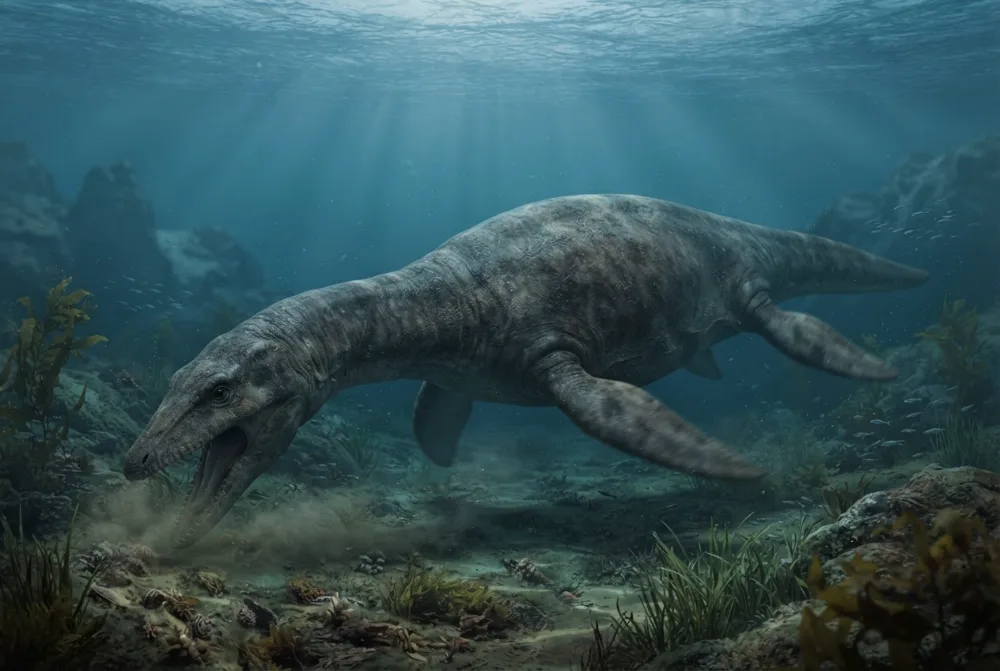
Aristonectes was a huge marine reptile that swam in the seas near Antarctica and South America at the end of the Age of Dinosaurs. It had a big head, a short neck, and a body shaped a bit like a whale. It used its wide mouth to suck up food from the seafloor, just like a gray whale does today.1
Хэзээ амьдарч байсан бэ?
Хэр том байсан бэ?
Хэр урт байсан бэ?
Хэр хүнд байсан бэ?

 2,5 машиныг эгнүүлэн зогсоосонтой тэнцэх урттай🍌66 бананыг дараалан тавьсантай тэнцэх урттай9 машинтай тэнцэх жинтэй🍉2700 тарвастай тэнцэх жинтэй🎒бүтэн 17 ангийн сурагчидтай тэнцэх жинтэй🐻❄️30 цагаан баавгайтай тэнцэх жинтэй🏊том бассейны уртыг (50 м) 8,6 секундэд сэлж туулах чадалтай
Aristonectes ЧАМТАЙ харьцуулахад хэр том байсан бэ?
Зүгээр л хөтөч доторх тооцоо. Юу ч хадгалагдахгүй, хаашаа ч илгээгдэхгүй.
Хэр хурдан байсан бэ?


Сонирхолтой баримтууд
Aristonectes is one of the biggest and heaviest plesiosaurs ever found. One Antarctic specimen may have weighed as much as 13.5 metric tons (about 15 tons), as heavy as a large school bus.1
Unlike most plesiosaurs, which had very long necks, Aristonectes had a short neck and a big, bulky skull. Scientists put it in a special group called Aristonectinae because of this.1
Aristonectes probably migrated between Patagonia and Antarctica, just like many whales do today. Its fossils are found in both places.1
The first fossils of Aristonectes were discovered in Argentina in 1941, but scientists had a hard time studying them because the bones were not well prepared. It took decades to figure out what kind of plesiosaur it was.1
Aristonectes had a mouth that could open very wide, letting it gulp a huge amount of water and food at once. It fed by mixing prey with sediment from the seafloor, a method called benthic suction feeding.1
Like other plesiosaurs, Aristonectes probably swallowed stones called gastroliths. These may have helped grind up food in its stomach or helped control its buoyancy in the water.1
Aristonectes: хамгийн их асуудаг асуултууд
?How big was Aristonectes?
Aristonectes was huge, measuring more than 10 metres (33 feet) long. One Antarctic specimen may have reached 11 to 11.9 metres (36 to 39 feet) and weighed 10.7 to 13.5 metric tons (11.8 to 14.9 short tons).12
?What did Aristonectes eat?
Aristonectes likely ate crustaceans and small fish, based on its small teeth. It fed by sucking up prey and sediment from the seafloor, like a gray whale.13
?Was Aristonectes a dinosaur?
No, Aristonectes was a plesiosaur, a marine reptile that lived alongside the dinosaurs. It was not a dinosaur.1
?Where did Aristonectes live?
Aristonectes lived in the seas near Patagonia and Antarctica during the Late Cretaceous. Its fossils have been found in Chile, Argentina, and Antarctica.1
?Could Aristonectes swim?
Yes, Aristonectes was a strong swimmer, using its large paddle-like limbs to move through the water. Its name means 'best swimmer'.1
Үлэг гүрвэлийн мэргэжилтнүүдэд
- Шинжлэх ухааны нэр
- Aristonectes
- Нэр өгсөн
- Cabrera 19414
- Бүлэг
- Плезиозаврууд
- Овог / клад
- Elasmosauridae4
- Ангилал
- Plesiosauria > Elasmosauridae > Sauropterygia4
- Чулуулгийн нас
- 84 / 66 сая жил (Campanian / Maastrichtian)4
- Чулуулгийн формацууд
- Quiriquina, López de Bertodano, Lopez de Bertodano4
- Улсууд
- Чили, Антарктид, Аргентин4
- Чулуужсан олдворын бүртгэл
- The Paleobiology Database дээр 124
- Өөр нэр
- Turneria (одоо нэг амьтан гэж тооцогддог хуучин нэрс)4
- Нээлт
- Aristonectes was named by Argentine paleontologist Ángel Cabrera in 1941, based on fossils found in Chubut, Argentina. The first species named was Aristonectes parvidens.14
- Маргаантай хэвээр
- Scientists are still debating exactly how Aristonectes is related to other plesiosaurs. For a long time it was thought to be a cryptoclidid, but now most agree it is an elasmosaurid.1
Баримтууд хаанаас ирдэг вэ
- Aristonectes (en.wikipedia.org)
- A giant elasmosaurid (Sauropterygia; Plesiosauria) from Antarctica: New information on elasmosaurid body size diversity and aristonectine evolutionary scenarios (sciencedirect.com)
- Fossil 'sea monster' found in Antarctica was the heaviest of its kind | National Geographic (nationalgeographic.com)
- Aristonectes in The Paleobiology Database (CC BY 4.0): нас, газар, чулуулгийн формац, ангилал.
Энэ хуудсан дээрх баримт бүр эх сурвалж руугаа заасан дугаартай. Хэрэв бид ямар нэг зүйл буруу бичсэн бол уучлаарай, бид шинжлэх ухааны сэтгүүл биш, зүгээр л үлэг гүрвэлд дурлагчид. [email protected] хаягаар бидэнд бичээрэй, бид засна.
 Рекс өлсөж байна! Dino Wiki бол үлэг гүрвэлд дурлагч хүүдээ зориулж нэгэн аавын хийсэн төсөл бөгөөд үнэгүй, зар сурталчилгаагүй, хянагчгүй. Сайтыг цааш ажиллуулахад туслахын тулд томчууд Рексийг амттангаар хооллож болно.Рексийг хооллох
 Elasmosaurus
 Pliosaurus
 Plesiosaurus
 Cimoliasaurus
 Colymbosaurus
 Trinacromerum
 Tyrannosaurus
 Triceratops
 Velociraptor
 Spinosaurus
 Ankylosaurus
 Parasaurolophus