 Kwizi ya Ndiwe dino uti?
 Nkhondo ya madino
 Mpikisano wa madino
 Masewera ang'onoang'ono a madino
 Chimbale cha zomata
 Mindandanda ya TOP ya madino
 Ndidabwitse!
Archaeopteryx
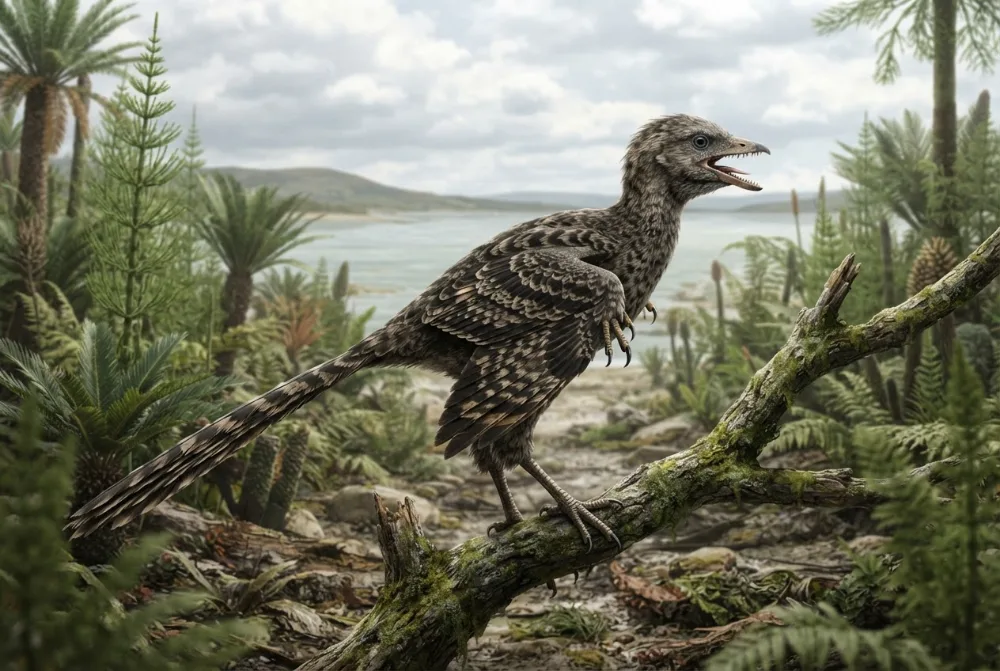
Archaeopteryx was a small, bird-like dinosaur that lived about 150 million years ago. It had feathers and wings like a bird, but also sharp teeth and a long bony tail like other dinosaurs. Scientists think it could fly or glide, making it one of the earliest known flying dinosaurs.21
Ankakhala liti?
Anali wamkulu bwanji?
Anali wautali bwanji?
Msinkhu wake unali wautali bwanji?
kuyerekeza
Ankalemera bwanji?
Archaeopteryx anali wamkulu bwanji poyerekeza ndi IWEYO?
Ndi masamu chabe mu msakatuli wako. Palibe chimene chimasungidwa kapena kutumizidwa kwina kulikonse.
Anali ndi liwiro lotani?


Mfundo zosangalatsa
Archaeopteryx was about the size of a magpie or a raven, with a body length of up to 50 centimetres.1
It had broad, rounded wings and a long tail, and its feathers were very similar to those of modern birds.1
All known fossils of Archaeopteryx come from limestone quarries near Solnhofen in Germany, which was once a lagoon surrounded by subtropical islands.21
The first Archaeopteryx fossil was discovered in 1861, and it was the first dinosaur ever found with feathers.21
Scientists are not sure if Archaeopteryx could truly fly or if it only glided from tree to tree.2
Mafunso ofunsidwa kwambiri okhudza Archaeopteryx
?Was Archaeopteryx a bird or a dinosaur?
It was both: a bird-like dinosaur and one of the earliest known birds. Scientists call it a transitional fossil between non-avian dinosaurs and modern birds.12
?How big was Archaeopteryx?
About 50 centimetres long, similar in size to a magpie or a raven. Its wingspan was up to 70 centimetres.12
?Could Archaeopteryx fly?
Scientists are not sure. It had broad, feathered wings and could probably glide, but it may not have been able to flap its wings like modern birds.12
?What did Archaeopteryx eat?
It was carnivorous and probably ate small reptiles, mammals, and insects.2
?When did Archaeopteryx live?
It lived during the Late Jurassic Period, about 150 million years ago.12
?Where was Archaeopteryx found?
All fossils come from limestone quarries near Solnhofen in Germany. Back then, that area was a warm, tropical lagoon.12
?Did Archaeopteryx have teeth?
Yes, it had small, sharp teeth, unlike modern birds. It also had a long, bony tail and claws on its wings.12
?Why is Archaeopteryx important?
It was the first dinosaur found with feathers, and it helped prove that birds evolved from dinosaurs. It is one of the most important fossils ever discovered.123
?How many Archaeopteryx fossils have been found?
Fourteen body fossils have been discovered, plus one single feather. Most are in museums in Germany and England.1
Wothetsa nthano zabodza
Nthano: Archaeopteryx is the oldest known bird.
Zoona: Older bird-like dinosaurs such as Anchiornis, Xiaotingia, and Aurornis have since been discovered, so Archaeopteryx is no longer considered the oldest.1
Kwa akatswiri a madino
- Dzina la sayansi
- Archaeopteryx
- Anapatsidwa dzina ndi
- Meyer 18614
- Gulu
- Mbalame zoyambirira
- Banja / kladi
- Avialae4
- Magawidwe a sayansi
- Theropoda > Avialae4
- Zaka za miyala
- zaka 149 mpaka 121 miliyoni (Tithonian / Barremian)4
- Mapangidwe a miyala
- Altmühltal, Solnhofen, Camarillas4
- Mayiko
- Jeremani, Sipeyini4
- Zolemba za mafosili
- 10 mu The Paleobiology Database4
- Amadziwikanso kuti
- Archaeornis, Griphosaurus (mayina akale tsopano amawerengedwa ngati nyama yomweyi)4
- Kupezeka
- Archaeopteryx was named by German paleontologist Hermann von Meyer in 1861, based on a single feather found in the Solnhofen limestone in Germany. The first skeleton was discovered later that same year.421
- Akukambiranabe
- Scientists still debate whether Archaeopteryx was mainly a ground-dweller or lived in trees, and whether it could truly fly or only glide.12
Kumene mfundo zimachokera
- Archaeopteryx (en.wikipedia.org)
- Archaeopteryx | Natural History Museum (nhm.ac.uk)
- Archaeopteryx (ucmp.berkeley.edu)
- Archaeopteryx in The Paleobiology Database (CC BY 4.0): zaka, malo, mapangidwe a miyala, magawidwe a sayansi.
Mfundo iliyonse patsamba lino ili ndi nambala yosonyeza kumene yachokera. Ngati talakwitsa kanthu, pepa, ndife okonda madino, osati magazini ya sayansi. Tiuze pa [email protected] ndipo tikonza.
 Rex ali ndi njala! Dino Wiki ndi ntchito ya bambo kwa mwana wawo wamwamuna wokonda madainoso, yaulere popanda zotsatsa ndi zokazonda. Akuluakulu angadyetse Rex zokhwasula-khwasula kuti tsambali lipitirize kupezeka pa intaneti.Dyetsa Rex
 Hesperornis
 Ichthyornis
 Baptornis
 Jurapteryx
 Gobipteryx
 Martinavis
 Stegosaurus
 Iguanodon
 Giganotosaurus
 Microraptor
 Deinonychus
 Baryonyx