 Kwizi ya Ndiwe dino uti?
 Nkhondo ya madino
 Mpikisano wa madino
 Masewera ang'onoang'ono a madino
 Chimbale cha zomata
 Mindandanda ya TOP ya madino
 Ndidabwitse!
Brachypterygius
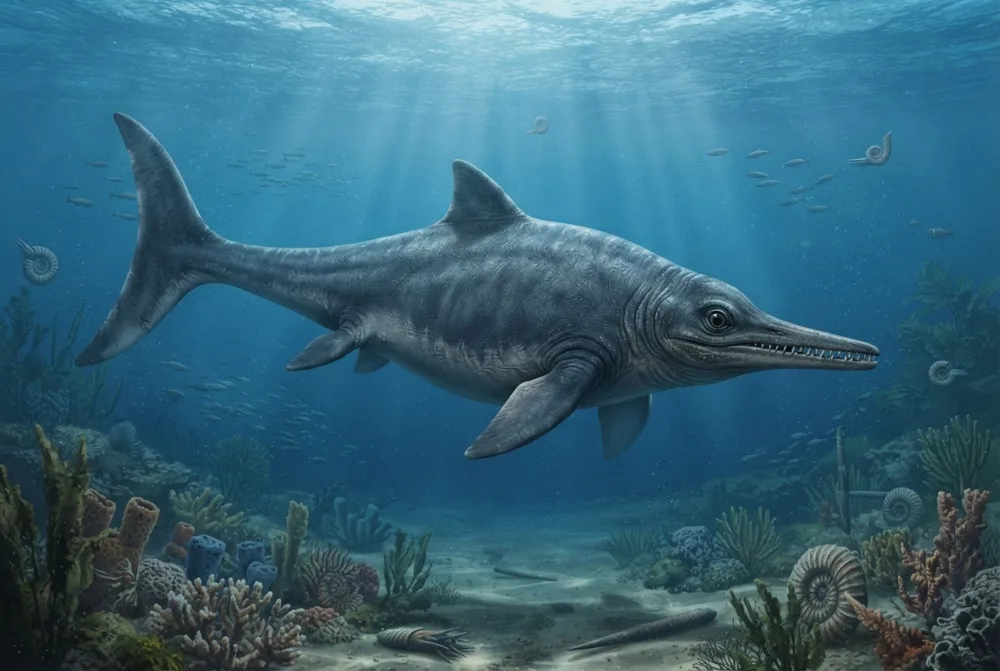
Brachypterygius was a fast-swimming marine reptile that lived in the Late Jurassic seas. It looked a bit like a dolphin but was a reptile, not a fish or a dinosaur. Its short, wide front flippers helped it steer through the water.1
Ankakhala liti?
Anali wamkulu bwanji?
Anali wautali bwanji?
 wautali ngati agalu 4 otsatizana mphuno ndi mchira🍌wautali ngati nthochi 22 zotsatizana🏊akanatha kusambira utali wa dziwe lalikulu losambira (50 m) m'masekondi 3.8
Brachypterygius anali wamkulu bwanji poyerekeza ndi IWEYO?
Ndi masamu chabe mu msakatuli wako. Palibe chimene chimasungidwa kapena kutumizidwa kwina kulikonse.
Anali ndi liwiro lotani?


Mfundo zosangalatsa
Brachypterygius had a short, wide front flipper with up to six fingers, and some fingers had as many as 16 bones.1
Its skull was between 0.5 and 1.2 metres long, about the size of a big dog's head.1
The first fossil of Brachypterygius was just a single right front flipper, found in England.1
Brachypterygius lived during the Kimmeridgian and Tithonian ages, about 154 to 143 million years ago.3
It is closely related to other ichthyosaurs like Platypterygius and Caypullisaurus.1
Scientists once thought Brachypterygius was the same as another ichthyosaur called Grendelius, but now many think they are different.1
Mafunso ofunsidwa kwambiri okhudza Brachypterygius
?How big was Brachypterygius?
Brachypterygius was a medium sized ichthyosaur, with a body length up to 4 metres (13 ft) and a skull length of 0.5 to 1.2 metres (1.6 to 3.9 ft).1
?Was Brachypterygius a dinosaur?
No, Brachypterygius was an ichthyosaur, a marine reptile that lived in the sea. It was not a dinosaur, even though it lived at the same time as dinosaurs.1
?What did Brachypterygius eat?
Scientists think Brachypterygius hunted in sunlit waters for slower prey like fish that swam in shoals. Its teeth were larger and more robust than those of some other ichthyosaurs.2
Kwa akatswiri a madino
- Dzina la sayansi
- Brachypterygius
- Anapatsidwa dzina ndi
- Huene 19223
- Gulu
- Maikitiosauri
- Banja / kladi
- Ophthalmosauridae3
- Magawidwe a sayansi
- Ichthyosauria > Ichthyosauromorpha3
- Zaka za miyala
- zaka 155 mpaka 143 miliyoni (Kimmeridgian / Tithonian)3
- Mapangidwe a miyala
- Kimmeridge Clay, Agardhfjellet3
- Mayiko
- United Kingdom, Rasha, Nowe3
- Zolemba za mafosili
- 6 mu The Paleobiology Database3
- Amadziwikanso kuti
- Ochevia, Otschevia (mayina akale tsopano amawerengedwa ngati nyama yomweyi)3
- Kupezeka
- The first fossil, a right front flipper, was described as Ichthyosaurus extremus by Boulenger in 1904. In 1922, Friedrich von Huene gave it the new name Brachypterygius because of its short, wide flipper.1
- Akukambiranabe
- Scientists still debate whether the species Grendelius mordax is the same as Brachypterygius extremus or a separate animal.1
Kumene mfundo zimachokera
- Brachypterygius (en.wikipedia.org)
- Brachypterygius (prehistoric-wildlife.com)
- Brachypterygius in The Paleobiology Database (CC BY 4.0): zaka, malo, mapangidwe a miyala, magawidwe a sayansi.
Mfundo iliyonse patsamba lino ili ndi nambala yosonyeza kumene yachokera. Ngati talakwitsa kanthu, pepa, ndife okonda madino, osati magazini ya sayansi. Tiuze pa [email protected] ndipo tikonza.
 Rex ali ndi njala! Dino Wiki ndi ntchito ya bambo kwa mwana wawo wamwamuna wokonda madainoso, yaulere popanda zotsatsa ndi zokazonda. Akuluakulu angadyetse Rex zokhwasula-khwasula kuti tsambali lipitirize kupezeka pa intaneti.Dyetsa Rex
 Ichthyosaurus
 Platypterygius
 Stenopterygius
 Khudiakovia
 Ophthalmosaurus
 Chonespondylus
 Brachiosaurus
 Diplodocus
 Allosaurus
 Brontosaurus
 Compsognathus
 Camarasaurus