 Kwizi ya Ndiwe dino uti?
 Nkhondo ya madino
 Mpikisano wa madino
 Masewera ang'onoang'ono a madino
 Chimbale cha zomata
 Mindandanda ya TOP ya madino
 Ndidabwitse!
Ankakhala liti?

Anali wamkulu bwanji?
Anali wautali bwanji?
Msinkhu wake unali wautali bwanji?
kuyerekeza
Ankalemera bwanji?
 wautali ngati magalimoto 6 oimikidwa pamzere🍌wautali ngati nthochi 140 zotsatizana
 wolemera ngati njovu 1.5🍉wolemera ngati mavwende 1900🎒wolemera ngati makalasi athunthu a ana a sukulu 12🐻❄️wolemera ngati zimbalangondo zoyera 21🏢wamtali moti angasuzumire pawindo la nsanjika ya 2🏃akanatha kuthamanga mamita 100 m'masekondi 24 (munthu waliwiro kwambiri amafunika 9.6)
Duriatitan anali wamkulu bwanji poyerekeza ndi IWEYO?
Ndi masamu chabe mu msakatuli wako. Palibe chimene chimasungidwa kapena kutumizidwa kwina kulikonse.
Anali ndi liwiro lotani?


Mfundo zosangalatsa
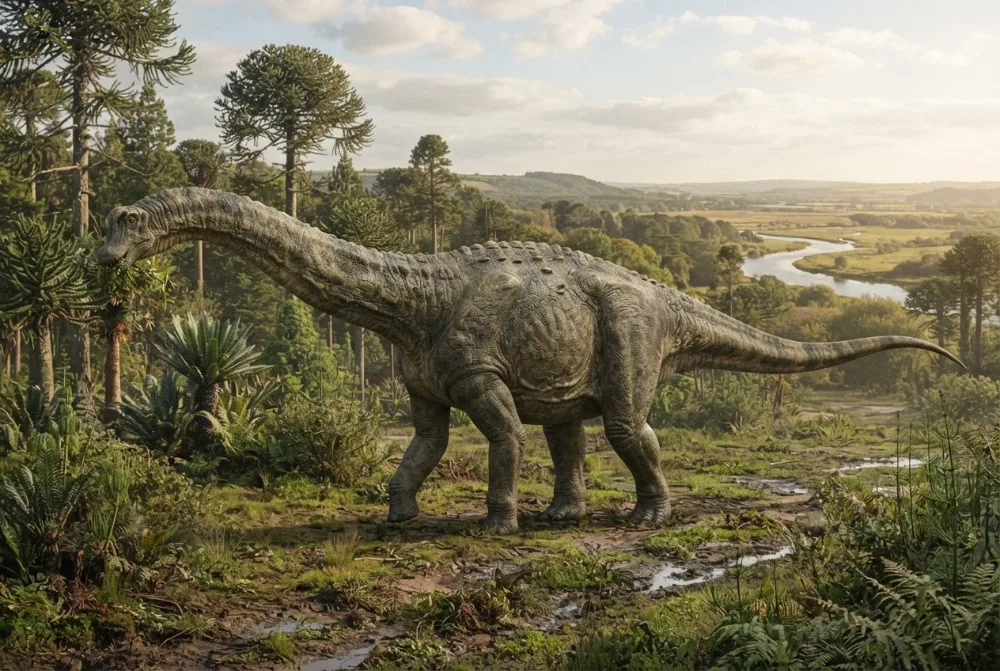
Duriatitan is only known from a single left upper arm bone, called a humerus.1
The bone was found near Sandsfoot, Weymouth in Dorset, England, by a man named R.I. Smith.1
It was first named in 1874 as a species of Cetiosaurus, and later given its own genus in 2010.1
The name Duriatitan comes from the Latin name for Dorset, Duria, and the Greek word Titan, meaning giant.1
Scientists think Duriatitan lived during the Late Jurassic, about 150 million years ago.1
It was a titanosauriform, a group of sauropods that includes some of the largest land animals ever.4
Thomas Holtz estimated Duriatitan could have been up to 25 meters (82 feet) long, as long as a blue whale.1
Mafunso ofunsidwa kwambiri okhudza Duriatitan
?How big was Duriatitan?
Duriatitan may have been up to 25 meters long, which is shorter than a 30 meter blue whale, though this is an estimate from one bone.13
?What did Duriatitan eat?
Duriatitan was a plant-eater, eating tough leaves from trees. Its huge body and long neck helped it reach food other dinosaurs couldn't.3
?Could Duriatitan swim?
Scientists once thought sauropods like Duriatitan lived in water, but now they think the opposite. Its air-filled bones and small feet would have made it float and be unstable in water.3
Kwa akatswiri a madino
- Dzina la sayansi
- Duriatitan
- Anapatsidwa dzina ndi
- Barrett et al. 20104
- Gulu
- Makosi atali
- Banja / kladi
- Titanosauriformes4
- Magawidwe a sayansi
- Sauropodomorpha > Sauropoda > Macronaria4
- Zaka za miyala
- zaka 155 mpaka 137 miliyoni (Kimmeridgian / Berriasian)4
- Mapangidwe a miyala
- Kimmeridge Clay, Mont-Lambert, Praia da Amoreira-Porto Novo4
- Mayiko
- United Kingdom, Falansa, Potogalo, Sipeyini4
- Zolemba za mafosili
- 8 mu The Paleobiology Database4
- Kupezeka
- The first fossil, a partial left upper arm bone, was found by R.I. Smith near Sandsfoot, Weymouth in Dorset. It was described by John Hulke in 1874 as a species of Cetiosaurus, and later renamed Duriatitan by Paul Barrett, Roger Benson, and Paul Upchurch in 2010.1
- Akukambiranabe
- Scientists are not sure exactly how big Duriatitan was, because only one arm bone has been found. The length estimate of 25 meters is just a guess.1
Kumene mfundo zimachokera
- Duriatitan (en.wikipedia.org)
- Duriatitan humerocristatus | Dinosaur Database by DinoAnimals.com (dinoanimals.com)
- Britain's biggest Jurassic dinosaurs | Natural History Museum (nhm.ac.uk)
- Duriatitan in The Paleobiology Database (CC BY 4.0): zaka, malo, mapangidwe a miyala, magawidwe a sayansi.
Mfundo iliyonse patsamba lino ili ndi nambala yosonyeza kumene yachokera. Ngati talakwitsa kanthu, pepa, ndife okonda madino, osati magazini ya sayansi. Tiuze pa [email protected] ndipo tikonza.
 Rex ali ndi njala! Dino Wiki ndi ntchito ya bambo kwa mwana wawo wamwamuna wokonda madainoso, yaulere popanda zotsatsa ndi zokazonda. Akuluakulu angadyetse Rex zokhwasula-khwasula kuti tsambali lipitirize kupezeka pa intaneti.Dyetsa Rex
 Brachiosaurus
 Diplodocus
 Brontosaurus
 Argentinosaurus
 Camarasaurus
 Morosaurus
 Allosaurus
 Compsognathus
 Camptosaurus
 Nanosaurus
 Rhamphorhynchus
 Ceratosaurus