 Kwizi ya Ndiwe dino uti?
 Nkhondo ya madino
 Mpikisano wa madino
 Masewera ang'onoang'ono a madino
 Chimbale cha zomata
 Mindandanda ya TOP ya madino
 Ndidabwitse!
Ankakhala liti?

Anali wamkulu bwanji?
Anali wautali bwanji?
Msinkhu wake unali wautali bwanji?
kuyerekeza
Ankalemera bwanji?

 wautali ngati magalimoto 3 oimikidwa pamzere🍌wautali ngati nthochi 78 zotsatizanawolemera ngati magalimoto 8🍉wolemera ngati mavwende 2400🎒wolemera ngati makalasi athunthu a ana a sukulu 15🐻❄️wolemera ngati zimbalangondo zoyera 27🏃akanatha kuthamanga mamita 100 m'masekondi 24 (munthu waliwiro kwambiri amafunika 9.6)
Dystrophaeus anali wamkulu bwanji poyerekeza ndi IWEYO?
Ndi masamu chabe mu msakatuli wako. Palibe chimene chimasungidwa kapena kutumizidwa kwina kulikonse.
Anali ndi liwiro lotani?


Mfundo zosangalatsa
Dystrophaeus was named by famous paleontologist Edward Drinker Cope in 1877, based on bones collected in 1859 by John S. Newberry.41
The only known fossils of Dystrophaeus include a partial arm bone, a shoulder blade, and a back bone, all from one individual.1
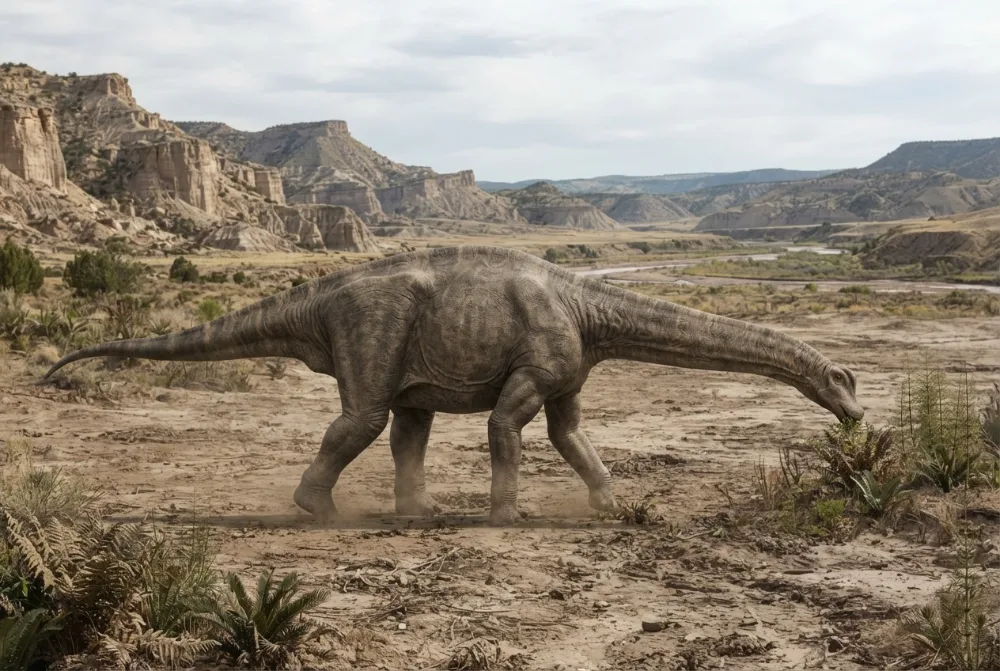
Scientists are not sure exactly what kind of sauropod Dystrophaeus was. Some think it might be related to Diplodocus, but others say it is too incomplete to tell.2
The name Dystrophaeus means 'bad joint' because Cope thought the bones looked oddly shaped.4
Dystrophaeus lived during the Oxfordian age of the Late Jurassic, about 157 to 155 million years ago.4
The Dystrophaeus fossils were found in the Tidwell Member of the Morrison Formation, a famous rock layer that also produced dinosaurs like Apatosaurus and Stegosaurus.1
Mafunso ofunsidwa kwambiri okhudza Dystrophaeus
?How big was Dystrophaeus?
It was a moderate-sized sauropod, maybe about 13 metres (43 ft) long and weighing roughly 7 to 12 tonnes (7.7 to 13.2 short tons).3
?What did Dystrophaeus eat?
It was a herbivore, meaning it ate plants. As a sauropod, it had a long neck to reach vegetation.34
?When did Dystrophaeus live?
It lived about 158 million years ago, during the Late Jurassic period. That makes it the oldest sauropod from the Morrison Formation.3
Kwa akatswiri a madino
- Dzina la sayansi
- Dystrophaeus
- Anapatsidwa dzina ndi
- Cope 18774
- Gulu
- Makosi atali
- Banja / kladi
- Eusauropoda4
- Magawidwe a sayansi
- Sauropodomorpha > Sauropoda4
- Zaka za miyala
- zaka 158 mpaka 155 miliyoni ()4
- Mapangidwe a miyala
- Morrison4
- Mayiko
- Amereka4
- Zolemba za mafosili
- 1 mu The Paleobiology Database4
- Kupezeka
- Dystrophaeus was named by Edward Drinker Cope in 1877, based on bones collected in 1859 by John S. Newberry in San Juan County, Utah.41
- Akukambiranabe
- Scientists still debate whether Dystrophaeus is a true diplodocid sauropod or belongs to a different group, because the fossils are so fragmentary.2
Kumene mfundo zimachokera
- Dystrophaeus viaemalae Cope, 1877 (si.edu)
- A specimen-level phylogenetic analysis and taxonomic revision of Diplodocidae (Dinosauria, Sauropoda) (docentes.fct.unl.pt)
- Dystrophaeus (Wikipedia) (Wikipedia)
- Dystrophaeus in The Paleobiology Database (CC BY 4.0): zaka, malo, mapangidwe a miyala, magawidwe a sayansi.
Mfundo iliyonse patsamba lino ili ndi nambala yosonyeza kumene yachokera. Ngati talakwitsa kanthu, pepa, ndife okonda madino, osati magazini ya sayansi. Tiuze pa [email protected] ndipo tikonza.
 Rex ali ndi njala! Dino Wiki ndi ntchito ya bambo kwa mwana wawo wamwamuna wokonda madainoso, yaulere popanda zotsatsa ndi zokazonda. Akuluakulu angadyetse Rex zokhwasula-khwasula kuti tsambali lipitirize kupezeka pa intaneti.Dyetsa Rex
 Brachiosaurus
 Diplodocus
 Brontosaurus
 Argentinosaurus
 Camarasaurus
 Morosaurus
 Allosaurus
 Compsognathus
 Camptosaurus
 Nanosaurus
 Rhamphorhynchus
 Ceratosaurus