 Kwizi ya Ndiwe dino uti?
 Nkhondo ya madino
 Mpikisano wa madino
 Masewera ang'onoang'ono a madino
 Chimbale cha zomata
 Mindandanda ya TOP ya madino
 Ndidabwitse!
Epidexipteryx
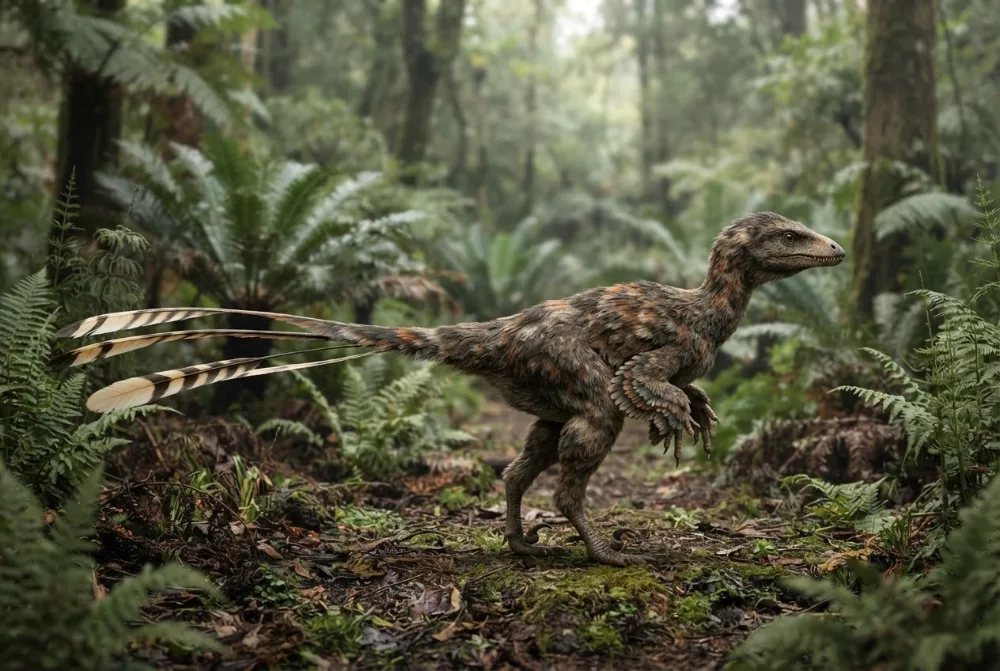
Epidexipteryx was a tiny, pigeon-sized dinosaur that lived in the Jurassic period. It had four long, ribbon-like feathers on its tail that it probably used to show off, not to fly. This little dinosaur was a meat-eater and is one of the oldest known dinosaurs with display feathers.1
Ankakhala liti?
Anali wamkulu bwanji?
Anali wautali bwanji?
Msinkhu wake unali wautali bwanji?
kuyerekeza
Ankalemera bwanji?
Epidexipteryx anali wamkulu bwanji poyerekeza ndi IWEYO?
Ndi masamu chabe mu msakatuli wako. Palibe chimene chimasungidwa kapena kutumizidwa kwina kulikonse.
Anali ndi liwiro lotani?


Mfundo zosangalatsa
Epidexipteryx had four long, ribbon-like feathers on its tail that were probably used for display, not for flying.1
It weighed only about 164 grams, which is less than a can of soda.1
Its front teeth were much larger than its back teeth, and they stuck out forward, similar to the dinosaur Masiakasaurus.1
Epidexipteryx lived about 165 to 161 million years ago, during the Middle to Late Jurassic.6
The only known fossil is a nearly complete skeleton of a young individual, found in Inner Mongolia, China.1
It had a short tail compared to its close relative Epidendrosaurus, with only 16 tail bones instead of more than 40.1
Epidexipteryx could not fly because it lacked the long flight feathers on its arms that birds use.1
Mafunso ofunsidwa kwambiri okhudza Epidexipteryx
?How big was Epidexipteryx?
It was tiny, about 25 to 30 cm long, not counting the tail feathers. That is about the size of a pigeon.3
?Did Epidexipteryx have feathers?
Yes, it had four long, ribbon-like feathers on its tail and a covering of simpler body feathers. The tail feathers were probably used for display, not for flying.34
?Could Epidexipteryx fly?
No, it could not fly. It lacked the long flight feathers on its arms that birds use, though it may have had a membrane wing for gliding.35
?What did Epidexipteryx eat?
It was a meat-eater. It may have used its long claws to rummage through trees for grubs, like an aye-aye.3
?When did Epidexipteryx live?
It lived during the Middle to Late Jurassic, about 165 to 154 million years ago, in what is now Inner Mongolia, China.3
Kwa akatswiri a madino
- Dzina la sayansi
- Epidexipteryx
- Anapatsidwa dzina ndi
- Zhang et al. 20086
- Gulu
- Madino odya nyama
- Banja / kladi
- Paraves6
- Magawidwe a sayansi
- Theropoda6
- Zaka za miyala
- zaka 165 mpaka 162 miliyoni (Callovian)6
- Mapangidwe a miyala
- Tiaojishan6
- Mayiko
- China6
- Zolemba za mafosili
- 1 mu The Paleobiology Database6
- Kupezeka
- Epidexipteryx was named in 2008 by scientists Fucheng Zhang, Zhonghe Zhou, Xing Xu, Xiaolin Wang, and Corwin Sullivan. The name honors the late paleontologist Yaoming Hu. The fossil was found in the Daohugou area of Inner Mongolia, China.1
- Akukambiranabe
- Scientists are not sure exactly how old the rocks where Epidexipteryx was found are. They could be from the Middle Jurassic or the Late Jurassic, between 152 and 168 million years old.1
Kumene mfundo zimachokera
- LETTERS (ivpp.cas.cn)
- Epidexipteryx Zhang et al. 2008 - Encyclopedia of Life (eol.org)
- Epidexipteryx (en.wikipedia.org)
- Access : A bizarre Jurassic maniraptoran from China with elongate ribbon-like feathers : Nature (web.archive.org)
- nature.com (nature.com)
- Epidexipteryx in The Paleobiology Database (CC BY 4.0): zaka, malo, mapangidwe a miyala, magawidwe a sayansi.
Mfundo iliyonse patsamba lino ili ndi nambala yosonyeza kumene yachokera. Ngati talakwitsa kanthu, pepa, ndife okonda madino, osati magazini ya sayansi. Tiuze pa [email protected] ndipo tikonza.
 Rex ali ndi njala! Dino Wiki ndi ntchito ya bambo kwa mwana wawo wamwamuna wokonda madainoso, yaulere popanda zotsatsa ndi zokazonda. Akuluakulu angadyetse Rex zokhwasula-khwasula kuti tsambali lipitirize kupezeka pa intaneti.Dyetsa Rex
 Allosaurus
 Carnotaurus
 Dilophosaurus
 Giganotosaurus
 Compsognathus
 Paronychodon
 Ichthyosaurus
 Khudiakovia
 Ophthalmosaurus
 Pterodactylus
 Peloneustes
 Rhamphocephalus