 Kwizi ya Ndiwe dino uti?
 Nkhondo ya madino
 Mpikisano wa madino
 Masewera ang'onoang'ono a madino
 Chimbale cha zomata
 Mindandanda ya TOP ya madino
 Ndidabwitse!
Ankakhala liti?

Anali wamkulu bwanji?
Anali wautali bwanji?
Msinkhu wake unali wautali bwanji?
kuyerekeza
 wautali ngati magalimoto 3 oimikidwa pamzere🍌wautali ngati nthochi 78 zotsatizana🏃akanatha kuthamanga mamita 100 m'masekondi 21 (munthu waliwiro kwambiri amafunika 9.6)
Galeamopus anali wamkulu bwanji poyerekeza ndi IWEYO?
Ndi masamu chabe mu msakatuli wako. Palibe chimene chimasungidwa kapena kutumizidwa kwina kulikonse.
Anali ndi liwiro lotani?


Mfundo zosangalatsa
Galeamopus was named in 2015, but its fossils were first found in 1884.1
The name Galeamopus means 'helmet need', a joke about the brittle braincase of the type specimen.1
Galeamopus had a unique skull with a curved paroccipital process on the back of the head.1
It had thirteen unique features that set it apart from other diplodocid dinosaurs.1
The first Galeamopus skeleton was found by William H. Utterback in 1902 near Sheridan, Wyoming.1
One Galeamopus specimen, nicknamed 'Max', was discovered in 1995 at the Howe-Stephens Quarry.1
Mafunso ofunsidwa kwambiri okhudza Galeamopus
?How big was Galeamopus?
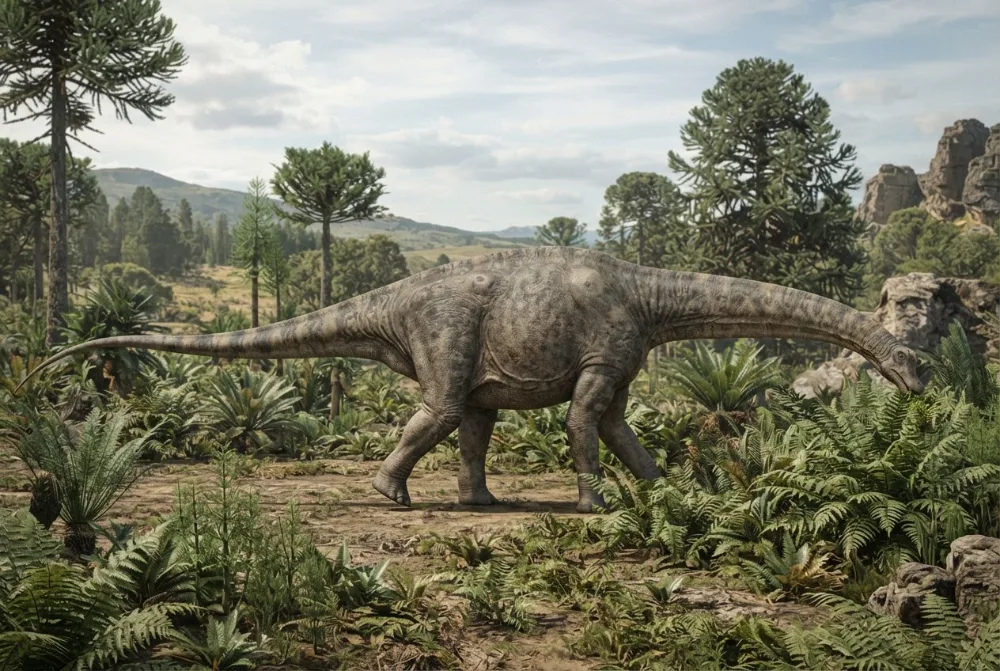
Scientists have not published a specific length or weight for Galeamopus, but as a diplodocid sauropod it was probably similar in size to other diplodocids, which could reach about 25 metres (82 feet) long.1
?When did Galeamopus live?
Galeamopus lived during the Late Jurassic, about 155 to 152 million years ago.13
?What did Galeamopus eat?
Galeamopus was a herbivore that ate plants like ferns, as mentioned in the page intro.1
Kwa akatswiri a madino
- Dzina la sayansi
- Galeamopus
- Anapatsidwa dzina ndi
- Tschopp et al. 20155
- Gulu
- Makosi atali
- Banja / kladi
- Diplodocidae5
- Magawidwe a sayansi
- Sauropodomorpha > Sauropoda > Diplodocoidea5
- Zaka za miyala
- zaka 155 mpaka 143 miliyoni (Kimmeridgian / Tithonian)5
- Mapangidwe a miyala
- Morrison5
- Mayiko
- Amereka5
- Zolemba za mafosili
- 6 mu The Paleobiology Database5
- Kupezeka
- The first fossils of Galeamopus were collected in 1884 by Marshall P. Felch in Colorado, but the genus was named in 2015 by Emanuel Tschopp, Octávio Mateus, and Roger Benson.1
- Akukambiranabe
- Scientists are still debating whether some Galeamopus specimens belong to a separate species or are just variations of the same species.1
Kumene mfundo zimachokera
- Galeamopus (en.wikipedia.org)
- ncbi.nlm.nih.gov (ncbi.nlm.nih.gov)
- Paleo Profile: The "Need Helmet" Dinosaur | Scientific American (scientificamerican.com)
- PeerJ Osteology of Galeamopus pabsti sp. nov. (Sauropoda: Diplodocidae), with implications for neurocentral closure timing, and the cervico-dorsal transition in diplodocids (peerj.com)
- Galeamopus in The Paleobiology Database (CC BY 4.0): zaka, malo, mapangidwe a miyala, magawidwe a sayansi.
Mfundo iliyonse patsamba lino ili ndi nambala yosonyeza kumene yachokera. Ngati talakwitsa kanthu, pepa, ndife okonda madino, osati magazini ya sayansi. Tiuze pa [email protected] ndipo tikonza.
 Rex ali ndi njala! Dino Wiki ndi ntchito ya bambo kwa mwana wawo wamwamuna wokonda madainoso, yaulere popanda zotsatsa ndi zokazonda. Akuluakulu angadyetse Rex zokhwasula-khwasula kuti tsambali lipitirize kupezeka pa intaneti.Dyetsa Rex
 Brachiosaurus
 Diplodocus
 Brontosaurus
 Argentinosaurus
 Camarasaurus
 Morosaurus
 Allosaurus
 Compsognathus
 Camptosaurus
 Nanosaurus
 Rhamphorhynchus
 Ceratosaurus