 Kwizi ya Ndiwe dino uti?
 Nkhondo ya madino
 Mpikisano wa madino
 Masewera ang'onoang'ono a madino
 Chimbale cha zomata
 Mindandanda ya TOP ya madino
 Ndidabwitse!
Ankakhala liti?

Anali wamkulu bwanji?
Anali wautali bwanji?
Msinkhu wake unali wautali bwanji?
kuyerekeza
Ankalemera bwanji?

 wautali ngati agalu 6 otsatizana mphuno ndi mchira🍌wautali ngati nthochi 36 zotsatizana
 wolemera pafupifupi ngati njovu🍉wolemera ngati mavwende 1000🎒wolemera ngati makalasi athunthu a ana a sukulu 6🐻❄️wolemera ngati zimbalangondo zoyera 11🏃akanatha kuthamanga mamita 100 m'masekondi 28 (munthu waliwiro kwambiri amafunika 9.6)
Hesperosaurus anali wamkulu bwanji poyerekeza ndi IWEYO?
Ndi masamu chabe mu msakatuli wako. Palibe chimene chimasungidwa kapena kutumizidwa kwina kulikonse.
Anali ndi liwiro lotani?


Mfundo zosangalatsa
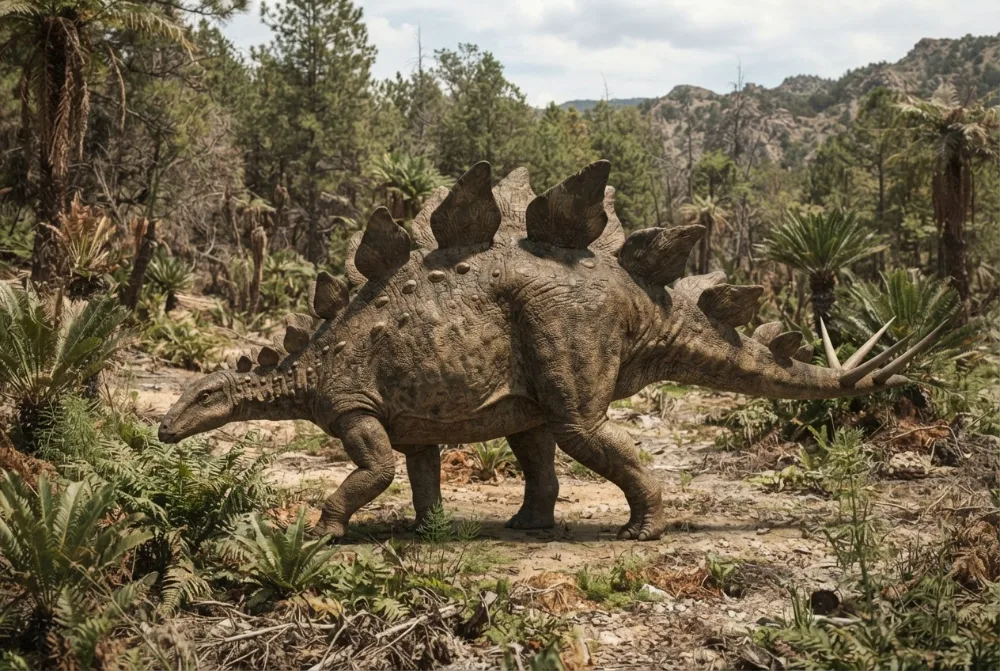
Hesperosaurus is known from a nearly complete skeleton and skull, which is rare for stegosaurs.3
One fossil preserves the first known impression of the horn sheath on a stegosaur back plate.1
Its back plates were longer and lower than those of its close relative Stegosaurus.1
Hesperosaurus lived a little earlier than other stegosaurs from the Morrison Formation.1
The tail spikes, called a thagomizer, had two pairs: the front pair thicker and the rear pair thinner and more horizontal.1
Scientists have debated whether Hesperosaurus should be its own genus or a species of Stegosaurus.1
Mafunso ofunsidwa kwambiri okhudza Hesperosaurus
?How big was Hesperosaurus?
Hesperosaurus was a large stegosaur, reaching about 6.5 metres (21 feet) in length and weighing around 3.5 metric tons (3.9 short tons). Some large individuals may have reached 5 metric tons (5.5 short tons).1
?What did Hesperosaurus eat?
Hesperosaurus was a herbivore, meaning it ate plants. It was a quadrupedal plant-eater, like other stegosaurs.13
?When did Hesperosaurus live?
Hesperosaurus lived during the Late Jurassic period, about 156 million years ago. It lived a little earlier than other stegosaurs from the Morrison Formation.13
?Where was Hesperosaurus found?
Fossils of Hesperosaurus have been found in the states of Wyoming and Montana in the United States of America. They were first discovered in 1985.1
?Did Hesperosaurus have plates or spikes?
Hesperosaurus had two rows of bony plates on its back and four spikes on its tail. The tail spikes, called a thagomizer, had two pairs: the front pair thicker and the rear pair thinner and more horizontal.1
Kwa akatswiri a madino
- Dzina la sayansi
- Hesperosaurus
- Anapatsidwa dzina ndi
- Carpenter et al. 20014
- Gulu
- Madino a mbale kumsana
- Banja / kladi
- Stegosauridae4
- Magawidwe a sayansi
- Ornithischia > Stegosauria > Thyreophora4
- Zaka za miyala
- zaka 158 mpaka 143 miliyoni ()4
- Mapangidwe a miyala
- Morrison4
- Mayiko
- Amereka4
- Zolemba za mafosili
- 8 mu The Paleobiology Database4
- Kupezeka
- Hesperosaurus was named in 2001 by Kenneth Carpenter, Clifford Miles, and Karen Cloward. The first fossils were found in 1985 on a ranch in Johnson County, Wyoming, USA.1
- Akukambiranabe
- Scientists still debate whether Hesperosaurus is a separate genus from Stegosaurus or just a species of Stegosaurus.1
Kumene mfundo zimachokera
- Hesperosaurus (en.wikipedia.org)
- PBDB Taxon (paleobiodb.org)
- Hesperosaurus | Natural History Museum (nhm.ac.uk)
- Hesperosaurus in The Paleobiology Database (CC BY 4.0): zaka, malo, mapangidwe a miyala, magawidwe a sayansi.
Mfundo iliyonse patsamba lino ili ndi nambala yosonyeza kumene yachokera. Ngati talakwitsa kanthu, pepa, ndife okonda madino, osati magazini ya sayansi. Tiuze pa [email protected] ndipo tikonza.
 Rex ali ndi njala! Dino Wiki ndi ntchito ya bambo kwa mwana wawo wamwamuna wokonda madainoso, yaulere popanda zotsatsa ndi zokazonda. Akuluakulu angadyetse Rex zokhwasula-khwasula kuti tsambali lipitirize kupezeka pa intaneti.Dyetsa Rex
 Stegosaurus
 Diracodon
 Hypsirophus
 Dacentrurus
 Miragaia
 Kentrosaurus
 Brachiosaurus
 Diplodocus
 Allosaurus
 Brontosaurus
 Compsognathus
 Camarasaurus