 Kwizi ya Ndiwe dino uti?
 Nkhondo ya madino
 Mpikisano wa madino
 Masewera ang'onoang'ono a madino
 Chimbale cha zomata
 Mindandanda ya TOP ya madino
 Ndidabwitse!
Ankakhala liti?

Anali wamkulu bwanji?
Anali wautali bwanji?
Msinkhu wake unali wautali bwanji?
kuyerekeza
Ankalemera bwanji?
 wautali ngati agalu 5 otsatizana mphuno ndi mchira🍌wautali ngati nthochi 28 zotsatizana🍉wolemera ngati mavwende 280🧸wolemera ngati ana a sukulu ya mkaka 74🎒wolemera ngati ana a sukulu 44🐻❄️wolemera ngati zimbalangondo zoyera 3🏃akanatha kuthamanga mamita 100 m'masekondi 20 (munthu waliwiro kwambiri amafunika 9.6)
Loricatosaurus anali wamkulu bwanji poyerekeza ndi IWEYO?
Ndi masamu chabe mu msakatuli wako. Palibe chimene chimasungidwa kapena kutumizidwa kwina kulikonse.
Anali ndi liwiro lotani?


Mfundo zosangalatsa
Loricatosaurus lived during the Middle Jurassic period, about 165 to 161 million years ago.4
Only two partial skeletons of Loricatosaurus have been found, one in England and one in France.1
The fossils were first thought to belong to another dinosaur called Lexovisaurus, but scientists later realized they were a different animal.1
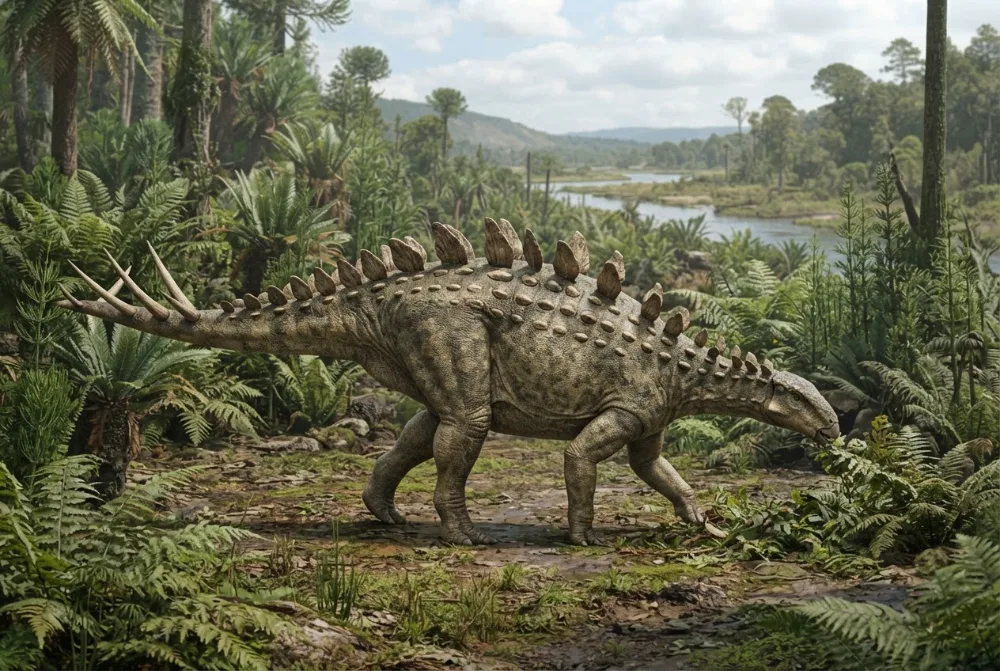
Loricatosaurus had bony plates and spikes on its body, but scientists are not sure if it had a shoulder spike like some other stegosaurs.1
The name Loricatosaurus means 'armored lizard' in Latin and Greek.1
Loricatosaurus is a type of stegosaur, a group of plant-eating dinosaurs with plates and spikes.1
Mafunso ofunsidwa kwambiri okhudza Loricatosaurus
?What did Loricatosaurus eat?
It was a herbivore, meaning it ate plants.3
?How big was Loricatosaurus?
Scientists are not sure of its exact size because only two partial skeletons have been found.3
?When did Loricatosaurus live?
It lived during the Middle Jurassic period, about 165 to 161 million years ago.1
?Where was Loricatosaurus found?
Its fossils have been found in England and France.1
Wothetsa nthano zabodza
Nthano: Some people think Loricatosaurus had a spike on its shoulder.
Zoona: Scientists now believe the supposed shoulder spike is actually a tail spike.1
Kwa akatswiri a madino
- Dzina la sayansi
- Loricatosaurus
- Anapatsidwa dzina ndi
- Maidment et al. 20084
- Gulu
- Madino a mbale kumsana
- Banja / kladi
- Stegosauridae4
- Magawidwe a sayansi
- Ornithischia > Stegosauria > Thyreophora4
- Zaka za miyala
- zaka 165 mpaka 162 miliyoni (Callovian)4
- Mapangidwe a miyala
- Marnes à Belemnopsis latesulcatus, Oxford Clay4
- Mayiko
- Falansa, United Kingdom4
- Zolemba za mafosili
- 2 mu The Paleobiology Database4
- Kupezeka
- The first fossils were found in 1901 by Alfred Leeds in a brick pit in Peterborough, England. The dinosaur was named Loricatosaurus in 2008 by Susannah Maidment and her team.1
- Akukambiranabe
- Scientists are still debating exactly how Loricatosaurus is related to other stegosaurs like Stegosaurus.1
Kumene mfundo zimachokera
- Loricatosaurus (en.wikipedia.org)
- Loricatosaurus priscus | Dinosaur Database by DinoAnimals.com (dinoanimals.com)
- PaleoCodex :: Loricatosaurus (paleocodex.com)
- Loricatosaurus in The Paleobiology Database (CC BY 4.0): zaka, malo, mapangidwe a miyala, magawidwe a sayansi.
Mfundo iliyonse patsamba lino ili ndi nambala yosonyeza kumene yachokera. Ngati talakwitsa kanthu, pepa, ndife okonda madino, osati magazini ya sayansi. Tiuze pa [email protected] ndipo tikonza.
 Rex ali ndi njala! Dino Wiki ndi ntchito ya bambo kwa mwana wawo wamwamuna wokonda madainoso, yaulere popanda zotsatsa ndi zokazonda. Akuluakulu angadyetse Rex zokhwasula-khwasula kuti tsambali lipitirize kupezeka pa intaneti.Dyetsa Rex
 Stegosaurus
 Diracodon
 Hypsirophus
 Dacentrurus
 Miragaia
 Kentrosaurus
 Ichthyosaurus
 Khudiakovia
 Ophthalmosaurus
 Pterodactylus
 Peloneustes
 Rhamphocephalus