 Kwizi ya Ndiwe dino uti?
 Nkhondo ya madino
 Mpikisano wa madino
 Masewera ang'onoang'ono a madino
 Chimbale cha zomata
 Mindandanda ya TOP ya madino
 Ndidabwitse!
Ankakhala liti?

Anali wamkulu bwanji?
Anali wautali bwanji?
Msinkhu wake unali wautali bwanji?
kuyerekeza
Serikornis anali wamkulu bwanji poyerekeza ndi IWEYO?
Ndi masamu chabe mu msakatuli wako. Palibe chimene chimasungidwa kapena kutumizidwa kwina kulikonse.
Anali ndi liwiro lotani?


Mfundo zosangalatsa
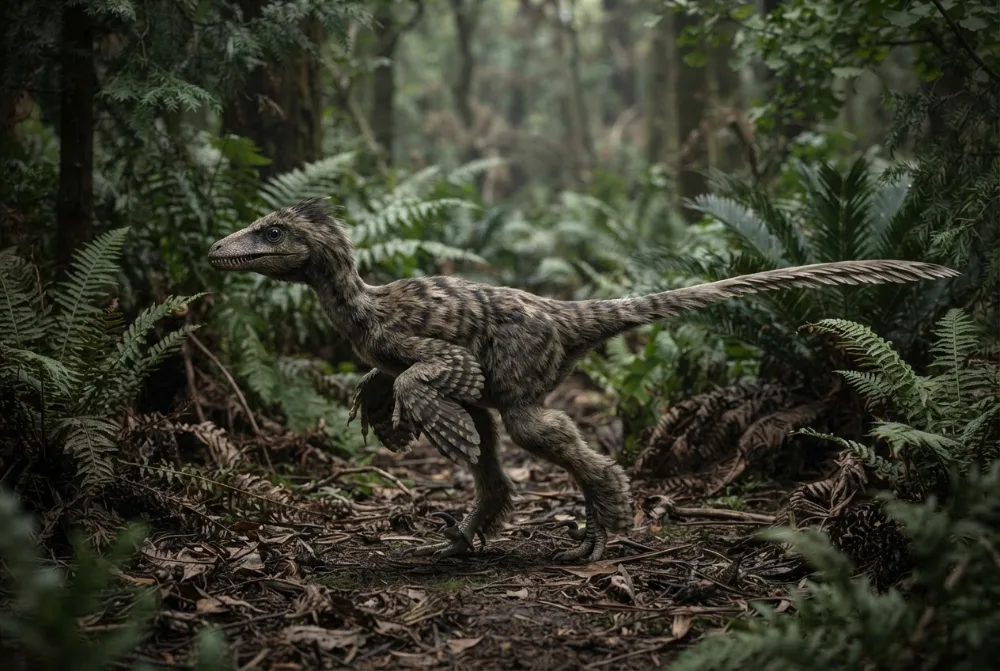
The name Serikornis means 'silken bird' because of its beautiful, feathery coat.1
It had long feathers on its hind legs all the way down to its toes, which is unusual for a ground-dwelling dinosaur.1
The feathers on its arms were symmetrical and didn't have tiny hooks called barbules, so they weren't good for flying.1
Serikornis lived during the Late Jurassic period, about 161 to 155 million years ago.2
Scientists think Serikornis was a ground-dwelling dinosaur that did not climb trees or fly.1
Mafunso ofunsidwa kwambiri okhudza Serikornis
?How big was Serikornis?
About 45 cm (1.5 feet) long, about the size of a pheasant.3
?Could Serikornis fly?
No, it could not fly. Its feathers lacked tiny hooks called barbules, so they couldn't hold air for flight.31
?What did Serikornis eat?
It was a meat-eating theropod dinosaur, so it likely ate small animals like insects or lizards.4
Wothetsa nthano zabodza
Nthano: Serikornis was a flying dinosaur with four wings.
Zoona: Serikornis had long feathers on its legs and arms, but it could not fly and probably lived on the ground.1
Kwa akatswiri a madino
- Dzina la sayansi
- Serikornis
- Anapatsidwa dzina ndi
- Lefèvre et al. 20175
- Gulu
- Madino odya nyama
- Banja / kladi
- Paraves5
- Magawidwe a sayansi
- Theropoda5
- Zaka za miyala
- zaka 162 mpaka 155 miliyoni (Oxfordian)5
- Mapangidwe a miyala
- Tiaojishan5
- Mayiko
- China5
- Zolemba za mafosili
- 1 mu The Paleobiology Database5
- Kupezeka
- Serikornis was named in 2017 by a team of scientists including Ulysse Lefèvre and Andrea Cau. The only fossil was found in the Tiaojishan Formation of Liaoning, China.15
- Akukambiranabe
- Scientists are still debating whether Serikornis is a very early bird relative or a more primitive dinosaur, and exactly how its feathers evolved.1
Kumene mfundo zimachokera
- A new Jurassic theropod from China documents a transitional step in the macrostructure of feathers (pubmed.ncbi.nlm.nih.gov)
- PBDB Taxon (paleobiodb.org)
- New Feathered Dinosaur Had Four Wings but Couldn't Fly | National Geographic (nationalgeographic.com)
- Serikornis (en.wikipedia.org)
- Serikornis in The Paleobiology Database (CC BY 4.0): zaka, malo, mapangidwe a miyala, magawidwe a sayansi.
Mfundo iliyonse patsamba lino ili ndi nambala yosonyeza kumene yachokera. Ngati talakwitsa kanthu, pepa, ndife okonda madino, osati magazini ya sayansi. Tiuze pa [email protected] ndipo tikonza.
 Rex ali ndi njala! Dino Wiki ndi ntchito ya bambo kwa mwana wawo wamwamuna wokonda madainoso, yaulere popanda zotsatsa ndi zokazonda. Akuluakulu angadyetse Rex zokhwasula-khwasula kuti tsambali lipitirize kupezeka pa intaneti.Dyetsa Rex
 Allosaurus
 Carnotaurus
 Dilophosaurus
 Giganotosaurus
 Compsognathus
 Paronychodon
 Brachiosaurus
 Diplodocus
 Brontosaurus
 Camarasaurus
 Morosaurus
 Apatosaurus