 Kwizi ya Ndiwe dino uti?
 Nkhondo ya madino
 Mpikisano wa madino
 Masewera ang'onoang'ono a madino
 Chimbale cha zomata
 Mindandanda ya TOP ya madino
 Ndidabwitse!
Tatenectes
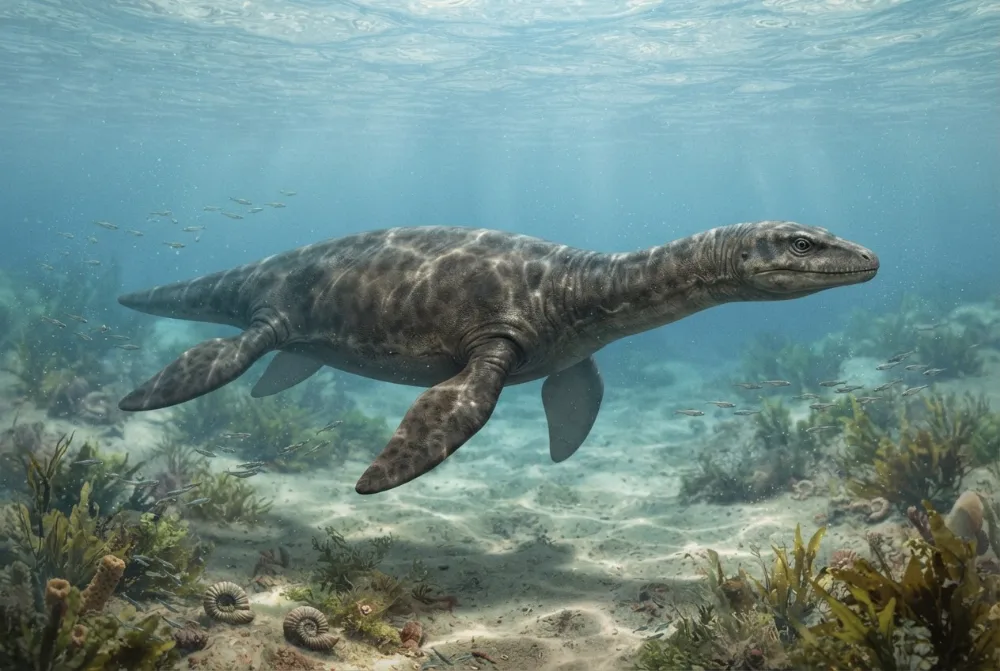
Tatenectes was a small plesiosaur that lived in a shallow sea that covered much of North America during the Jurassic Period. It had a flattened, boxy body and a long neck, and it swam using four flippers like paddles.1
Ankakhala liti?
Anali wamkulu bwanji?
Anali wautali bwanji?
 wautali ngati agalu 3 otsatizana mphuno ndi mchira🍌wautali ngati nthochi 17 zotsatizana🏊akanatha kusambira utali wa dziwe lalikulu losambira (50 m) m'masekondi 6.4
Tatenectes anali wamkulu bwanji poyerekeza ndi IWEYO?
Ndi masamu chabe mu msakatuli wako. Palibe chimene chimasungidwa kapena kutumizidwa kwina kulikonse.
Anali ndi liwiro lotani?


Mfundo zosangalatsa
Tatenectes had a very unusual body shape for a plesiosaur: its torso was flattened and boxy, and its belly ribs were thickened, which helped it stay stable in turbulent water.1
The first fossil of Tatenectes was described in 1900 by Wilbur Clinton Knight, who thought it was a species of Cimoliosaurus. That original specimen has since been lost.1
Tatenectes lived in the Sundance Sea, a shallow inland sea that was less than 40 meters (130 feet) deep and covered parts of western North America during the Jurassic.1
Its teeth were small and thin, with long roots and low enamel ridges, perfect for catching slippery prey like fish and squid.1
Tatenectes shared its sea home with other marine reptiles, including the plesiosaur Pantosaurus and the large pliosaur Megalneusaurus.1
Scientists think Tatenectes could have used lung deflation to help it dive, just like some modern sea turtles do.1
Kwa akatswiri a madino
- Dzina la sayansi
- Tatenectes
- Anapatsidwa dzina ndi
- O'Keefe and Wahl 20033
- Gulu
- Maplesiosauri
- Banja / kladi
- Cryptoclididae3
- Magawidwe a sayansi
- Plesiosauria > Sauropterygia3
- Zaka za miyala
- zaka 162 mpaka 155 miliyoni (Oxfordian)3
- Mapangidwe a miyala
- Sundance3
- Mayiko
- Amereka3
- Zolemba za mafosili
- 3 mu The Paleobiology Database3
- Kupezeka
- The first fossil was described by Wilbur Clinton Knight in 1900 as a new species of Cimoliosaurus. In 2003, F. Robin O'Keefe and William Wahl Jr. gave it its own genus, Tatenectes, based on a new specimen found in Wyoming.12
- Akukambiranabe
- Scientists are still debating whether the gastroliths (stomach stones) found in plesiosaurs like Tatenectes were used for ballast, digestion, or something else.1
Kumene mfundo zimachokera
- Tatenectes (en.wikipedia.org)
- "Preliminary Report on the Osteology and Relationships of a New Aberran" by F. Robin O’Keefe and William Wahl Jr. (mds.marshall.edu)
- Tatenectes in The Paleobiology Database (CC BY 4.0): zaka, malo, mapangidwe a miyala, magawidwe a sayansi.
Mfundo iliyonse patsamba lino ili ndi nambala yosonyeza kumene yachokera. Ngati talakwitsa kanthu, pepa, ndife okonda madino, osati magazini ya sayansi. Tiuze pa [email protected] ndipo tikonza.
 Rex ali ndi njala! Dino Wiki ndi ntchito ya bambo kwa mwana wawo wamwamuna wokonda madainoso, yaulere popanda zotsatsa ndi zokazonda. Akuluakulu angadyetse Rex zokhwasula-khwasula kuti tsambali lipitirize kupezeka pa intaneti.Dyetsa Rex
 Elasmosaurus
 Pliosaurus
 Plesiosaurus
 Cimoliasaurus
 Colymbosaurus
 Trinacromerum
 Brachiosaurus
 Diplodocus
 Allosaurus
 Brontosaurus
 Compsognathus
 Camarasaurus