 Kwizi ya Ndiwe dino uti?
 Nkhondo ya madino
 Mpikisano wa madino
 Masewera ang'onoang'ono a madino
 Chimbale cha zomata
 Mindandanda ya TOP ya madino
 Ndidabwitse!
Woolly mammoth
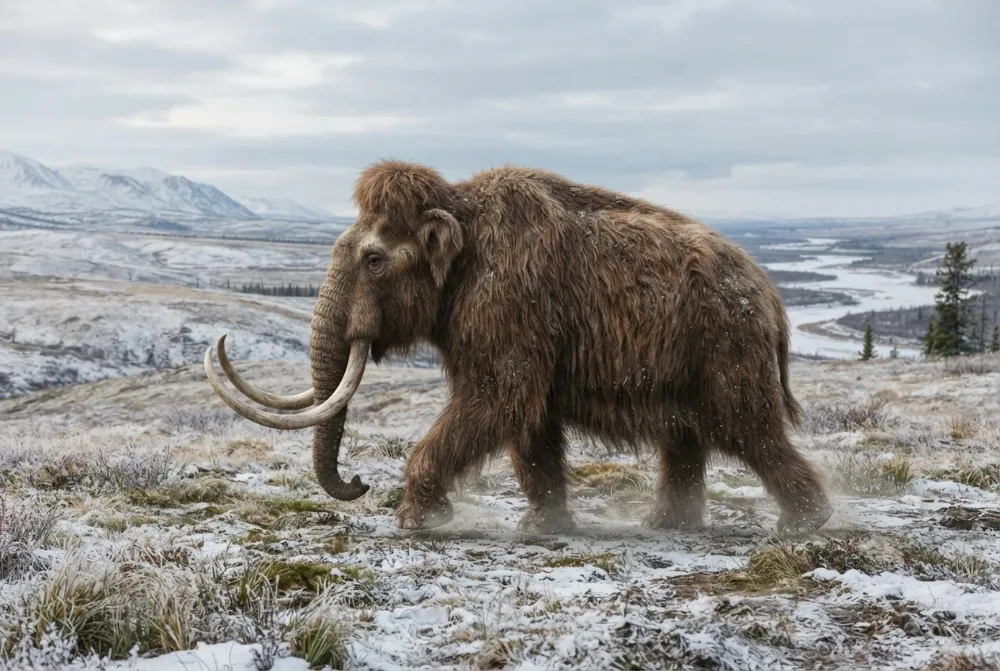
The woolly mammoth was a huge, furry elephant that lived during the Ice Age. It had long, curved tusks and a thick coat of hair to keep warm in the freezing cold. These amazing animals roamed across Europe, Asia, and North America.1
Ankakhala liti?
Anali wamkulu bwanji?
Anali wautali bwanji?
Msinkhu wake unali wautali bwanji?
Ankalemera bwanji?

 wautali ngati agalu 4 otsatizana mphuno ndi mchira🍌wautali ngati nthochi 25 zotsatizana
 wolemera ngati njovu 1.5🍉wolemera ngati mavwende 1600🎒wolemera ngati makalasi athunthu a ana a sukulu 10🐻❄️wolemera ngati zimbalangondo zoyera 18🏃akanatha kuthamanga mamita 100 m'masekondi 14 (munthu waliwiro kwambiri amafunika 9.6)
Woolly mammoth anali wamkulu bwanji poyerekeza ndi IWEYO?
Ndi masamu chabe mu msakatuli wako. Palibe chimene chimasungidwa kapena kutumizidwa kwina kulikonse.
Anali ndi liwiro lotani?


Mfundo zosangalatsa
Woolly mammoths had very small ears and a short tail to stop them from getting frostbite in the cold.1
A newborn woolly mammoth calf weighed about 90 kilograms (200 pounds), as much as a large adult human.1
Woolly mammoths and Columbian mammoths sometimes mated and had hybrid babies in North America.1
The last woolly mammoths lived on Wrangel Island in the Arctic Ocean until about 4,000 years ago, when the Egyptian pyramids were already built.1
Woolly mammoths had four molars that were replaced six times during their life, just like modern elephants.1
Scientists have found frozen woolly mammoth carcasses with fur, skin, and even stomach contents still preserved.1
Mafunso ofunsidwa kwambiri okhudza Woolly mammoth
?How big was a woolly mammoth?
About the same size as a modern African elephant. Males stood 2.67 to 3.49 metres tall at the shoulder and weighed 3.9 to 8.2 tonnes.1
?What did woolly mammoths eat?
They mainly ate forbs and grasses. Their diet was similar to that of modern elephants.1
?When did woolly mammoths go extinct?
Most woolly mammoths died out about 10,000 years ago, but small groups survived on islands. The very last ones lived on Wrangel Island until about 4,000 years ago.1
?Did woolly mammoths have fur?
Yes, they had a thick, shaggy coat of fur to keep warm in the Ice Age cold. It had long guard hairs and a shorter, dense undercoat.1
?How long were woolly mammoth tusks?
Their tusks were long and curved, but the exact length varied. They used them for fighting, foraging, and moving objects.1
?Did humans hunt woolly mammoths?
Yes, early humans hunted woolly mammoths for food and used their bones and tusks to make art, tools, and shelters.1
?Are woolly mammoths dinosaurs?
No, they are not dinosaurs. Woolly mammoths are mammals, specifically a type of extinct elephant.1
?Why did woolly mammoths have small ears?
Their small ears helped prevent frostbite and reduce heat loss in the freezing cold.1
?Can we bring woolly mammoths back?
Scientists have talked about trying to revive them using DNA, but none of those methods are possible right now.1
Wothetsa nthano zabodza
Nthano: Many people think woolly mammoths lived only in snowy, icy landscapes.
Zoona: Woolly mammoths actually lived on a dry, grassy steppe called the mammoth steppe, which was not covered in ice and snow all year.1
Kwa akatswiri a madino
- Dzina la sayansi
- Mammuthus primigenius
- Anapatsidwa dzina ndi
- (Blumenbach 1799)4
- Gulu
- Ngwazi za kalekale
- Banja / kladi
- Elephantidae4
- Magawidwe a sayansi
- Mammalia > Proboscidea > Elephantidae4
- Zaka za miyala
- zaka 7.2 mpaka 0.01 miliyoni (Messinian / Holocene)4
- Mapangidwe a miyala
- Wiota Gravels, Oberer Travertin4
- Mayiko
- Amereka, Kanada, Jeremani, United Kingdom, Rasha, Netherlands4
- Zolemba za mafosili
- 77 mu The Paleobiology Database4
- Kupezeka
- In 1796, French scientist Georges Cuvier was the first to show that woolly mammoth fossils were from an extinct species, not modern elephants. German naturalist Johann Friedrich Blumenbach gave it the scientific name Elephas primigenius in 1799.1
- Akukambiranabe
- Scientists are still debating exactly why woolly mammoths went extinct, whether it was due to climate change, hunting by humans, or a combination of both.1
Kumene mfundo zimachokera
- Woolly mammoth (en.wikipedia.org)
- Genomics of adaptive evolution in the woolly mammoth: Current Biology (cell.com)
- Woolly Mammoth — size, diet & habitat | DinoLifePedia (dinolifepedia.com)
- Woolly mammoth in The Paleobiology Database (CC BY 4.0): zaka, malo, mapangidwe a miyala, magawidwe a sayansi.
Mfundo iliyonse patsamba lino ili ndi nambala yosonyeza kumene yachokera. Ngati talakwitsa kanthu, pepa, ndife okonda madino, osati magazini ya sayansi. Tiuze pa [email protected] ndipo tikonza.
 Rex ali ndi njala! Dino Wiki ndi ntchito ya bambo kwa mwana wawo wamwamuna wokonda madainoso, yaulere popanda zotsatsa ndi zokazonda. Akuluakulu angadyetse Rex zokhwasula-khwasula kuti tsambali lipitirize kupezeka pa intaneti.Dyetsa Rex
 Megalodon
 Sabre-toothed cat
 Dimetrodon
 Arthropleura
 Helicoprion
 Deinosuchus