 Ati daayinoo kami? Qormaata
 Lola daayinoo
 Dorgommii daayinoo
 Taphoota daayinoo xixiqqoo
 Albamii istiikarii
 Tarreewwan TOP daayinoo
 Na dinqisiisi!
Agujaceratops
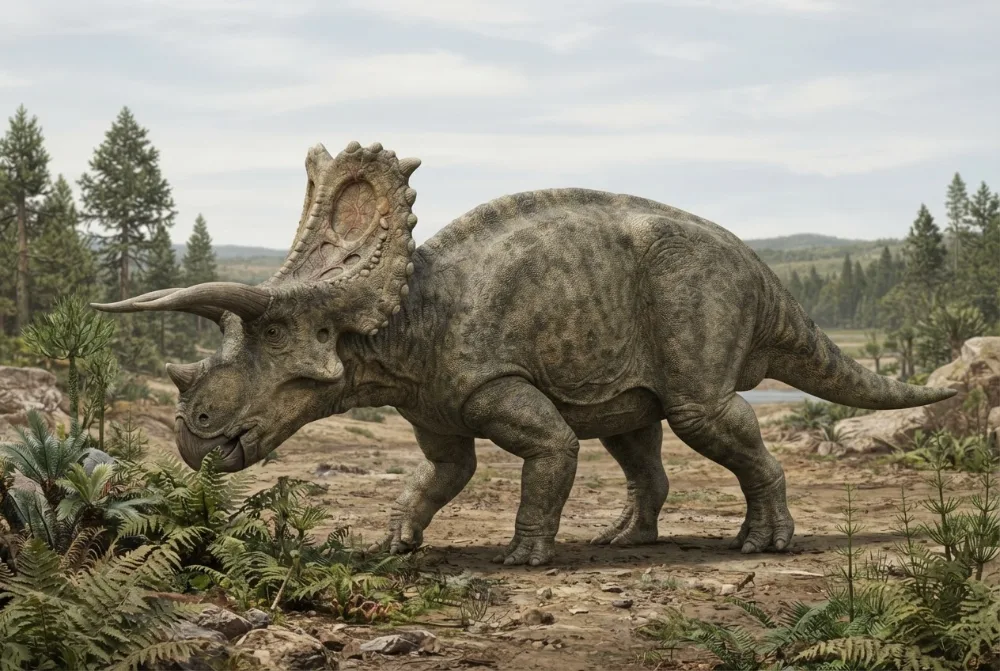
Agujaceratops was a big, four-legged plant eater with a huge frill and long horns on its face. It lived in what is now Texas and Mexico, about 77 million years ago. It looked a bit like a Triceratops, but with a longer frill and different horns.13
Yoom jiraate?
Hammam guddaa ture?
Hammam dheeraa ture?
Hammam ol-dheeraa ture?
tilmaama
Hammam ulfaataa ture?

 akka saree 4 funyaan hanga eegeetti dheeraa🍌akka muuzii 24 walitti hiriiran dheeraaakka saree 75 ulfaata🍉akka habxuu 300 ulfaata🧸akka ijoollee KG 79 ulfaata🎒akka ijoollee mana barumsaa 47 ulfaata🐻❄️akka beeraa adii 3 ulfaata🏃meetira 100 sekondii 10 keessatti fiiguu danda'a (namni hunda caalaa saffisaan 9.6 barbaada)
SI wajjin yoo wal bira qabamu, Agujaceratops hammam guddaa ture?
Herrega qofa barbaadduu kee keessatti. Wanti tokkollee hin olkaa'amu, eessayyuu hin ergamu.
Hammam saffisaa ture?


Odeeffannoowwan bashannansiisoo
Agujaceratops had a heart-shaped frill with a deep notch at the back, and the edges were covered with small, blunt hornlets that made it look scalloped.1
Its brow horns pointed up and out, then curved backwards, which is different from many other horned dinosaurs.1
There are two known species: Agujaceratops mariscalensis and Agujaceratops mavericus. The second one has longer brow horns and a longer frill.1
Many Agujaceratops fossils have been found together in one quarry, which might mean they lived in herds or were gathered by a flood.1
It lived alongside the feathered dinosaur Leptorhynchos and the small pachycephalosaur Texacephale, and was hunted by tyrannosaurs and the giant crocodilian Deinosuchus.1
The first fossils were found in 1938 in Big Bend National Park, Texas, but they were not studied until many years later.1
Gaaffiiwwan waa'ee Agujaceratops baay'ee gaafataman
?How big was Agujaceratops?
Agujaceratops was about 4.3 metres (14 feet) long and weighed around 1.5 metric tons (1.7 short tons). That is roughly the size of a small car.1
?What did Agujaceratops eat?
It was a four-legged plant eater, like other ceratopsids. It probably ate low-growing plants with its beak and teeth.13
?When did Agujaceratops live?
It lived about 77 million years ago, during the Late Cretaceous period. Its fossils are found in Texas and Mexico.13
?Why did Agujaceratops have a frill?
The frill and horns were probably used for showing off to other members of its species, and maybe for fighting over territory or mates.1
Seenaa sobaa diigaa
Seenaa sobaa: Some people think Agujaceratops is the same as Chasmosaurus.
Dhugaa: It was first named Chasmosaurus mariscalensis, but scientists later decided it was different enough to be its own genus, Agujaceratops.1
Ogeeyyii daayinootiif
- Maqaa saayinsii
- Agujaceratops
- Kan maqaa baase
- Lucas et al. 20063
- Garee
- Daayinoowwan gaanfa qaban
- Maatii / kilaadii
- Ceratopsidae3
- Ramaddii
- Ornithischia > Ceratopsia > Ceratopsidae3
- Umurii dhagaawwanii
- waggaa miliyoona 84 hanga 72 (Campanian)3
- Caasaawwan dhagaa
- Aguja3
- Biyyoota
- Ameerikaa, Meeksikoo3
- Galmee fosilii
- 16 The Paleobiology Database keessa3
- Argannoo
- The first fossils were collected in 1938 from Big Bend National Park, Texas. In 1989, Lehman named them Chasmosaurus mariscalensis, and in 2006 Lucas, Sullivan, and Hunt gave them the new name Agujaceratops.1
- Ammallee falmisiisaa
- Scientists are not sure if the many Agujaceratops fossils found together represent a herd or just animals that died together in a drought or flood.1
Odeeffannoon eessaa dhufa
- Agujaceratops (en.wikipedia.org)
- PBDB Taxon (paleobiodb.org)
- Agujaceratops in The Paleobiology Database (CC BY 4.0): umurii, bakkeewwan, caasaawwan dhagaa, ramaddii.
Odeeffannoon fuula kana irra jiru hundi lakkoofsa madda isaa agarsiisu qaba. Yoo waa dogoggorre, dhiifama, nuti jaallattoota daayinoo malee joornaalii saayinsii miti. [email protected] irratti nutti himi, nus ni sirreessina.
 Rex beela'eera! Dino Wiki pirojektii abbaa tokkoo kan ilma isaa daayinoo jaallatuuf hojjetame, bilisa, beeksisa malee fi hordoftuu malee. Ga'eessonni akka inni interneetii irra turuuf Rexiif nyaata xiqqoo kennuu danda'u.Rex soori
 Triceratops
 Protoceratops
 Ojoceratops
 Tatankaceratops
 Psittacosaurus
 Centrosaurus
 Tyrannosaurus
 Velociraptor
 Spinosaurus
 Ankylosaurus
 Parasaurolophus
 Pteranodon