 Ati daayinoo kami? Qormaata
 Lola daayinoo
 Dorgommii daayinoo
 Taphoota daayinoo xixiqqoo
 Albamii istiikarii
 Tarreewwan TOP daayinoo
 Na dinqisiisi!
Anserimimus
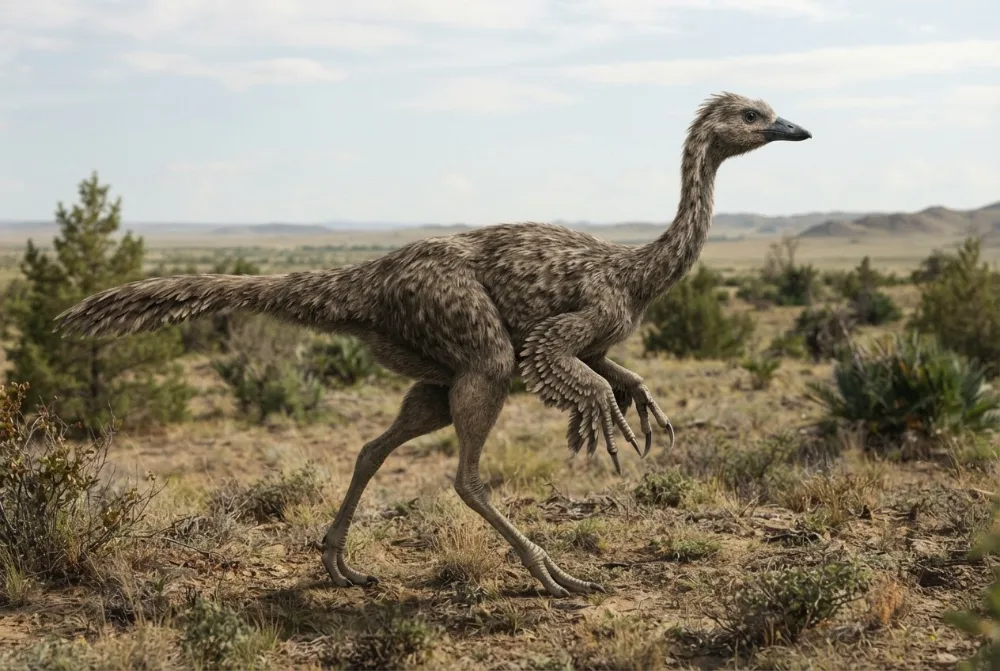
Anserimimus was a fast, long-legged dinosaur that looked a bit like an ostrich. It had strong arms with flat claws, which made it different from its relatives. This dinosaur lived in what is now Mongolia during the Late Cretaceous period.2
Yoom jiraate?
Hammam guddaa ture?
Hammam dheeraa ture?
Hammam ol-dheeraa ture?
tilmaama
Hammam ulfaataa ture?
 akka saree 4 funyaan hanga eegeetti dheeraa🍌akka muuzii 19 walitti hiriiran dheeraa🍉akka habxuu 34 ulfaata🧸akka ijoollee KG 9 ulfaata🎒akka ijoollee mana barumsaa 5 ulfaata🏃meetira 100 sekondii 5.5 keessatti fiiguu danda'a (namni hunda caalaa saffisaan 9.6 barbaada)
SI wajjin yoo wal bira qabamu, Anserimimus hammam guddaa ture?
Herrega qofa barbaadduu kee keessatti. Wanti tokkollee hin olkaa'amu, eessayyuu hin ergamu.
Hammam saffisaa ture?


Odeeffannoowwan bashannansiisoo
Anserimimus had flat, straight claws on its hands, unlike the curved claws of other ornithomimids.2
Its arms were more powerful than those of other ornithomimids, with large crests for strong muscles like the biceps.2
The hand bones (metacarpals) were fused together, making the hand stronger.2
Anserimimus lived about 70 million years ago, during the Maastrichtian stage of the Late Cretaceous.2
Only one complete skeleton of Anserimimus has been found, and it is missing the skull and lower jaws.2
Its closest relative might be Gallimimus, another ornithomimid from the same formation in Mongolia.2
Anserimimus lived alongside giant dinosaurs like Tarbosaurus and Deinocheirus in the Nemegt Formation.2
Gaaffiiwwan waa'ee Anserimimus baay'ee gaafataman
?How big was Anserimimus?
About 3 metres long and weighed around 50 kilograms, though some estimates suggest up to 170 kilograms.2
?What did Anserimimus eat?
Scientists think it was probably an omnivore, but since its skull is missing, its exact diet is unknown.2
?When did Anserimimus live?
It lived about 70 million years ago, during the Late Cretaceous Period.2
?Why did Anserimimus have flat claws?
Nobody knows for sure. The flat, straight claws may have been used for a different way of gathering food, but the animal's skull is missing so its diet is hard to study.2
Ogeeyyii daayinootiif
- Maqaa saayinsii
- Anserimimus
- Kan maqaa baase
- Barsbold 19884
- Garee
- Daayinoowwan guchii
- Maatii / kilaadii
- Ornithomimidae4
- Ramaddii
- Theropoda > Ornithomimosauria4
- Umurii dhagaawwanii
- waggaa miliyoona 72 hanga 66 (Maastrichtian)4
- Caasaawwan dhagaa
- Nemegt4
- Biyyoota
- Mongooliyaa4
- Galmee fosilii
- 2 The Paleobiology Database keessa4
- Argannoo
- Anserimimus was named by Mongolian paleontologist Rinchen Barsbold in 1988, based on a skeleton found during a Soviet-Mongolian expedition to the Gobi Desert in the late 1970s.2
- Ammallee falmisiisaa
- Scientists are not sure what Anserimimus ate, because its skull has never been found. Its strong arms and flat claws might mean it had a different diet or way of gathering food than other ornithomimids.2
Odeeffannoon eessaa dhufa
- Anserimimus | Natural History Museum (nhm.ac.uk)
- Anserimimus (en.wikipedia.org)
- PBDB Taxon (paleobiodb.org)
- Anserimimus in The Paleobiology Database (CC BY 4.0): umurii, bakkeewwan, caasaawwan dhagaa, ramaddii.
Odeeffannoon fuula kana irra jiru hundi lakkoofsa madda isaa agarsiisu qaba. Yoo waa dogoggorre, dhiifama, nuti jaallattoota daayinoo malee joornaalii saayinsii miti. [email protected] irratti nutti himi, nus ni sirreessina.
 Rex beela'eera! Dino Wiki pirojektii abbaa tokkoo kan ilma isaa daayinoo jaallatuuf hojjetame, bilisa, beeksisa malee fi hordoftuu malee. Ga'eessonni akka inni interneetii irra turuuf Rexiif nyaata xiqqoo kennuu danda'u.Rex soori
 Gallimimus
 Ornithomimus
 Struthiomimus
 Deinocheirus
 Dromiceiomimus
 Archaeornithomimus
 Tyrannosaurus
 Triceratops
 Velociraptor
 Spinosaurus
 Ankylosaurus
 Parasaurolophus