 Ati daayinoo kami? Qormaata
 Lola daayinoo
 Dorgommii daayinoo
 Taphoota daayinoo xixiqqoo
 Albamii istiikarii
 Tarreewwan TOP daayinoo
 Na dinqisiisi!
Arthropleura
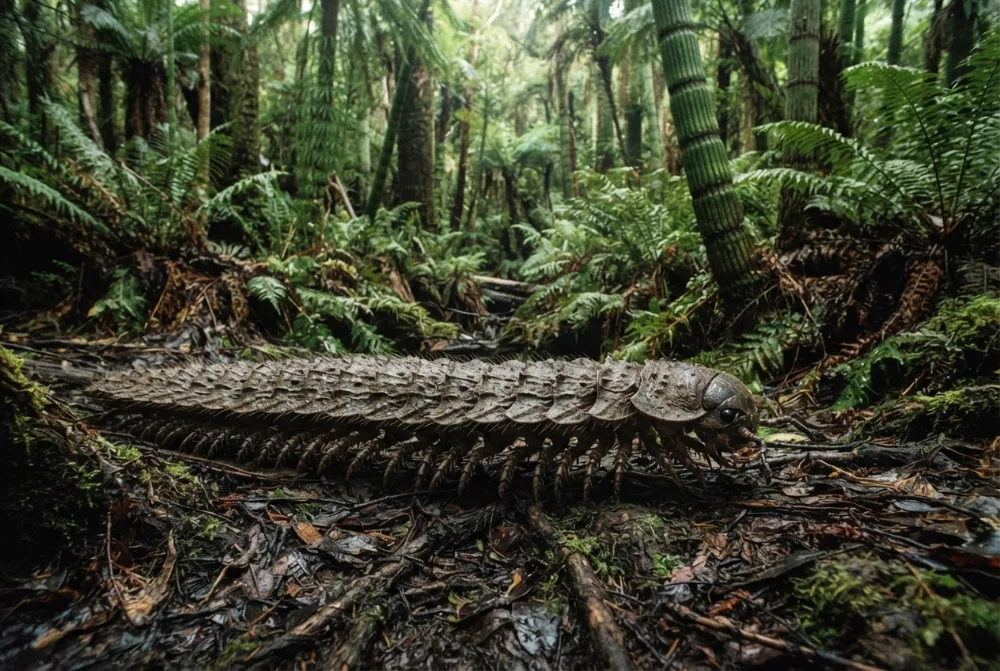
Arthropleura was a giant millipede that lived long before the dinosaurs. It could grow as long as a car, making it the biggest land bug ever! It crawled through ancient forests near water.1
Yoom jiraate?
Hammam guddaa ture?
Hammam dheeraa ture?
Hammam ulfaataa ture?
 akka saree 2.5 funyaan hanga eegeetti dheeraa🍌akka muuzii 14 walitti hiriiran dheeraa
 akka adurree manaa 12 ulfaata🍉akka habxuu 10 ulfaata🧸akka ijoollee KG 2.5 ulfaata🎒akka ijoollee mana barumsaa 1.5 ulfaata🏃meetira 100 sekondii 90 keessatti fiiguu danda'a (namni hunda caalaa saffisaan 9.6 barbaada)
SI wajjin yoo wal bira qabamu, Arthropleura hammam guddaa ture?
Herrega qofa barbaadduu kee keessatti. Wanti tokkollee hin olkaa'amu, eessayyuu hin ergamu.
Hammam saffisaa ture?


Odeeffannoowwan bashannansiisoo
Arthropleura is the largest known land arthropod of all time, reaching at least 2 metres (6.5 feet) long.1
It left giant trackways up to 50 centimetres (20 inches) wide, which are fossilized footprints of its many legs.1
Its head had features of both millipedes and centipedes, showing it was a mix of both groups.2
Arthropleura lived in open, sparsely wooded areas near water and may have been able to go on land and in water.1
It was a slow mover, not a fast runner like centipedes, based on its short legs and trackways.2
Some Arthropleura fossils are so well preserved that scientists can see the details of its head and mouthparts using special scanners.2
Gaaffiiwwan waa'ee Arthropleura baay'ee gaafataman
?How big was Arthropleura?
About 2 metres (6.5 feet) long, possibly up to 2.63 metres (8.6 feet). That makes it the largest known land arthropod of all time.12
?What did Arthropleura eat?
It probably ate dead plants and other detritus, like modern millipedes. It did not have venom fangs or legs for catching prey.5
?Was Arthropleura a dinosaur?
No, it was a giant millipede, not a dinosaur. It lived long before the dinosaurs, from about 344 to 292 million years ago.1
?Could Arthropleura swim?
It may have been amphibious, meaning it could live both on land and in water. It lived in open, sparsely wooded areas near water.1
?How fast could Arthropleura move?
Probably only about 4 km/h (2 mph), a slow walking pace. This is a guess: it was a giant millipede with short legs, and its trackways show it did not hurry.5
?Did Arthropleura have a head?
Yes, and scientists recently used special scanners to see its head in detail. It had antennae, mandibles, and two pairs of maxillae.2
?When did Arthropleura go extinct?
It died out around 292 million years ago, during the early Permian period.1
?Where did Arthropleura live?
It lived in what is now Europe and North America, in open, sparsely wooded forests near water.1
?Is Arthropleura related to centipedes?
It is a millipede, but its head has features of both millipedes and centipedes, showing it was a mix of both groups.5
?How much did Arthropleura weigh?
One large fossil suggests it weighed about 50 kilograms (110 pounds), as heavy as a small human.1
Seenaa sobaa diigaa
Seenaa sobaa: Arthropleura was a giant centipede that hunted other animals.
Dhugaa: Arthropleura was actually a millipede, and it was likely a slow plant-eater, not a predator.2
Ogeeyyii daayinootiif
- Maqaa saayinsii
- Arthropleura
- Kan maqaa baase
- (Jordan 1854)6
- Garee
- Bineensota durii beekamoo
- Maatii / kilaadii
- Arthropleuridae6
- Ramaddii
- Myriapoda > Arthropleurida > Arthropleuridae6
- Umurii dhagaawwanii
- waggaa miliyoona 347 hanga 290 (Visean / Sakmarian)6
- Caasaawwan dhagaa
- Saarbrucker layers, Farrington6
- Biyyoota
- Jarmanii, Faransaay, Beljiyeem, Biriteen, Ispeen, Ameerikaa6
- Galmee fosilii
- 61 The Paleobiology Database keessa6
- Argannoo
- Arthropleura was first named by Jordan in 1854, based on fossils found in Europe.3
- Ammallee falmisiisaa
- Scientists still debate whether Arthropleura was a true millipede or a more primitive relative, and they are not sure exactly what it ate.2
Odeeffannoon eessaa dhufa
- Arthropleura (en.wikipedia.org)
- Head anatomy and phylogenomics show the Carboniferous giant Arthropleura belonged to a millipede-centipede group (science.org)
- PBDB Taxon (paleobiodb.org)
- Millipedes ‘as big as cars’ once roamed England | University of Cambridge (cam.ac.uk)
- Largest ever millipede’s head revealed by 300-million-year-old fossils | Natural History Museum (nhm.ac.uk)
- Arthropleura in The Paleobiology Database (CC BY 4.0): umurii, bakkeewwan, caasaawwan dhagaa, ramaddii.
Odeeffannoon fuula kana irra jiru hundi lakkoofsa madda isaa agarsiisu qaba. Yoo waa dogoggorre, dhiifama, nuti jaallattoota daayinoo malee joornaalii saayinsii miti. [email protected] irratti nutti himi, nus ni sirreessina.
 Rex beela'eera! Dino Wiki pirojektii abbaa tokkoo kan ilma isaa daayinoo jaallatuuf hojjetame, bilisa, beeksisa malee fi hordoftuu malee. Ga'eessonni akka inni interneetii irra turuuf Rexiif nyaata xiqqoo kennuu danda'u.Rex soori
 Megalodon
 Sabre-toothed cat
 Dimetrodon
 Woolly mammoth
 Helicoprion
 Deinosuchus