 Ati daayinoo kami? Qormaata
 Lola daayinoo
 Dorgommii daayinoo
 Taphoota daayinoo xixiqqoo
 Albamii istiikarii
 Tarreewwan TOP daayinoo
 Na dinqisiisi!
Yoom jiraate?

Hammam guddaa ture?
Hammam dheeraa ture?
Hammam ol-dheeraa ture?
Hammam ulfaataa ture?
 akka konkolaataa 2 tarreen dhaabatan dheeraa🍌akka muuzii 56 walitti hiriiran dheeraa
 akka saree 190 ulfaata🍉akka habxuu 760 ulfaata🎒akka kutaalee mana barumsaa guutuu 5 ulfaata🐻❄️akka beeraa adii 8 ulfaata🏃meetira 100 sekondii 18 keessatti fiiguu danda'a (namni hunda caalaa saffisaan 9.6 barbaada)
SI wajjin yoo wal bira qabamu, Camelotia hammam guddaa ture?
Herrega qofa barbaadduu kee keessatti. Wanti tokkollee hin olkaa'amu, eessayyuu hin ergamu.
Hammam saffisaa ture?


Odeeffannoowwan bashannansiisoo
Camelotia lived about 205 to 201 million years ago, during the Rhaetian stage of the Late Triassic.3
Its thigh bone (femur) is about 1 metre (3.3 feet) long, which helped scientists guess its size.1
Camelotia is named after Camelot, the legendary castle of King Arthur, because its fossils were found in Somerset, near where the stories take place.1
It was one of the largest sauropodomorphs from the Triassic, weighing about 3.8 tonnes (8,400 pounds).1
Scientists think Camelotia walked on all four legs, like later sauropods, because its relatives were becoming more quadrupedal.1
The first fossils of Camelotia were discovered in 1894 in a quarry in Wedmore, but they were not named until 1985.1
Some large dinosaur footprints found in Wales might have been made by Camelotia, but scientists are not sure.1
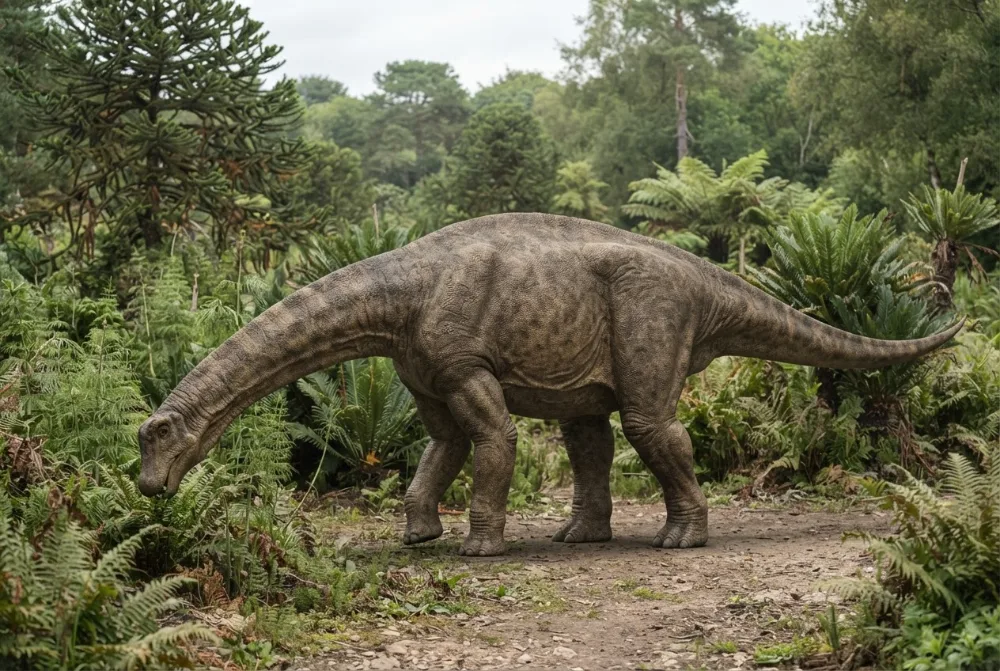
Gaaffiiwwan waa'ee Camelotia baay'ee gaafataman
?How big was Camelotia?
Camelotia was about 8 to 10 metres long and weighed around 3.8 tonnes. That is about as long as a school bus.1
?What did Camelotia eat?
Camelotia was a plant-eater. Its teeth were leaf-shaped and serrated, perfect for eating plants.1
?Did Camelotia walk on two legs or four?
Scientists think Camelotia walked on all four legs, like later sauropods. Its relatives were becoming more quadrupedal.1
?Where was Camelotia found?
Camelotia's fossils were found in a quarry in Wedmore, Somerset, England. That is near the legendary castle of King Arthur, Camelot.1
Seenaa sobaa diigaa
Seenaa sobaa: Camelotia was a meat-eater because its teeth were found near its bones.
Dhugaa: The teeth found with Camelotia actually belong to a different dinosaur, a theropod called Newtonsaurus. Camelotia itself was a plant-eater.1
Ogeeyyii daayinootiif
- Maqaa saayinsii
- Camelotia
- Kan maqaa baase
- Galton 19853
- Garee
- Morma-dheertota
- Maatii / kilaadii
- Sauropodiformes3
- Ramaddii
- Sauropodomorpha3
- Umurii dhagaawwanii
- waggaa miliyoona 206 hanga 201 (Rhaetian)3
- Caasaawwan dhagaa
- Westbury3
- Biyyoota
- Biriteen3
- Galmee fosilii
- 2 The Paleobiology Database keessa3
- Argannoo
- The first fossils were found in 1894 in a quarry near Wedmore, England. They were named Camelotia borealis by Peter M. Galton in 1985.1
- Ammallee falmisiisaa
- Scientists are not sure exactly where Camelotia fits on the dinosaur family tree. Some think it is a close relative of Melanorosaurus, while others think it is a very early sauropod.1
Odeeffannoon eessaa dhufa
- Camelotia (en.wikipedia.org)
- Camelotia - Justapedia (justapedia.org)
- Camelotia in The Paleobiology Database (CC BY 4.0): umurii, bakkeewwan, caasaawwan dhagaa, ramaddii.
Odeeffannoon fuula kana irra jiru hundi lakkoofsa madda isaa agarsiisu qaba. Yoo waa dogoggorre, dhiifama, nuti jaallattoota daayinoo malee joornaalii saayinsii miti. [email protected] irratti nutti himi, nus ni sirreessina.
 Rex beela'eera! Dino Wiki pirojektii abbaa tokkoo kan ilma isaa daayinoo jaallatuuf hojjetame, bilisa, beeksisa malee fi hordoftuu malee. Ga'eessonni akka inni interneetii irra turuuf Rexiif nyaata xiqqoo kennuu danda'u.Rex soori
 Brachiosaurus
 Diplodocus
 Brontosaurus
 Argentinosaurus
 Camarasaurus
 Morosaurus
 Nothosaurus
 Coelophysis
 Podokesaurus
 Simosaurus
 Eudimorphodon
 Herrerasaurus