 Ati daayinoo kami? Qormaata
 Lola daayinoo
 Dorgommii daayinoo
 Taphoota daayinoo xixiqqoo
 Albamii istiikarii
 Tarreewwan TOP daayinoo
 Na dinqisiisi!
Yoom jiraate?

Hammam guddaa ture?
Hammam dheeraa ture?
Hammam ol-dheeraa ture?
tilmaama
Hammam ulfaataa ture?
 akka saree 5 funyaan hanga eegeetti dheeraa🍌akka muuzii 26 walitti hiriiran dheeraa🍉akka habxuu 20 ulfaata🧸akka ijoollee KG 5 ulfaata🎒akka ijoollee mana barumsaa 3 ulfaata🏃meetira 100 sekondii 5.5 keessatti fiiguu danda'a (namni hunda caalaa saffisaan 9.6 barbaada)
SI wajjin yoo wal bira qabamu, Garudimimus hammam guddaa ture?
Herrega qofa barbaadduu kee keessatti. Wanti tokkollee hin olkaa'amu, eessayyuu hin ergamu.
Hammam saffisaa ture?


Odeeffannoowwan bashannansiisoo
Garudimimus had four toes on each foot, but the first toe was very small. Most later ornithomimids had only three toes.1
Scientists once thought Garudimimus had a horn on its skull. Later they realized it was just a crushed bone.1
Garudimimus was not built for fast running. Its leg muscles were not as strong as those of speedier ornithomimids.1
The only known skeleton of Garudimimus is almost complete and still has its bones connected.1
Garudimimus lived alongside turtles, crocodile relatives, and other dinosaurs in a warm, semi-arid floodplain.1
The name Garudimimus comes from Garuda, a mythical bird-like creature in Mongolian Buddhism.1
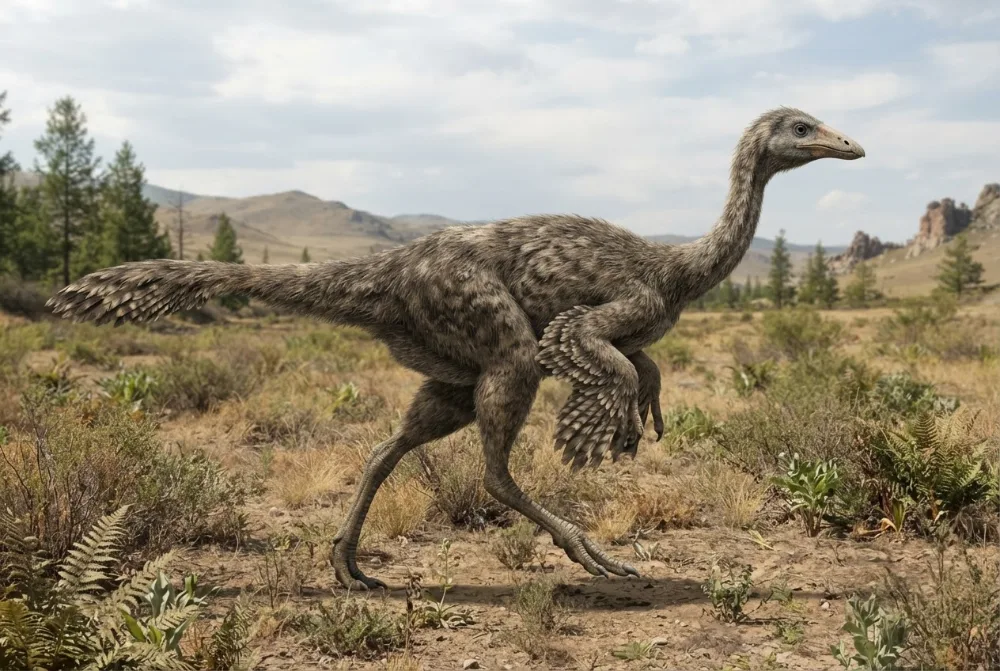
Gaaffiiwwan waa'ee Garudimimus baay'ee gaafataman
?How big was Garudimimus?
About 3.5 metres (11.5 feet) long and weighed around 77 to 98 kilograms (170 to 216 pounds).1
?What did Garudimimus eat?
It was an omnivore or herbivore, eating plants and maybe small animals. It had a toothless beak and a weak bite.1
?Could Garudimimus run fast?
Yes, it was likely a fast runner. Its long legs and anatomy suggest it was built for speed, similar to other ornithomimosaurs.1
?Did Garudimimus have feathers?
Scientists think it probably had feathers, like many other ornithomimosaurs, but no direct feather impressions have been found on the only known skeleton.1
?When did Garudimimus live?
It lived during the Late Cretaceous period, about 99 to 89 million years ago.2
?Where was Garudimimus found?
In the Gobi Desert of Mongolia, at a place called Bayshin Tsav in the Bayan Shireh Formation.1
Seenaa sobaa diigaa
Seenaa sobaa: Garudimimus was a fast runner like an ostrich.
Dhugaa: Garudimimus had short, stocky legs and weak leg muscles, so it was not a fast runner.1
Ogeeyyii daayinootiif
- Maqaa saayinsii
- Garudimimus
- Kan maqaa baase
- Barsbold 19813
- Garee
- Daayinoowwan guchii
- Maatii / kilaadii
- Deinocheiridae3
- Ramaddii
- Theropoda > Ornithomimosauria3
- Umurii dhagaawwanii
- waggaa miliyoona 94 hanga 84 (Turonian / Santonian)3
- Caasaawwan dhagaa
- Baynshire3
- Biyyoota
- Mongooliyaa3
- Galmee fosilii
- 1 The Paleobiology Database keessa3
- Argannoo
- A Soviet-Mongolian expedition found the skeleton in the Gobi Desert in 1981. Mongolian paleontologist Rinchen Barsbold named it Garudimimus brevipes that same year.1
- Ammallee falmisiisaa
- Scientists are not sure if Garudimimus belongs in the family Deinocheiridae or in its own family, Garudimimidae.1
Odeeffannoon eessaa dhufa
- Garudimimus (en.wikipedia.org)
- Garudimimus | Natural History Museum (nhm.ac.uk)
- Garudimimus in The Paleobiology Database (CC BY 4.0): umurii, bakkeewwan, caasaawwan dhagaa, ramaddii.
Odeeffannoon fuula kana irra jiru hundi lakkoofsa madda isaa agarsiisu qaba. Yoo waa dogoggorre, dhiifama, nuti jaallattoota daayinoo malee joornaalii saayinsii miti. [email protected] irratti nutti himi, nus ni sirreessina.
 Rex beela'eera! Dino Wiki pirojektii abbaa tokkoo kan ilma isaa daayinoo jaallatuuf hojjetame, bilisa, beeksisa malee fi hordoftuu malee. Ga'eessonni akka inni interneetii irra turuuf Rexiif nyaata xiqqoo kennuu danda'u.Rex soori
 Gallimimus
 Ornithomimus
 Struthiomimus
 Deinocheirus
 Dromiceiomimus
 Archaeornithomimus
 Tyrannosaurus
 Triceratops
 Velociraptor
 Spinosaurus
 Ankylosaurus
 Parasaurolophus