 Ati daayinoo kami? Qormaata
 Lola daayinoo
 Dorgommii daayinoo
 Taphoota daayinoo xixiqqoo
 Albamii istiikarii
 Tarreewwan TOP daayinoo
 Na dinqisiisi!
Yoom jiraate?

Hammam guddaa ture?
Hammam dheeraa ture?
Hammam ol-dheeraa ture?
tilmaama
Hammam ulfaataa ture?
 akka adurree manaa 2 funyaan hanga eegeetti dheeraa🍌akka muuzii 6 walitti hiriiran dheeraa🪶adurree manaa caalaa salphaa🍌akka muuzii 16 ulfaata🪑akka barcuma jala deemuu danda'utti xiqqaa🏃meetira 100 sekondii 15 keessatti fiiguu danda'a (namni hunda caalaa saffisaan 9.6 barbaada)
SI wajjin yoo wal bira qabamu, Hesperonychus hammam guddaa ture?
Herrega qofa barbaadduu kee keessatti. Wanti tokkollee hin olkaa'amu, eessayyuu hin ergamu.
Hammam saffisaa ture?


Odeeffannoowwan bashannansiisoo
Hesperonychus weighed only about 1.9 kilograms, which is less than a house cat.1
It is the smallest carnivorous non-avian dinosaur known from North America.1
Hesperonychus belongs to a group called Microraptorinae, which includes the four-winged Microraptor from China.1
Its fossils were first collected in 1982 but were not studied until 25 years later.1
Hesperonychus lived about 75 million years ago during the Late Cretaceous.1
Even though it was fully grown, its hip bones were fused together, showing it was an adult.1
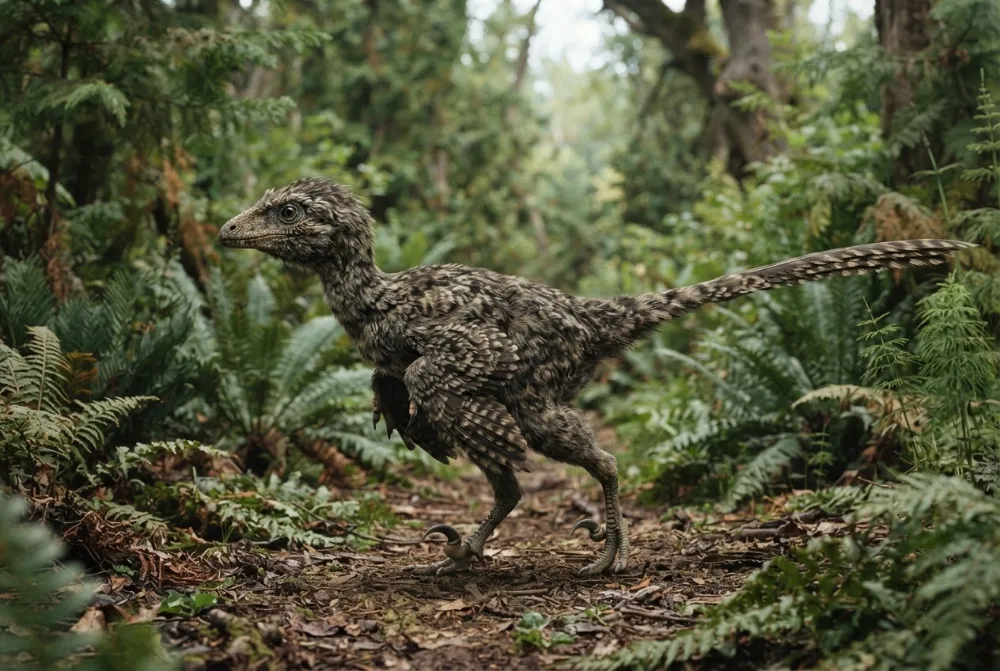
Gaaffiiwwan waa'ee Hesperonychus baay'ee gaafataman
?How big was Hesperonychus?
About 1 metre long and weighed between 1.5 and 2 kilograms, roughly the size of a large cat.31
?What did Hesperonychus eat?
It was a meat-eater. It ate small animals like lizards, mammals, and insects.31
?Did Hesperonychus have feathers?
Yes, it almost certainly had feathers. It belonged to a group of feathered dinosaurs called Microraptorinae, which includes the four-winged Microraptor.31
?Could Hesperonychus fly?
Probably not. Scientists think it was more like a ground-running predator, not a glider like its relative Microraptor.3
Ogeeyyii daayinootiif
- Maqaa saayinsii
- Hesperonychus
- Kan maqaa baase
- Longrich and Currie 20094
- Garee
- Raappitaroota
- Maatii / kilaadii
- Dromaeosauridae4
- Ramaddii
- Theropoda > Dromaeosauridae4
- Umurii dhagaawwanii
- waggaa miliyoona 84 hanga 72 (Campanian)4
- Caasaawwan dhagaa
- Dinosaur Park, Oldman4
- Biyyoota
- Kanaadaa4
- Galmee fosilii
- 4 The Paleobiology Database keessa4
- Argannoo
- The holotype was collected in 1982 by Dr. Elizabeth Nicholls, but it was not described until 2009 by Nicholas Longrich and Philip Currie. The species name honors Elizabeth Nicholls.13
- Ammallee falmisiisaa
- Scientists are not sure exactly how many small dromaeosaurids lived in North America, because only isolated bones have been found so far.1
Odeeffannoon eessaa dhufa
- A microraptorine (Dinosauria, Dromaeosauridae) from the Late Cretaceous of North America (pmc.ncbi.nlm.nih.gov)
- A microraptorine (Dinosauria, Dromaeosauridae) from the Late Cretaceous of North America (pnas.org)
- Hesperonychus (en.wikipedia.org)
- Hesperonychus in The Paleobiology Database (CC BY 4.0): umurii, bakkeewwan, caasaawwan dhagaa, ramaddii.
Odeeffannoon fuula kana irra jiru hundi lakkoofsa madda isaa agarsiisu qaba. Yoo waa dogoggorre, dhiifama, nuti jaallattoota daayinoo malee joornaalii saayinsii miti. [email protected] irratti nutti himi, nus ni sirreessina.
 Rex beela'eera! Dino Wiki pirojektii abbaa tokkoo kan ilma isaa daayinoo jaallatuuf hojjetame, bilisa, beeksisa malee fi hordoftuu malee. Ga'eessonni akka inni interneetii irra turuuf Rexiif nyaata xiqqoo kennuu danda'u.Rex soori
 Velociraptor
 Microraptor
 Deinonychus
 Asiamericana
 Richardoestesia
 Saurornitholestes
 Tyrannosaurus
 Triceratops
 Spinosaurus
 Ankylosaurus
 Parasaurolophus
 Pteranodon