 Ati daayinoo kami? Qormaata
 Lola daayinoo
 Dorgommii daayinoo
 Taphoota daayinoo xixiqqoo
 Albamii istiikarii
 Tarreewwan TOP daayinoo
 Na dinqisiisi!
Yoom jiraate?

Hammam guddaa ture?
Hammam dheeraa ture?
SI wajjin yoo wal bira qabamu, Juravenator hammam guddaa ture?
Herrega qofa barbaadduu kee keessatti. Wanti tokkollee hin olkaa'amu, eessayyuu hin ergamu.
Hammam saffisaa ture?


Odeeffannoowwan bashannansiisoo
Juravenator is known from a single, nearly complete skeleton of a juvenile, making it one of the best-preserved predatory dinosaurs from Europe.21
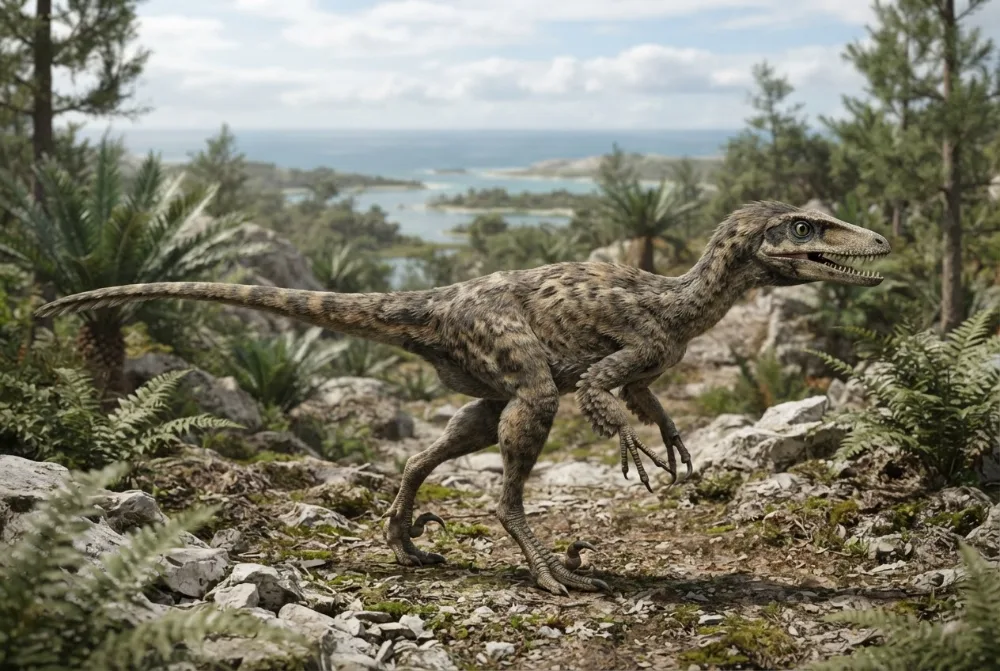
Unlike many other small theropods from the same time, Juravenator did not have feathers or feather-like structures on its tail.21
Scientists think Juravenator may have been nocturnal, based on the shape of its eye bones.1
In 2020, researchers found tiny round structures on the sides of Juravenator's tail that might have been sensory organs, like those on crocodile scales.1
The only known Juravenator fossil was found in a lagoon deposit, suggesting it may have drowned after being washed into the water.1
Gaaffiiwwan waa'ee Juravenator baay'ee gaafataman
?How big was Juravenator?
About 75 centimetres (2.46 feet) long, which is roughly the size of a small dog.1
?Did Juravenator have feathers?
It had mostly scales on its tail and legs, but some faint impressions of possible simple feathers have been found on the top of the tail and hips.1
?What did Juravenator eat?
It was a small meat-eater that may have hunted fish and other small prey in shallow water.4
?Could Juravenator swim?
It may have waded in water to hunt, but it probably did not swim well. The only known fossil was found in a lagoon, possibly after drowning.1
?Was Juravenator nocturnal?
Yes, scientists think it may have been nocturnal based on the shape of its eye bones.1
?Where was Juravenator found?
In Germany, in the Franconian Jura region, from rocks that are about 151 to 152 million years old.1
Ogeeyyii daayinootiif
- Maqaa saayinsii
- Juravenator
- Kan maqaa baase
- Göhlich and Chiappe 20065
- Garee
- Daayinoowwan foon nyaatan
- Maatii / kilaadii
- Coelurosauria5
- Ramaddii
- Theropoda5
- Umurii dhagaawwanii
- waggaa miliyoona 152 hanga 149 (Kimmeridgian)5
- Caasaawwan dhagaa
- Painten5
- Biyyoota
- Jarmanii5
- Galmee fosilii
- 1 The Paleobiology Database keessa5
- Argannoo
- Juravenator was discovered in 1998 by volunteers Klaus-Dieter Weiß and Hans-Joachim Weiß in a quarry near Schamhaupten, Germany. It was named and described by Ursula Göhlich and Luis Chiappe in 2006.12
- Ammallee falmisiisaa
- Scientists are not sure if Juravenator was fully grown when it died, because the only known skeleton is from a juvenile.1
Odeeffannoon eessaa dhufa
- Juravenator (en.wikipedia.org)
- A new carnivorous dinosaur from the Late Jurassic Solnhofen archipelago | Nature (nature.com)
- PBDB Taxon (paleobiodb.org)
- This small dinosaur had a marvelous sense of touch, detailed fossils reveal | National Geographic (nationalgeographic.com)
- Juravenator in The Paleobiology Database (CC BY 4.0): umurii, bakkeewwan, caasaawwan dhagaa, ramaddii.
Odeeffannoon fuula kana irra jiru hundi lakkoofsa madda isaa agarsiisu qaba. Yoo waa dogoggorre, dhiifama, nuti jaallattoota daayinoo malee joornaalii saayinsii miti. [email protected] irratti nutti himi, nus ni sirreessina.
 Rex beela'eera! Dino Wiki pirojektii abbaa tokkoo kan ilma isaa daayinoo jaallatuuf hojjetame, bilisa, beeksisa malee fi hordoftuu malee. Ga'eessonni akka inni interneetii irra turuuf Rexiif nyaata xiqqoo kennuu danda'u.Rex soori
 Allosaurus
 Carnotaurus
 Dilophosaurus
 Giganotosaurus
 Compsognathus
 Paronychodon
 Brachiosaurus
 Diplodocus
 Brontosaurus
 Camarasaurus
 Morosaurus
 Apatosaurus