 Ati daayinoo kami? Qormaata
 Lola daayinoo
 Dorgommii daayinoo
 Taphoota daayinoo xixiqqoo
 Albamii istiikarii
 Tarreewwan TOP daayinoo
 Na dinqisiisi!
Martinectes
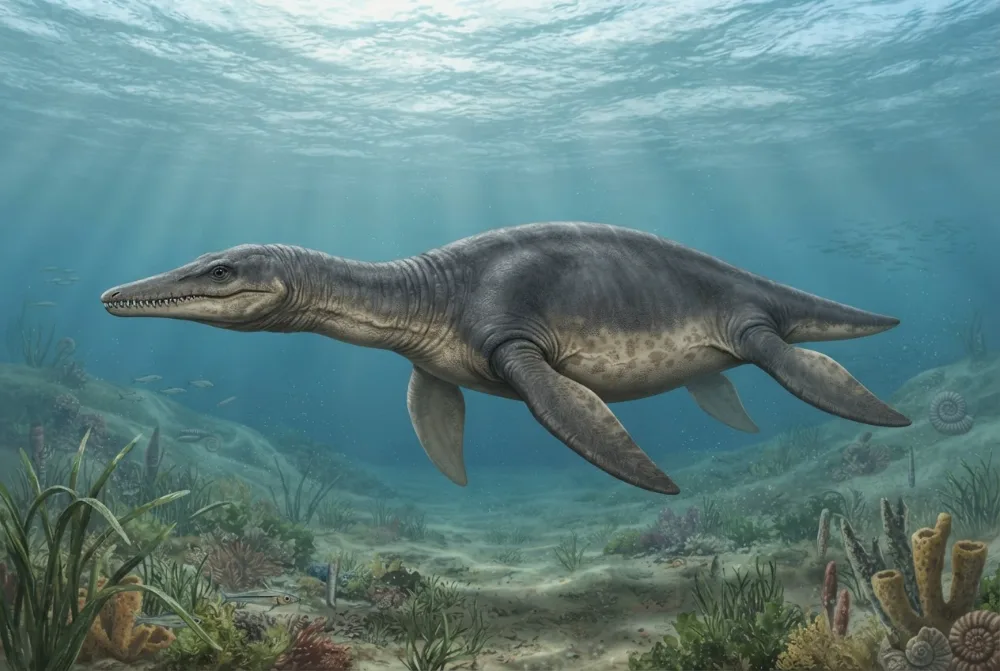
Martinectes was a small, fast-swimming marine reptile that lived in the shallow seas of North America during the time of the dinosaurs. It had a short neck, a long snout, and four big flippers that helped it chase after fish and squid.1
Yoom jiraate?
Hammam guddaa ture?
Hammam dheeraa ture?
Hammam ulfaataa ture?
 akka saree 2.5 funyaan hanga eegeetti dheeraa🍌akka muuzii 14 walitti hiriiran dheeraa🍉akka habxuu 250 ulfaata🧸akka ijoollee KG 67 ulfaata🎒akka ijoollee mana barumsaa 40 ulfaata🐻❄️akka beeraa adii 3 ulfaata🏊dheerina bishaan daakaa guddaa (50 m) sekondii 6.9 keessatti daakuu danda'a
SI wajjin yoo wal bira qabamu, Martinectes hammam guddaa ture?
Herrega qofa barbaadduu kee keessatti. Wanti tokkollee hin olkaa'amu, eessayyuu hin ergamu.
Hammam saffisaa ture?


Odeeffannoowwan bashannansiisoo
Martinectes was one of the smallest adult polycotylid plesiosaurs ever found, measuring only about 2.3 to 2.6 metres long.1
It had large eyes with a bony ledge above them, which may have shaded its eyes from sunlight while hunting near the water's surface.1
Martinectes lived about 80 million years ago in the Western Interior Seaway, a huge ocean that split North America in two.1
Its name means 'Martin's swimmer', honoring the person who helped discover its fossils.1
Martinectes was originally thought to be a species of Dolichorhynchops, but scientists gave it its own genus in 2024.1
It had unusually wide bones in its spine and a very short back part of its skull, which helped scientists tell it apart from other plesiosaurs.1
Gaaffiiwwan waa'ee Martinectes baay'ee gaafataman
?How big was Martinectes?
Martinectes was a large polycotylid plesiosaur, measuring at least around 5 metres (16 ft) long. Some estimates suggest it could reach up to 6 to 7 metres (20 to 23 ft), while a 2026 estimate put it at about 4.95 metres (16.2 ft) long.2
?Was Martinectes a dinosaur?
No, Martinectes was a plesiosaur, a marine reptile that lived in the seas during the time of the dinosaurs. It was not a dinosaur.2
?What did Martinectes eat?
Martinectes likely chased after fish and squid, using its long snout and four big flippers to swim fast. Its small teeth and narrow jaws suggest it ate small, slippery prey.2
Ogeeyyii daayinootiif
- Maqaa saayinsii
- Martinectes
- Kan maqaa baase
- Clark et al. 20243
- Garee
- Pileesiyoosaroota
- Maatii / kilaadii
- Polycotylidae3
- Ramaddii
- Plesiosauria > Sauropterygia3
- Umurii dhagaawwanii
- waggaa miliyoona 84 hanga 72 (Campanian)3
- Caasaawwan dhagaa
- Pierre Shale, Taylor Marl3
- Biyyoota
- Ameerikaa3
- Galmee fosilii
- 3 The Paleobiology Database keessa3
- Argannoo
- Martinectes was named in 2024 by Robert O. Clark, F. Robin O'Keefe, and Sara E. Slack. They studied fossils that had been found in Wyoming and South Dakota, USA, and realized they belonged to a new genus.31
- Ammallee falmisiisaa
- Scientists are still debating exactly how Martinectes used its unusual eye ledges and wide skull for hunting.1
Odeeffannoon eessaa dhufa
- A new genus of small polycotylid plesiosaur from the Upper Cretaceous of the Western Interior Seaway and a clarification of the genus Dolichorhynchops (sciencedirect.com)
- Martinectes (en.wikipedia.org)
- Martinectes in The Paleobiology Database (CC BY 4.0): umurii, bakkeewwan, caasaawwan dhagaa, ramaddii.
Odeeffannoon fuula kana irra jiru hundi lakkoofsa madda isaa agarsiisu qaba. Yoo waa dogoggorre, dhiifama, nuti jaallattoota daayinoo malee joornaalii saayinsii miti. [email protected] irratti nutti himi, nus ni sirreessina.
 Rex beela'eera! Dino Wiki pirojektii abbaa tokkoo kan ilma isaa daayinoo jaallatuuf hojjetame, bilisa, beeksisa malee fi hordoftuu malee. Ga'eessonni akka inni interneetii irra turuuf Rexiif nyaata xiqqoo kennuu danda'u.Rex soori
 Elasmosaurus
 Pliosaurus
 Plesiosaurus
 Cimoliasaurus
 Colymbosaurus
 Trinacromerum
 Tyrannosaurus
 Triceratops
 Velociraptor
 Spinosaurus
 Ankylosaurus
 Parasaurolophus