 Ati daayinoo kami? Qormaata
 Lola daayinoo
 Dorgommii daayinoo
 Taphoota daayinoo xixiqqoo
 Albamii istiikarii
 Tarreewwan TOP daayinoo
 Na dinqisiisi!
Oxalaia
Oxalaia was a huge, meat-eating dinosaur with a long snout like a crocodile. It lived in what is now Brazil and was one of the biggest predators of its time.1
Yoom jiraate?
Hammam guddaa ture?
Hammam dheeraa ture?
Hammam ol-dheeraa ture?
tilmaama
Hammam ulfaataa ture?
 akka konkolaataa 3 tarreen dhaabatan dheeraa🍌akka muuzii 78 walitti hiriiran dheeraa
 gara ulfaatina arbaa🍉akka habxuu 1400 ulfaata🎒akka kutaalee mana barumsaa guutuu 9 ulfaata🐻❄️akka beeraa adii 16 ulfaata🏢akka foddaa darbii 2 keessa ilaaluu danda'utti ol-dheeraa🏃meetira 100 sekondii 20 keessatti fiiguu danda'a (namni hunda caalaa saffisaan 9.6 barbaada)
SI wajjin yoo wal bira qabamu, Oxalaia hammam guddaa ture?
Herrega qofa barbaadduu kee keessatti. Wanti tokkollee hin olkaa'amu, eessayyuu hin ergamu.
Hammam saffisaa ture?


Odeeffannoowwan bashannansiisoo
Oxalaia is the largest meat-eating dinosaur ever found in Brazil.1
Its teeth had no serrations, unlike many other spinosaurids such as Suchomimus.1
Oxalaia had one functional tooth followed by two replacement teeth, a feature not seen in other theropod dinosaurs.1
The front part of its snout was very expanded and rounded, different from Spinosaurus.1
Oxalaia lived about 100 to 94 million years ago during the Late Cretaceous period.3
Its fossils were found on Cajual Island, a place where descendants of escaped slaves (quilombolas) live.1
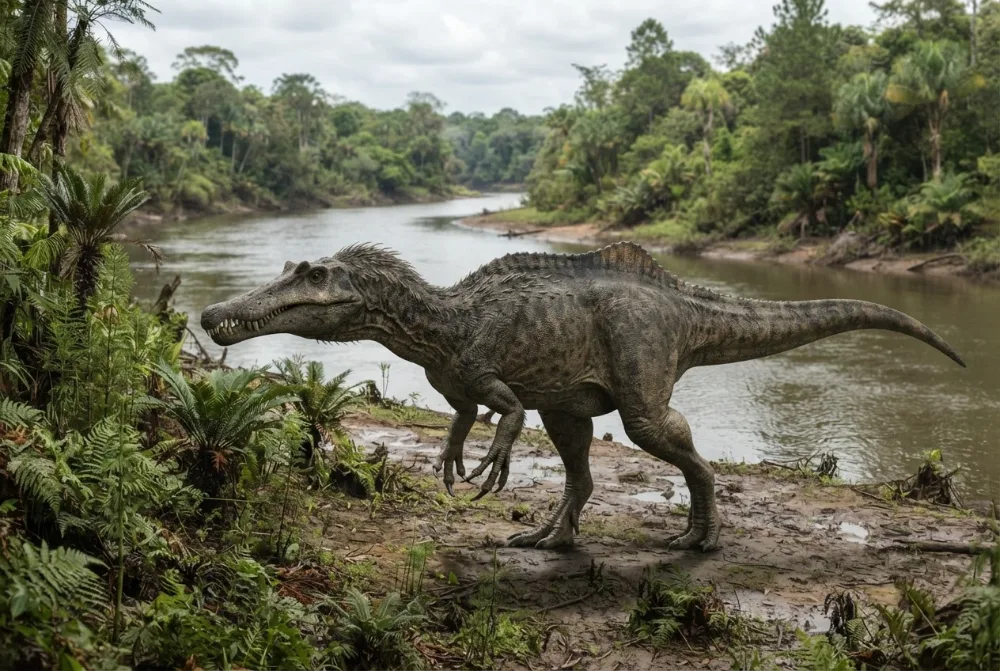
Gaaffiiwwan waa'ee Oxalaia baay'ee gaafataman
?How big was Oxalaia?
Oxalaia was about 12 to 14 metres long and weighed 5 to 7 tonnes. That makes it the largest meat eating dinosaur found in Brazil.12
?What did Oxalaia eat?
Oxalaia was a spinosaurid, so it mostly ate fish, like a crocodile. It may also have eaten small dinosaurs and pterosaurs.2
?When did Oxalaia live?
Oxalaia lived during the Late Cretaceous period, about 100.5 to 93.9 million years ago.2
?Where was Oxalaia found?
Oxalaia's fossils were found on Cajual Island in Maranhão, northeastern Brazil, in the Alcântara Formation.2
?Is Oxalaia a dinosaur?
Yes, Oxalaia is a dinosaur. It is a spinosaurid theropod, which means it was a meat-eating dinosaur.2
?Did Oxalaia have feathers?
Nobody knows for sure. No feathers have been found with Oxalaia fossils, and spinosaurids are not known to have feathers, but some related dinosaurs may have had them.2
?Was Oxalaia bigger than T. rex?
Oxalaia was about 12 to 14 metres long, similar in length to T. rex, but T. rex was heavier, weighing about 8 tonnes compared to Oxalaia's 5 to 7 tonnes.12
?Could Oxalaia swim?
It is possible. Spinosaurids like Oxalaia had long snouts and conical teeth like fish-eaters, and some scientists think they could swim, but there is no direct evidence for Oxalaia.2
Ogeeyyii daayinootiif
- Maqaa saayinsii
- Oxalaia
- Kan maqaa baase
- Kellner et al. 20113
- Garee
- Ispaayinoosaroota
- Maatii / kilaadii
- Spinosauridae3
- Ramaddii
- Theropoda > Spinosauridae3
- Umurii dhagaawwanii
- waggaa miliyoona 100 hanga 94 (Cenomanian)3
- Caasaawwan dhagaa
- Alcântara3
- Biyyoota
- Biraazil3
- Galmee fosilii
- 1 The Paleobiology Database keessa3
- Argannoo
- Oxalaia was named in 2011 by Alexander Kellner and his team based on a snout and a jaw fragment found at Laje do Coringa in Brazil.31
- Ammallee falmisiisaa
- Scientists are not sure if Oxalaia is a separate species or the same as Spinosaurus, because only a few bones have been found.1
Odeeffannoon eessaa dhufa
- A new dinosaur (Theropoda, Spinosauridae) from the Cretaceous (Cenomanian) Alcântara Formation, Cajual Island, Brazil (scielo.br)
- Oxalaia (en.wikipedia.org)
- Oxalaia in The Paleobiology Database (CC BY 4.0): umurii, bakkeewwan, caasaawwan dhagaa, ramaddii.
Odeeffannoon fuula kana irra jiru hundi lakkoofsa madda isaa agarsiisu qaba. Yoo waa dogoggorre, dhiifama, nuti jaallattoota daayinoo malee joornaalii saayinsii miti. [email protected] irratti nutti himi, nus ni sirreessina.
 Rex beela'eera! Dino Wiki pirojektii abbaa tokkoo kan ilma isaa daayinoo jaallatuuf hojjetame, bilisa, beeksisa malee fi hordoftuu malee. Ga'eessonni akka inni interneetii irra turuuf Rexiif nyaata xiqqoo kennuu danda'u.Rex soori
 Spinosaurus
 Baryonyx
 Suchomimus
 Angaturama
 Camarillasaurus
 Ceratosuchops
 Tyrannosaurus
 Triceratops
 Velociraptor
 Ankylosaurus
 Parasaurolophus
 Pteranodon