 Quiz: Tge dino es ti?
 Cumbat da dinos
 Cursa da dinos
 Mini-gieus da dinos
 Album d'adesivs
 TOP-glistas da dinos
 Ma surprenda!
Ajnabia
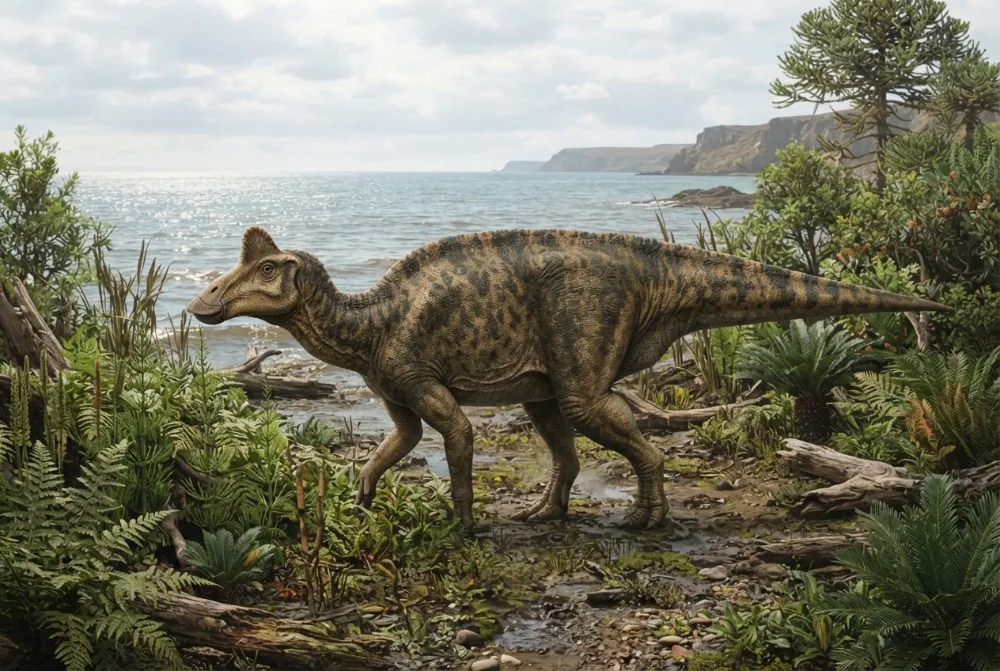
Ajnabia was a small duck-billed dinosaur that lived in Africa at the very end of the Cretaceous. It was a surprise to scientists because duck-billed dinosaurs were not known from Africa before. Ajnabia probably swam or rafted across the sea from Europe to reach its home.2
Cura viveva el?
Quant grond era el?
Quant lung era el?
Quant aut era el?
stima
Quant grev era el?
 uschè lung sco 4 chauns dal nas a la cua🍌uschè lung sco 19 bananas ina suenter l'autra🍉uschè grev sco 50 melunas🧸uschè grev sco 13 uffants da scoletta🎒uschè grev sco 8 scolars🏃pudess currer 100 meters en 8,4 secundas (il pli spert uman dovra 9,6)
Quant grond era Ajnabia cumpareglià cun TAI?
Mo matematica en tes navigatur. Nagut na vegn arcunà u tramess.
Quant spert era el?


Fatgs divertents
Ajnabia is a lambeosaurine hadrosaur, a group of duck-billed dinosaurs that often had fancy head crests.2
It was one of the smallest duck-billed dinosaurs, only about 3.5 metres (11 feet) long.2
Ajnabia lived around 68 to 66 million years ago, just before the mass extinction that ended the age of dinosaurs.1
Its fossils were found in phosphate mines, which were once a shallow sea. The bones probably washed in from land.2
Ajnabia is related to European duck-billed dinosaurs, suggesting its ancestors crossed the sea from Europe to Africa.2
Only a few bones of Ajnabia have been found: part of the upper jaw, a piece of the lower jaw, and some teeth.1
Las dumondas las pli frequentas davart Ajnabia
?What did Ajnabia eat?
It was a herbivore, eating plants. As a duck-billed dinosaur, it had many teeth for chewing tough vegetation.1
?Did Ajnabia have a crest?
It probably did. Ajnabia was a lambeosaurine hadrosaur, a group known for having fancy head crests, though its fossils don't include the skull top.1
?How did Ajnabia get to Africa?
Scientists think it swam or rafted across the sea from Europe, because Africa was isolated by water at the time.12
?When did Ajnabia live?
About 68 to 66 million years ago, in the very latest Cretaceous, just before the asteroid impact that ended the dinosaurs.1
?Is Ajnabia a dinosaur?
Yes, it is a dinosaur. Specifically, it is a duck-billed dinosaur (hadrosaur) from the group Lambeosaurinae.1
Per experts da dinos
- Num scientific
- Ajnabia
- Numnà da
- Longrich et al. 20214
- Gruppa
- Pichels d'anda
- Famiglia / clada
- Hadrosauridae4
- Classificaziun
- Ornithischia > Ornithopoda > Iguanodontia > Hadrosauridae4
- Vegliadetgna da la crappa
- 72 fin 66 milliuns onns (Maastrichtian)4
- Formaziuns da crap
- Couche III4
- Pajais
- Marocco4
- Chats da fossils
- 1 en The Paleobiology Database4
- Scuverta
- Ajnabia was named in 2021 by Longrich and colleagues. The fossils came from phosphate mines in Morocco and were described as a new species of duck-billed dinosaur.3
- Anc discutà
- Scientists are not sure exactly how Ajnabia got to Africa. It may have swum or rafted across the sea from Europe, but the details of this journey are still debated.2
Danunder che vegnan ils fatgs
- Ajnabia (en.wikipedia.org)
- A new small duckbilled dinosaur (Hadrosauridae: Lambeosaurinae) from Morocco and dinosaur diversity in the late Maastrichtian of North Africa | Scientific Reports (nature.com)
- PBDB Taxon (paleobiodb.org)
- Ajnabia in The Paleobiology Database (CC BY 4.0): vegliadetgna, lieus, formaziuns da crap, classificaziun.
Mintga fatg sin questa pagina ha in numer che maina tar sia funtauna. Sche nus avain fatg in sbagl, perstgisa, nus essan fans da dinos, betg ina revista scientifica. Scriva a nus sin [email protected] e nus il curregin.
 Rex ha fom! Dino Wiki è in project d'in bab per ses figl che ama ils dinos, gratuit, senza reclama e senza trackers. Ils creschids pon dar ina marenda a Rex per gidar a tegnair la pagina online.Pavlar Rex
 Parasaurolophus
 Edmontosaurus
 Saurolophus
 Hypacrosaurus
 Corythosaurus
 Kritosaurus
 Tyrannosaurus
 Triceratops
 Velociraptor
 Spinosaurus
 Ankylosaurus
 Pteranodon