 Quiz: Tge dino es ti?
 Cumbat da dinos
 Cursa da dinos
 Mini-gieus da dinos
 Album d'adesivs
 TOP-glistas da dinos
 Ma surprenda!
Euoplocephalus
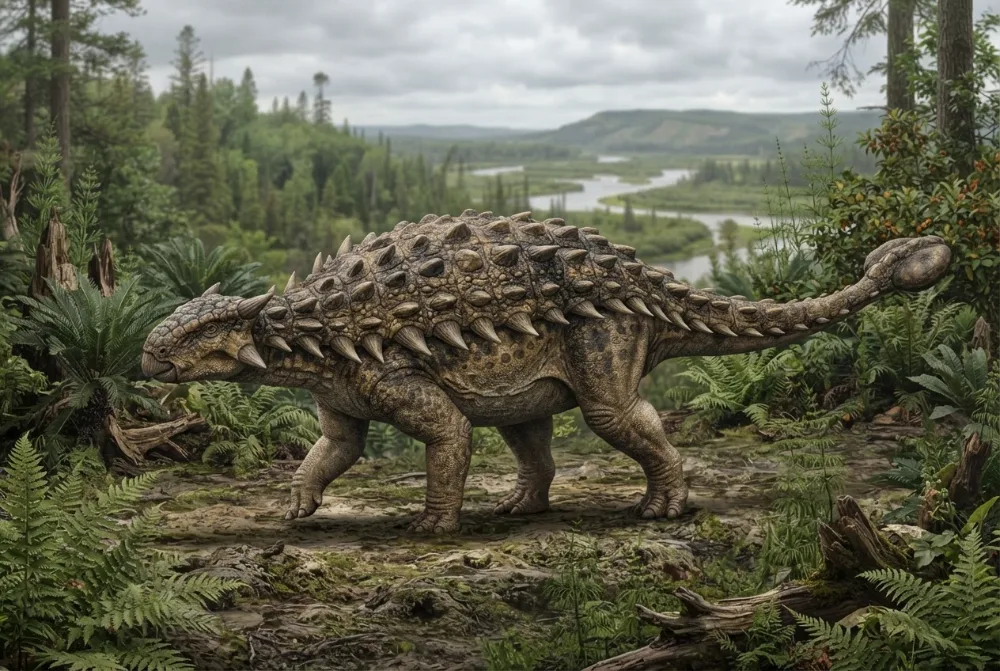
Euoplocephalus was a tank-like dinosaur covered in bony armour and a heavy club on its tail. It lived in what is now Canada and the USA during the Late Cretaceous period. This slow-moving plant-eater could defend itself from big predators like Albertosaurus.1
Cura viveva el?
Quant grond era el?
Quant lung era el?
Quant aut era el?
Quant grev era el?

 uschè lung sco 5 chauns dal nas a la cua🍌uschè lung sco 29 bananas ina suenter l'autrauschè grev sco 100 chauns🍉uschè grev sco 400 melunas🎒uschè grev sco 2,5 classas da scola entiras🐻❄️uschè grev sco 4 urs polars🏃pudess currer 100 meters en 24 secundas (il pli spert uman dovra 9,6)
Quant grond era Euoplocephalus cumpareglià cun TAI?
Mo matematica en tes navigatur. Nagut na vegn arcunà u tramess.
Quant spert era el?


Fatgs divertents
Euoplocephalus had a heavy club at the end of its tail made of bone. It could swing this club to fight off predators.1
Its body was covered in rows of bony plates called scutes. It also had two bone rings around its neck for extra protection.1
Euoplocephalus was about 5.3 metres (17 feet) long and weighed around 2 metric tons (2.2 short tons). That is as heavy as a small car.1
The first fossil was found in 1897 in Alberta, Canada. It was originally named Stereocephalus, but that name was already used for an insect, so it was changed to Euoplocephalus in 1910.1
Euoplocephalus lived between about 76 and 75 million years ago, during the late Campanian stage of the Late Cretaceous.1
Scientists once thought many different ankylosaur fossils all belonged to Euoplocephalus, but now they know most are separate species like Scolosaurus and Platypelta.1
Euoplocephalus had a short, drooping snout and a horny beak to bite off plants. Its teeth show it could chew tough plant material.1
Las dumondas las pli frequentas davart Euoplocephalus
?How big was Euoplocephalus?
About 5.3 metres (17 feet) long and 2 tonnes (2.2 short tons) in weight, as heavy as a small car.13
?What did Euoplocephalus eat?
It was a plant-eater. It used a horny beak to bite off plants and had small teeth to chew tough plant material.13
?Did Euoplocephalus have a tail club?
Yes, it had a heavy bony club at the end of its tail. It could swing this club to defend itself from predators like Albertosaurus.13
?Was Euoplocephalus bigger than Ankylosaurus?
No, Ankylosaurus was bigger. Among ankylosaurids, Euoplocephalus was exceeded in size only by Ankylosaurus and perhaps Tarchia and Cedarpelta.1
?When did Euoplocephalus live?
It lived during the Late Cretaceous period, about 76 to 70 million years ago.3
?Where was Euoplocephalus found?
Fossils have been found in Canada (Alberta) and the United States (Montana).13
?How fast could Euoplocephalus run?
Nobody knows for sure, but it was a slow-moving dinosaur with short, sturdy legs built for walking, not running.1
?What does the name Euoplocephalus mean?
It means 'well-armed head', from Greek words for 'well', 'armed', and 'head'.1
Chatschader da mitus
Mitus: Euoplocephalus could roll into a ball like an armadillo to protect itself.
Vardad: Euoplocephalus could not roll into a ball. It relied on its armour and tail club for defence.1
Per experts da dinos
- Num scientific
- Euoplocephalus
- Numnà da
- Lambe 19104
- Gruppa
- Dinos cun armadura
- Famiglia / clada
- Ankylosauridae4
- Classificaziun
- Ornithischia > Ankylosauria > Ankylosauridae > Thyreophora4
- Vegliadetgna da la crappa
- 84 fin 66 milliuns onns (Campanian / Maastrichtian)4
- Formaziuns da crap
- Dinosaur Park, Judith River, Two Medicine4
- Pajais
- Canada, USA, China4
- Chats da fossils
- 18 en The Paleobiology Database4
- Era enconuschent sco
- Stereocephalus (nums pli vegls che valan ussa sco il medem animal)4
- Scuverta
- Canadian paleontologist Lawrence Morris Lambe discovered the first Euoplocephalus fossil on 18 August 1897 in what is now Dinosaur Provincial Park, Alberta. He named it Stereocephalus in 1902, but changed the name to Euoplocephalus in 1910 because the old name was already taken.1
- Anc discutà
- Scientists still debate exactly which fossils belong to Euoplocephalus and which belong to other closely related ankylosaurs like Anodontosaurus and Scolosaurus.1
Danunder che vegnan ils fatgs
- Euoplocephalus (en.wikipedia.org)
- PBDB Taxon (paleobiodb.org)
- Euoplocephalus | Natural History Museum (nhm.ac.uk)
- Euoplocephalus in The Paleobiology Database (CC BY 4.0): vegliadetgna, lieus, formaziuns da crap, classificaziun.
Mintga fatg sin questa pagina ha in numer che maina tar sia funtauna. Sche nus avain fatg in sbagl, perstgisa, nus essan fans da dinos, betg ina revista scientifica. Scriva a nus sin [email protected] e nus il curregin.
 Rex ha fom! Dino Wiki è in project d'in bab per ses figl che ama ils dinos, gratuit, senza reclama e senza trackers. Ils creschids pon dar ina marenda a Rex per gidar a tegnair la pagina online.Pavlar Rex
 Ankylosaurus
 Sauropelta
 Pinacosaurus
 Scutellosaurus
 Struthiosaurus
 Edmontonia
 Tyrannosaurus
 Triceratops
 Velociraptor
 Spinosaurus
 Parasaurolophus
 Pteranodon