 Quiz: Tge dino es ti?
 Cumbat da dinos
 Cursa da dinos
 Mini-gieus da dinos
 Album d'adesivs
 TOP-glistas da dinos
 Ma surprenda!
Ornithomimus
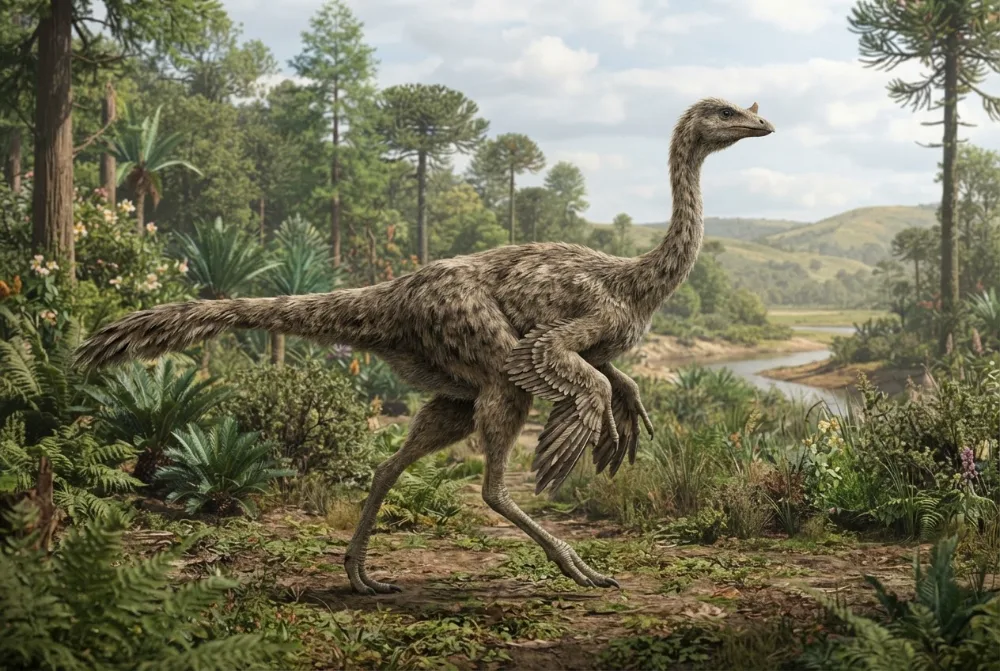
Ornithomimus was a fast, ostrich-like dinosaur that lived in North America during the Late Cretaceous. It had a small toothless beak, long legs, and was covered in downy feathers. Adults even had wings on their arms, which they probably used for showing off to mates.12
Cura viveva el?
Quant grond era el?
Quant lung era el?
Quant aut era el?
Quant grev era el?
 uschè lung sco 4 chauns dal nas a la cua🍌uschè lung sco 21 bananas ina suenter l'autra🍉uschè grev sco 34 melunas🧸uschè grev sco 9 uffants da scoletta🎒uschè grev sco 5 scolars🏃pudess currer 100 meters en 5,1 secundas (il pli spert uman dovra 9,6)
Quant grond era Ornithomimus cumpareglià cun TAI?
Mo matematica en tes navigatur. Nagut na vegn arcunà u tramess.
Quant spert era el?


Fatgs divertents
Ornithomimus was one of the first feathered dinosaurs found in the Western Hemisphere. Paleontologist François Therrien discovered the feathers in 2008.2
Its brain was small and its sense of smell was poor, so it probably relied on its big eyes and good eyesight to find food and avoid danger.2
Young Ornithomimus did not have wings on their arms. Only adults grew the long, stiff feathers that formed wings, which they used for courtship displays.2
Ornithomimus could run very fast thanks to its long, powerful legs and big leg muscles. It probably escaped predators by sprinting away.2
Its fingers had long, straight claws that might have helped it grab branches or dig for food.2
The name Ornithomimus means 'bird mimic' because its feet looked a lot like a bird's feet.1
Las dumondas las pli frequentas davart Ornithomimus
?How big was Ornithomimus?
Ornithomimus measured up to about 4 metres (13 feet) long and weighed up to 170 kilograms (375 pounds).45
?What did Ornithomimus eat?
Ornithomimus was probably an omnivore or plant-eater. It had a toothless beak and may have swallowed stones (gastroliths) to help grind up plants, like many birds do.15
?Did Ornithomimus have feathers?
Yes, Ornithomimus was covered in downy feathers. Adults also had long, stiff feathers on their arms that formed wings, used for display and courtship.15
?How fast could Ornithomimus run?
Ornithomimus could run very fast, probably between 30 and 60 km/h (19 to 37 mph), and maybe even up to 80 km/h (50 mph), as fast as an ostrich.5
?When did Ornithomimus live?
Ornithomimus lived during the Late Cretaceous period, about 74 to 66 million years ago.4
?Where was Ornithomimus found?
Fossils of Ornithomimus have been found in Canada (especially Alberta) and the United States (Colorado, Montana, Wyoming).14
Chatschader da mitus
Mitus: Many people think Ornithomimus was a meat-eater like most other theropod dinosaurs.
Vardad: Ornithomimus had no teeth and a beak, so scientists think it was a plant-eater or an omnivore, not a carnivore.2
Per experts da dinos
- Num scientific
- Ornithomimus
- Numnà da
- Marsh 18906
- Gruppa
- Dinos-struzi
- Famiglia / clada
- Ornithomimidae6
- Classificaziun
- Theropoda > Ornithomimosauria6
- Vegliadetgna da la crappa
- 84 fin 66 milliuns onns (Campanian / Maastrichtian)6
- Formaziuns da crap
- Lance, Horseshoe Canyon, Denver6
- Pajais
- USA, Canada6
- Chats da fossils
- 35 en The Paleobiology Database6
- Scuverta
- The first Ornithomimus fossils were found in Colorado in 1889 by George Lyman Cannon. The famous paleontologist Othniel Charles Marsh named the dinosaur Ornithomimus velox in 1890.1
- Anc discutà
- Scientists are still debating what Ornithomimus ate. Some think it was a plant-eater, others think it ate insects, small animals, and maybe fruit too.12
Danunder che vegnan ils fatgs
- Ornithomimus (en.wikipedia.org)
- Ornithomimus | The Canadian Encyclopedia (thecanadianencyclopedia.ca)
- Ornithomimus — size, diet & habitat | DinoLifePedia (dinolifepedia.com)
- Ornithomimus | Natural History Museum (nhm.ac.uk)
- Ornithomimus | The Canadian Encyclopedia (thecanadianencyclopedia.ca)
- Ornithomimus in The Paleobiology Database (CC BY 4.0): vegliadetgna, lieus, formaziuns da crap, classificaziun.
Mintga fatg sin questa pagina ha in numer che maina tar sia funtauna. Sche nus avain fatg in sbagl, perstgisa, nus essan fans da dinos, betg ina revista scientifica. Scriva a nus sin [email protected] e nus il curregin.
 Rex ha fom! Dino Wiki è in project d'in bab per ses figl che ama ils dinos, gratuit, senza reclama e senza trackers. Ils creschids pon dar ina marenda a Rex per gidar a tegnair la pagina online.Pavlar Rex
 Gallimimus
 Struthiomimus
 Deinocheirus
 Dromiceiomimus
 Archaeornithomimus
 Anserimimus
 Tyrannosaurus
 Triceratops
 Velociraptor
 Spinosaurus
 Ankylosaurus
 Parasaurolophus