 Quiz: Tge dino es ti?
 Cumbat da dinos
 Cursa da dinos
 Mini-gieus da dinos
 Album d'adesivs
 TOP-glistas da dinos
 Ma surprenda!
Pycnonemosaurus
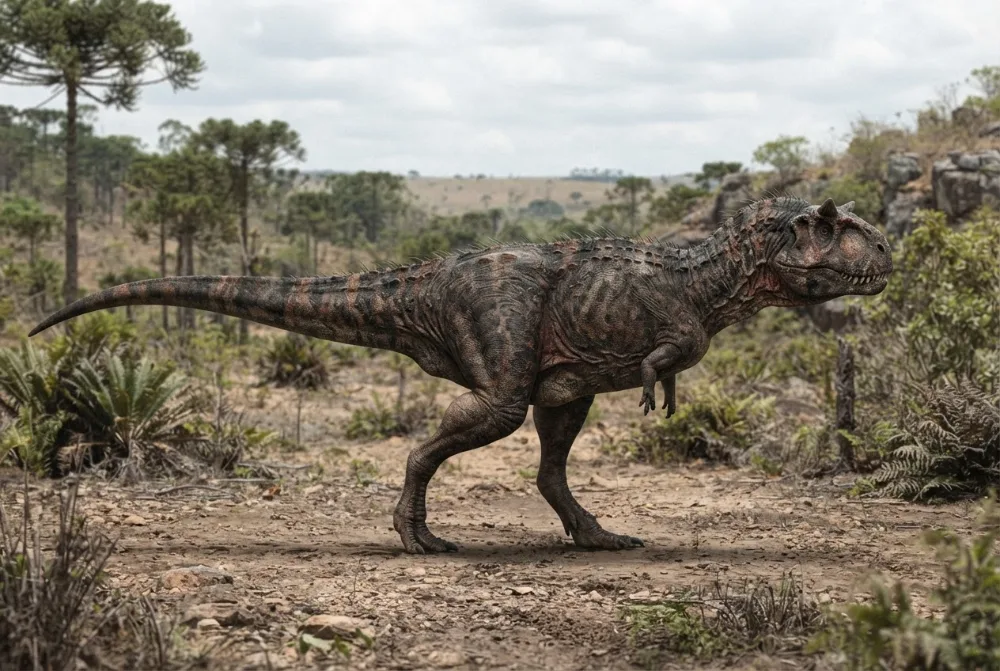
Pycnonemosaurus was a big meat-eating dinosaur with sharp teeth and strong legs. It lived in what is now Brazil, about 72 million years ago. It was one of the largest abelisaurids, a group of short-snouted predators.1
Cura viveva el?
Quant grond era el?
Quant lung era el?
Quant aut era el?
stima
Quant grev era el?
 uschè lung sco 2 autos parcads in suenter l'auter🍌uschè lung sco 50 bananas ina suenter l'autra
 uschè grev sco 180 chauns🍉uschè grev sco 720 melunas🎒uschè grev sco 4 classas da scola entiras🐻❄️uschè grev sco 8 urs polars🏃pudess currer 100 meters en 12 secundas (il pli spert uman dovra 9,6)
Quant grond era Pycnonemosaurus cumpareglià cun TAI?
Mo matematica en tes navigatur. Nagut na vegn arcunà u tramess.
Quant spert era el?


Fatgs divertents
Pycnonemosaurus is the largest formally described abelisaurid, with later estimates reaching about 8.9 metres (29.2 ft) long.1
Its bones were found in red conglomeratic sandstone, and the surface was abraded, meaning the bones were partly exposed before being collected.1
The only known skeleton is incomplete, including five teeth, parts of seven tail vertebrae, a right pubis, a right tibia, and part of a right fibula.12
It had a small pubic foot and a hatchet-shaped cnemial crest on its tibia, which are unique features among abelisaurs.12
The specimen is thought to be from an immature individual, probably a subadult, so adults might have been even larger.1
Its tail vertebrae have fan-shaped transverse processes and forward projections, typical of abelisaurids, but these projections become smaller towards the end of the tail.1
Las dumondas las pli frequentas davart Pycnonemosaurus
?How big was Pycnonemosaurus?
It was about 8.9 metres long and weighed around 3.6 tonnes. That makes it the largest formally described abelisaurid.1
?What did Pycnonemosaurus eat?
It was a predator that probably ate titanosaurs, which were huge long-necked dinosaurs found in the same area. Its small, sharp teeth helped it grip struggling prey.1
?Where was Pycnonemosaurus found?
Its bones were found in Brazil, in the state of Mato Grosso, in red conglomeratic sandstone of the Cachoeira do Bom Jardim Formation.1
?When did Pycnonemosaurus live?
It lived during the Late Cretaceous, about 72 million years ago, in the late Campanian to early Maastrichtian stages.1
?Was Pycnonemosaurus a dinosaur?
Yes, it was a carnivorous theropod dinosaur, part of the group Abelisauridae.1
?Is Pycnonemosaurus bigger than Carnotaurus?
Yes, Pycnonemosaurus was larger. It reached about 8.9 metres long, while Carnotaurus was about 7.8 metres long.3
Chatschader da mitus
Mitus: Pycnonemosaurus was a small dinosaur.
Vardad: It was actually one of the largest abelisaurids, with length estimates up to 9 metres (29.5 ft) and weight up to 3.6 tonnes (4.0 short tons).1
Per experts da dinos
- Num scientific
- Pycnonemosaurus
- Numnà da
- Kellner and Campos 20024
- Gruppa
- Dinos carnivors
- Famiglia / clada
- Abelisauridae4
- Classificaziun
- Theropoda > Ceratosauria > Abelisauridae4
- Vegliadetgna da la crappa
- 100 fin 66 milliuns onns (Cenomanian / Maastrichtian)4
- Pajais
- Brasilia4
- Chats da fossils
- 1 en The Paleobiology Database4
- Scuverta
- The fossils were collected in 1952 to 1953 by Llewellyn Ivor Price at a farm called Roncador in Mato Grosso, Brazil. The species was named by Kellner and Campos in 2002.14
- Anc discutà
- Scientists are not sure about its exact size because the only skeleton is incomplete and from a young individual, so estimates range from 6 to 9 metres long.1
Danunder che vegnan ils fatgs
- Pycnonemosaurus (en.wikipedia.org)
- On a theropod dinosaur (Abelisauria) from the continental Cretaceous of Brazil (eurekamag.com)
- Allometry and body length of abelisauroid theropods: Pycnonemosaurus nevesi is the new king (sciencedirect.com)
- Pycnonemosaurus in The Paleobiology Database (CC BY 4.0): vegliadetgna, lieus, formaziuns da crap, classificaziun.
Mintga fatg sin questa pagina ha in numer che maina tar sia funtauna. Sche nus avain fatg in sbagl, perstgisa, nus essan fans da dinos, betg ina revista scientifica. Scriva a nus sin [email protected] e nus il curregin.
 Rex ha fom! Dino Wiki è in project d'in bab per ses figl che ama ils dinos, gratuit, senza reclama e senza trackers. Ils creschids pon dar ina marenda a Rex per gidar a tegnair la pagina online.Pavlar Rex
 Allosaurus
 Carnotaurus
 Dilophosaurus
 Giganotosaurus
 Compsognathus
 Paronychodon
 Tyrannosaurus
 Triceratops
 Velociraptor
 Spinosaurus
 Ankylosaurus
 Parasaurolophus