 Quiz: Tge dino es ti?
 Cumbat da dinos
 Cursa da dinos
 Mini-gieus da dinos
 Album d'adesivs
 TOP-glistas da dinos
 Ma surprenda!
Sabre-toothed cat
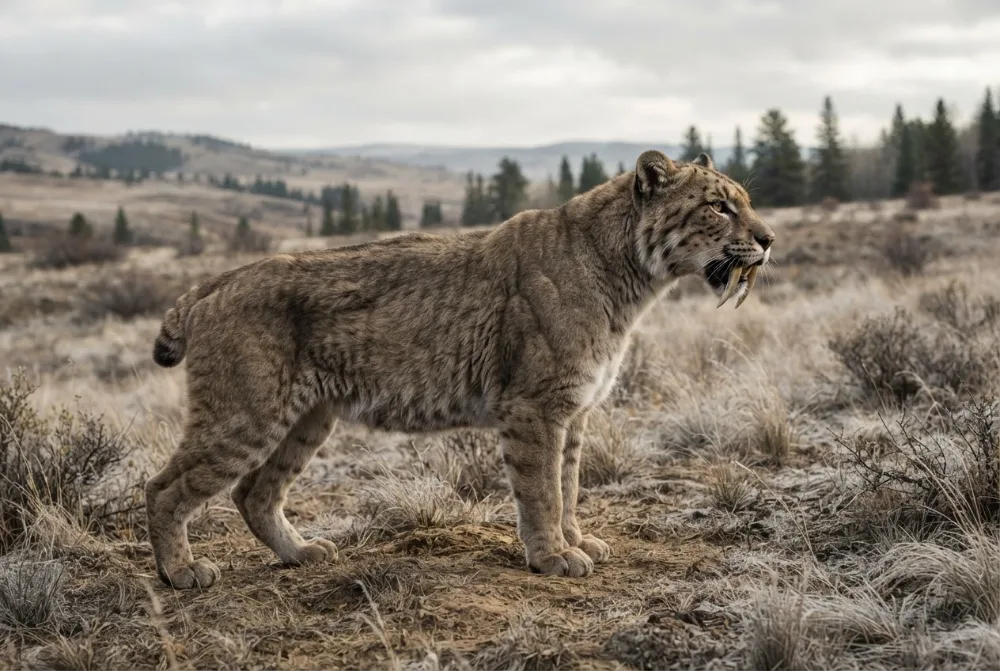
Smilodon was a powerful, prehistoric cat with huge, blade-like canine teeth. It is often called the saber-toothed tiger, but it was not a tiger at all. This fierce hunter lived in the Americas during the Ice Age.1
Cura viveva el?
Quant grond era el?
Quant lung era el?
Quant aut era el?
Quant grev era el?
 uschè lung sco 2,5 chauns dal nas a la cua🍌uschè lung sco 14 bananas ina suenter l'autra🍉uschè grev sco 56 melunas🧸uschè grev sco 15 uffants da scoletta🎒uschè grev sco 9 scolars🏃pudess currer 100 meters en 7,2 secundas (il pli spert uman dovra 9,6)
Quant grond era Sabre-toothed cat cumpareglià cun TAI?
Mo matematica en tes navigatur. Nagut na vegn arcunà u tramess.
Quant spert era el?


Fatgs divertents
Smilodon had the longest canine teeth of any saber-toothed cat, reaching up to 28 centimeters (11 inches) long in the largest species, S. populator.1
Thousands of Smilodon fossils have been found in the La Brea Tar Pits in Los Angeles, California, making it the most complete record of the genus.1
Despite its nickname 'saber-toothed tiger', Smilodon is not closely related to modern tigers. Its ancestors split from the line leading to living cats about 20 million years ago.1
Smilodon had a short tail, unlike modern big cats like lions and tigers, which have long tails for balance.1
Scientists think Smilodon may have lived in social groups, like modern lions, because many fossils of the same species are found together in the tar pits.1
Smilodon went extinct around 8,200 years ago, at the end of the last Ice Age, possibly due to climate change and the loss of its large prey.1
The three recognized species of Smilodon are S. gracilis (the smallest), S. fatalis (medium-sized, from North America), and S. populator (the largest, from South America).1
Las dumondas las pli frequentas davart Sabre-toothed cat
?How big was Smilodon?
About 1 metre (3.3 feet) tall at the shoulder and 1.75 metres (5.7 feet) long. It weighed between 160 and 280 kilograms (350 to 620 pounds). The largest species, S. populator, was even bigger at 1.2 metres (3.9 feet) tall and up to 470 kilograms (1,040 pounds).13
?Could Smilodon roar?
Yes, scientists think it could roar. Its hyoid bones (in the throat) were similar to those of modern roaring cats like lions.34
?What did Smilodon eat?
It ate large plant-eaters like bison, camels, ground sloths and horses. It was an ambush predator that grabbed prey with its strong forelimbs and used its long canine teeth for a precision bite.13
?Did Smilodon live in groups?
Scientists are not sure, but fossils of injured animals that healed suggest they may have lived in social groups like lions. However, some researchers think they were solitary.143
?How fast could Smilodon run?
Maybe up to about 50 km/h (31 mph) in a short sprint. This is an estimate: nobody knows for sure. It was slower than a lion, with a heavy, muscular body and a short tail, so it was an ambush hunter, not a long chaser.43
?When did Smilodon go extinct?
Around 8,200 years ago, at the end of the last Ice Age. It died out as part of a mass extinction of large animals in the Americas.14
?Where did Smilodon live?
It lived in North America and South America during the Ice Age. Thousands of fossils have been found in the La Brea Tar Pits in Los Angeles, California.13
?Why did Smilodon have such long teeth?
The long canine teeth (up to 28 cm or 11 inches) were used to deliver a precise, deep bite to the throat or belly of large prey. They were slender and fragile, so Smilodon had a very wide gape to avoid breaking them.13
?Is Smilodon a dinosaur?
No, it is a prehistoric mammal and a saber-toothed cat. It lived long after the dinosaurs went extinct, during the Ice Age.13
?How strong was Smilodon's bite?
Its bite was not as strong as that of a modern lion, but it could open its mouth very wide (over 120 degrees) to stab with its long canine teeth. It used powerful forelimbs to hold prey still while biting.1
Chatschader da mitus
Mitus: Many people think Smilodon was a tiger.
Vardad: Smilodon was not a tiger. It belonged to a different, extinct group of cats called machairodonts, which had longer canine teeth and a different body shape.1
Per experts da dinos
- Num scientific
- Smilodon
- Numnà da
- Lund 18415
- Gruppa
- Legendas preistoricas
- Famiglia / clada
- Felidae5
- Classificaziun
- Mammalia > Carnivora > Felidae5
- Vegliadetgna da la crappa
- 4,7 fin 0,01 milliuns onns (Zanclean / Holocene)5
- Formaziuns da crap
- Palm Spring, Miramar5
- Pajais
- USA, Brasilia, Argentinia, Mexico, Germania, Bolivia5
- Chats da fossils
- 143 en The Paleobiology Database5
- Scuverta
- Smilodon was first named in 1842 by Danish naturalist Peter Wilhelm Lund, based on fossils he found in caves in Brazil.12
- Anc discutà
- Scientists still debate whether Smilodon was a social animal that lived in groups or a solitary hunter, because the evidence from the La Brea Tar Pits can be interpreted both ways.1
Danunder che vegnan ils fatgs
- Smilodon - Wikipedia (en.wikipedia.org)
- PBDB Taxon (paleobiodb.org)
- The Big Cats (U.S. National Park Service) (nps.gov)
- Saber-Toothed Cats (ucmp.berkeley.edu)
- Sabre-toothed cat in The Paleobiology Database (CC BY 4.0): vegliadetgna, lieus, formaziuns da crap, classificaziun.
Mintga fatg sin questa pagina ha in numer che maina tar sia funtauna. Sche nus avain fatg in sbagl, perstgisa, nus essan fans da dinos, betg ina revista scientifica. Scriva a nus sin [email protected] e nus il curregin.
 Rex ha fom! Dino Wiki è in project d'in bab per ses figl che ama ils dinos, gratuit, senza reclama e senza trackers. Ils creschids pon dar ina marenda a Rex per gidar a tegnair la pagina online.Pavlar Rex
 Megalodon
 Dimetrodon
 Woolly mammoth
 Arthropleura
 Helicoprion
 Deinosuchus