 Quiz: Tge dino es ti?
 Cumbat da dinos
 Cursa da dinos
 Mini-gieus da dinos
 Album d'adesivs
 TOP-glistas da dinos
 Ma surprenda!
Tsintaosaurus
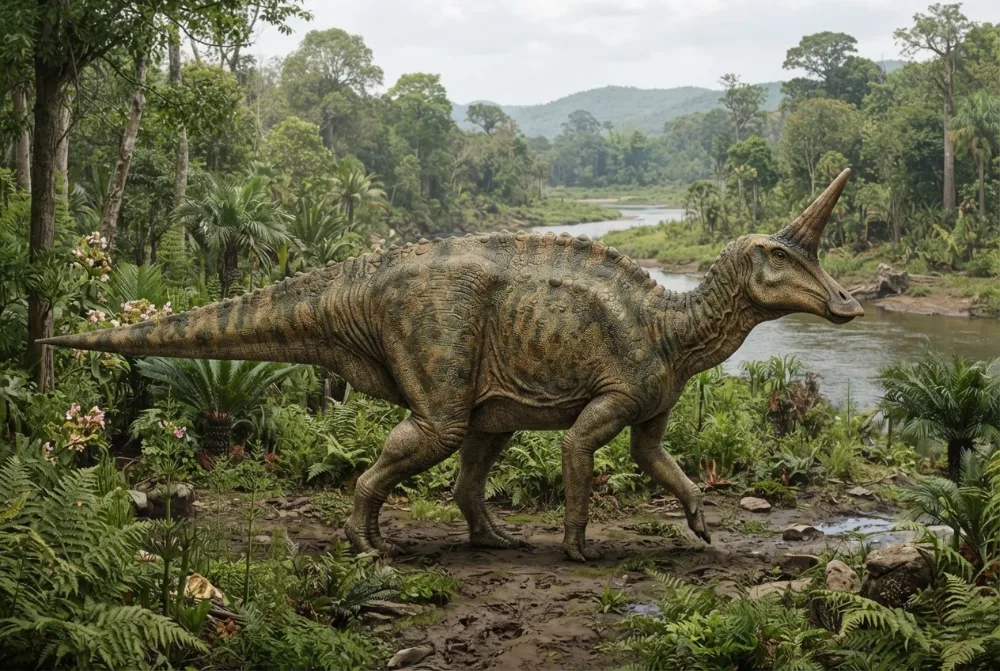
Tsintaosaurus was a duck-billed dinosaur that lived in China during the Late Cretaceous. It had a strange, hollow crest on its head that looked a bit like a unicorn horn. This plant-eater could walk on four legs or run on two to escape predators.21
Cura viveva el?
Quant grond era el?
Quant lung era el?
Quant aut era el?
Quant grev era el?
 uschè lung sco 2,5 autos parcads in suenter l'auter🍌uschè lung sco 67 bananas ina suenter l'autra
 uschè grev sco 120 chauns🍉uschè grev sco 500 melunas🎒uschè grev sco 3 classas da scola entiras🐻❄️uschè grev sco 6 urs polars🏃pudess currer 100 meters en 14 secundas (il pli spert uman dovra 9,6)
Quant grond era Tsintaosaurus cumpareglià cun TAI?
Mo matematica en tes navigatur. Nagut na vegn arcunà u tramess.
Quant spert era el?


Fatgs divertents
Tsintaosaurus was first thought to have a unicorn-like horn, but scientists now think the crest was actually part of a larger, hollow structure on its snout.2
The crest was hollow and may have been used to make loud honking sounds to communicate with other Tsintaosaurus.2
It lived about 84 to 71 million years ago, during the Campanian stage of the Late Cretaceous.1
Tsintaosaurus is known from skulls and a partial skeleton, so scientists are still learning about its body.1
Like other hadrosaurs, Tsintaosaurus probably traveled in herds for protection.2
The name Tsintaosaurus comes from the old spelling of Qingdao, the city near where it was found.2
Las dumondas las pli frequentas davart Tsintaosaurus
?How big was Tsintaosaurus?
About 8.3 metres (27 feet) long and weighed 2.5 tonnes (2.8 short tons), according to Wikipedia. The Natural History Museum gives a length of 12.0 metres, so estimates vary.21
?What did Tsintaosaurus eat?
It was a plant-eater. It had a duck-like beak and strong teeth for chewing vegetation.21
?Why did Tsintaosaurus have a crest?
The crest was hollow and may have been used to make loud honking sounds to communicate. It might also have helped attract mates, and the hollow tube made the crest lighter.24
?Could Tsintaosaurus swim?
It had a large tail that may have helped it swim, according to the Australian Museum. It probably lived near lakes and rivers.4
Chatschader da mitus
Mitus: Tsintaosaurus had a single, solid horn like a unicorn.
Vardad: The crest was actually hollow and was the back part of a larger, flat crest that ran from the tip of the snout.2
Per experts da dinos
- Num scientific
- Tsintaosaurus
- Numnà da
- Young 19585
- Gruppa
- Pichels d'anda
- Famiglia / clada
- Hadrosauridae5
- Classificaziun
- Ornithischia > Ornithopoda > Iguanodontia > Hadrosauridae5
- Vegliadetgna da la crappa
- 84 fin 72 milliuns onns (Campanian)5
- Formaziuns da crap
- Jingangkou5
- Pajais
- China5
- Chats da fossils
- 4 en The Paleobiology Database5
- Scuverta
- Chinese paleontologist C. C. Young named Tsintaosaurus in 1958 after fossils were found near Laiyang, Shandong, China.21
- Anc discutà
- Scientists still debate the exact shape and function of Tsintaosaurus's head crest, because only a few fossils have been found.2
Danunder che vegnan ils fatgs
- Tsintaosaurus | Natural History Museum (nhm.ac.uk)
- Tsintaosaurus (en.wikipedia.org)
- Tsintaosaurus: Discover more about this Dinosaur | Dinosaurland (dinosaurland.es)
- Dinosaurs - Tsintaosaurus spinorhinus - The Australian Museum (australian.museum)
- Tsintaosaurus in The Paleobiology Database (CC BY 4.0): vegliadetgna, lieus, formaziuns da crap, classificaziun.
Mintga fatg sin questa pagina ha in numer che maina tar sia funtauna. Sche nus avain fatg in sbagl, perstgisa, nus essan fans da dinos, betg ina revista scientifica. Scriva a nus sin [email protected] e nus il curregin.
 Rex ha fom! Dino Wiki è in project d'in bab per ses figl che ama ils dinos, gratuit, senza reclama e senza trackers. Ils creschids pon dar ina marenda a Rex per gidar a tegnair la pagina online.Pavlar Rex
 Parasaurolophus
 Edmontosaurus
 Saurolophus
 Hypacrosaurus
 Corythosaurus
 Kritosaurus
 Tyrannosaurus
 Triceratops
 Velociraptor
 Spinosaurus
 Ankylosaurus
 Pteranodon