 Uri dinozore iyihe? Umukino w'ibibazo
 Intambara ya dinozore
 Isiganwa rya dinozore
 Imikino mito ya dinozore
 Alubumu ya sitikeri
 Intonde za TOP za dinozore
 Ntungura!
Alaskacephale
Alaskacephale was a small, dome-headed dinosaur that lived in the cold Arctic of ancient Alaska. It had a thick, bony skull with two rows of bumps along the back of its head. This plant-eater was one of the few dinosaurs that lived near the North Pole.1
Yabayeho ryari?
Yanganaga ite?
Yari ndende ite?
Yari iremereye ite?
 ndende nk'injangwe 3 zo mu rugo zikurikiranye🍌ndende nk'imineke 8 ikurikiranye🍌iremereye nk'imineke 83🏃yashoboraga kwiruka metero 100 mu masegonda 11 (umuntu wihuta kurusha abandi akenera 9,6)
Alaskacephale yanganaga ite ugereranyije NAWE?
Ni imibare gusa ibarirwa muri mushakisha yawe. Nta kintu kibikwa cyangwa cyoherezwa ahandi.
Yihutaga ite?


Utuntu dushimishije
Alaskacephale lived about 70 to 69 million years ago, during the Maastrichtian stage of the Late Cretaceous.1
Only one fossil of Alaskacephale has been found: a piece of skull bone called a squamosal.1
The skull had two rows of bony bumps that helped scientists tell it apart from other dome-headed dinosaurs.1
Alaskacephale lived in a cold Arctic environment with winter darkness for 120 days and temperatures as low as -2°C (28°F).1
It shared its home with other dinosaurs like the horned Pachyrhinosaurus, the duck-billed Edmontosaurus, and the tyrannosaur Nanuqsaurus.1
Alaskacephale was about half the size of its relative Pachycephalosaurus, making it one of the smaller pachycephalosaurs.1
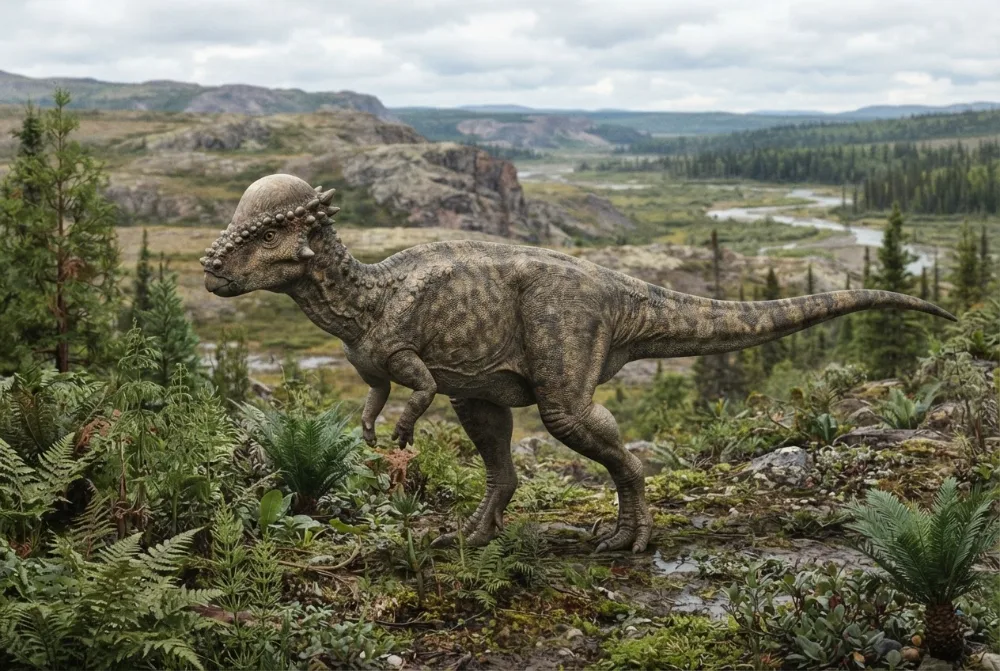
Ibibazo bibazwa cyane kuri Alaskacephale
?How big was Alaskacephale?
About 1.5 metres long and 10 kilograms, based on a similarly sized relative. It was one of the smaller pachycephalosaurs.1
?What did Alaskacephale eat?
It was a plant-eater, like all dome-headed dinosaurs.1
?When did Alaskacephale live?
It lived about 72 to 71 million years ago, during the Late Cretaceous (Maastrichtian stage).1
?Is Alaskacephale a dinosaur?
Yes, it is a dome-headed dinosaur (a pachycephalosaur).1
?Why did Alaskacephale have a thick skull?
The thick, bony dome on its skull might have been used for head-butting or for display, but scientists are not sure.1
?Did Alaskacephale have feathers?
Nobody knows for sure. No fossil feathers have been found with Alaskacephale, and it is not known if pachycephalosaurs had feathers.1
Ku bazobereye muri dinozore
- Izina rya siyansi
- Alaskacephale
- Yiswe na
- Sullivan 20062
- Itsinda
- Imitwe y'ikibumbe
- Umuryango / ishami
- Pachycephalosauridae2
- Ishyirwa mu byiciro
- Ornithischia > Pachycephalosauria2
- Imyaka y'amabuye
- imyaka miliyoni 72 kugeza 66 (Maastrichtian)2
- Inzego z'amabuye
- Prince Creek2
- Ibihugu
- Amerika2
- Ibisigazwa byanditswe
- 1 muri The Paleobiology Database2
- Ivumburwa
- The only fossil was found in 1999 by a University of Alaska expedition on the Colville River. It was named Alaskacephale gangloffi in 2006 by paleontologist Robert Sullivan, honoring the earlier researcher Roland Gangloff.1
- Biracyagibwaho impaka
- Scientists are not sure exactly how big Alaskacephale was, because only a skull fragment has been found.1
Aho amakuru yakuwe
- Alaskacephale (en.wikipedia.org)
- Alaskacephale in The Paleobiology Database (CC BY 4.0): imyaka, ahantu, inzego z'amabuye, ishyirwa mu byiciro.
Buri kintu kiri kuri uru rupapuro gifite nimero yerekana aho cyakuwe. Niba hari icyo twibeshye, tubabarire, turi abakunzi ba dinozore, ntituri ikinyamakuru cya siyansi. Tubwire kuri [email protected] tuzagikosora.
 Rex arashonje! Dino Wiki ni umushinga wa papa umwe yakoreye umuhungu we ukunda dinozore, ni ubuntu, nta matangazo kandi nta bigukurikirana. Abantu bakuru bashobora guha Rex akantu ko kurya kugira ngo Dino Wiki ikomeze kuboneka kuri interineti.Gaburira Rex
 Pachycephalosaurus
 Stegoceras
 Prenocephale
 Sphaerotholus
 Foraminacephale
 Brontotholus
 Tyrannosaurus
 Triceratops
 Velociraptor
 Spinosaurus
 Ankylosaurus
 Parasaurolophus