 Uri dinozore iyihe? Umukino w'ibibazo
 Intambara ya dinozore
 Isiganwa rya dinozore
 Imikino mito ya dinozore
 Alubumu ya sitikeri
 Intonde za TOP za dinozore
 Ntungura!
Anchiceratops
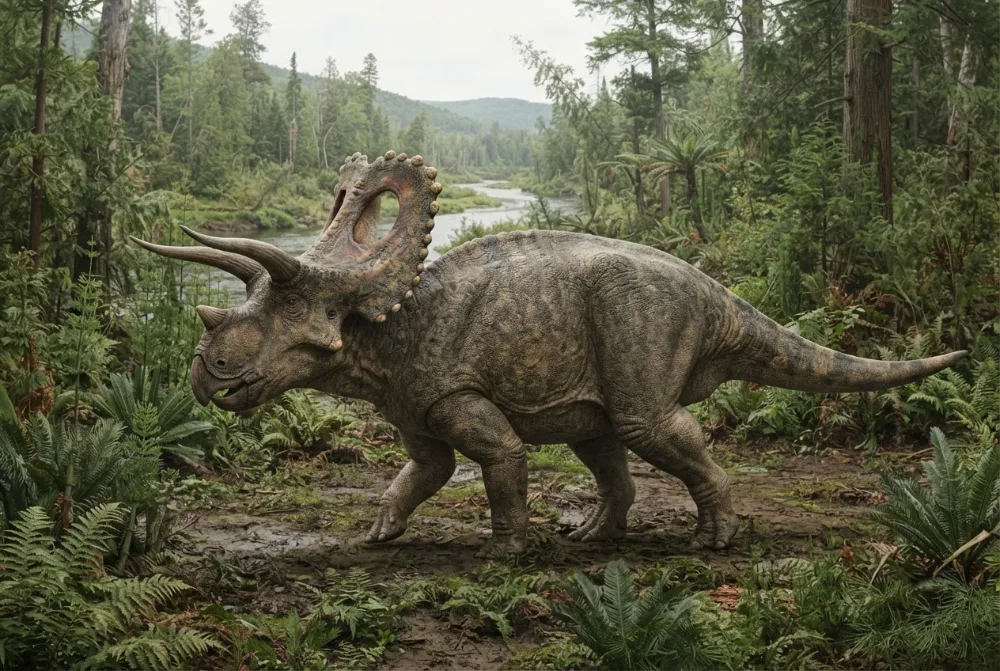
Anchiceratops was a horned dinosaur that lived in Canada about 73 to 68 million years ago. It had two long horns above its eyes and a short horn on its nose. Its frill was long and rectangular with bumpy edges.1
Yabayeho ryari?
Yanganaga ite?
Yari ndende ite?
Ubutumburuke bwayo bwanganaga iki?
igereranya
Yari iremereye ite?
 ndende nk'imbwa 6 zikurikiranye🍌ndende nk'imineke 33 ikurikiranye🍉iremereye nk'imbuto 240 za watermelon🧸iremereye nk'abana 63 bo mu ishuri ry'incuke🎒iremereye nk'abanyeshuri 38🐻❄️iremereye nk'idubu 2,5 zo mu rubura🏃yashoboraga kwiruka metero 100 mu masegonda 9,5 (umuntu wihuta kurusha abandi akenera 9,6)
Anchiceratops yanganaga ite ugereranyije NAWE?
Ni imibare gusa ibarirwa muri mushakisha yawe. Nta kintu kibikwa cyangwa cyoherezwa ahandi.
Yihutaga ite?


Utuntu dushimishije
Anchiceratops is rare compared to other horned dinosaurs in the same area, and its fossils are often found near ancient marine sediments.1
The name Anchiceratops means 'near horned face' because Barnum Brown thought it was a close relative of Triceratops.1
Its frill had coarse triangular projections along the edge, which is why the species name ornatus means 'ornate'.1
Anchiceratops lived in estuaries and coastal areas, where other ceratopsids did not live.1
The first fossils were found along the Red Deer River in Alberta, Canada, in 1912 by an expedition led by Barnum Brown.1
Anchiceratops shared its environment with dinosaurs like Albertosaurus, Edmontosaurus, and Pachyrhinosaurus.1
Ibibazo bibazwa cyane kuri Anchiceratops
?How big was Anchiceratops?
About 4.3 metres long and weighed around 1.2 tonnes.1
?What did Anchiceratops eat?
It was a herbivore, eating plants like conifers, cycads, and ferns.1
?Could Anchiceratops swim?
Some scientists think it may have lived in swamps and estuaries like a hippopotamus, but others disagree.1
?Why did Anchiceratops have a frill?
Probably for display and to recognize other members of its species, not for defense.1
?How many horns did Anchiceratops have?
Three: two long horns above its eyes and a short horn on its nose.1
Ku bazobereye muri dinozore
- Izina rya siyansi
- Anchiceratops
- Yiswe na
- Brown 19143
- Itsinda
- Dinozore zifite amahembe
- Umuryango / ishami
- Ceratopsidae3
- Ishyirwa mu byiciro
- Ornithischia > Ceratopsia > Ceratopsidae3
- Imyaka y'amabuye
- imyaka miliyoni 84 kugeza 66 (Campanian / Maastrichtian)3
- Inzego z'amabuye
- Horseshoe Canyon, St. Mary River3
- Ibihugu
- Kanada3
- Ibisigazwa byanditswe
- 7 muri The Paleobiology Database3
- Ivumburwa
- Anchiceratops was named by American paleontologist Barnum Brown in 1914. He found the first fossils in 1912 along the Red Deer River in Alberta, Canada.1
- Biracyagibwaho impaka
- Scientists still debate whether some frill fragments from older rock formations belong to Anchiceratops or to a different, related species.1
Aho amakuru yakuwe
- Anchiceratops (en.wikipedia.org)
- Anchiceratops | Natural History Museum (nhm.ac.uk)
- Anchiceratops in The Paleobiology Database (CC BY 4.0): imyaka, ahantu, inzego z'amabuye, ishyirwa mu byiciro.
Buri kintu kiri kuri uru rupapuro gifite nimero yerekana aho cyakuwe. Niba hari icyo twibeshye, tubabarire, turi abakunzi ba dinozore, ntituri ikinyamakuru cya siyansi. Tubwire kuri [email protected] tuzagikosora.
 Rex arashonje! Dino Wiki ni umushinga wa papa umwe yakoreye umuhungu we ukunda dinozore, ni ubuntu, nta matangazo kandi nta bigukurikirana. Abantu bakuru bashobora guha Rex akantu ko kurya kugira ngo Dino Wiki ikomeze kuboneka kuri interineti.Gaburira Rex
 Triceratops
 Protoceratops
 Ojoceratops
 Tatankaceratops
 Psittacosaurus
 Centrosaurus
 Tyrannosaurus
 Velociraptor
 Spinosaurus
 Ankylosaurus
 Parasaurolophus
 Pteranodon