 Uri dinozore iyihe? Umukino w'ibibazo
 Intambara ya dinozore
 Isiganwa rya dinozore
 Imikino mito ya dinozore
 Alubumu ya sitikeri
 Intonde za TOP za dinozore
 Ntungura!
Argentinonectes
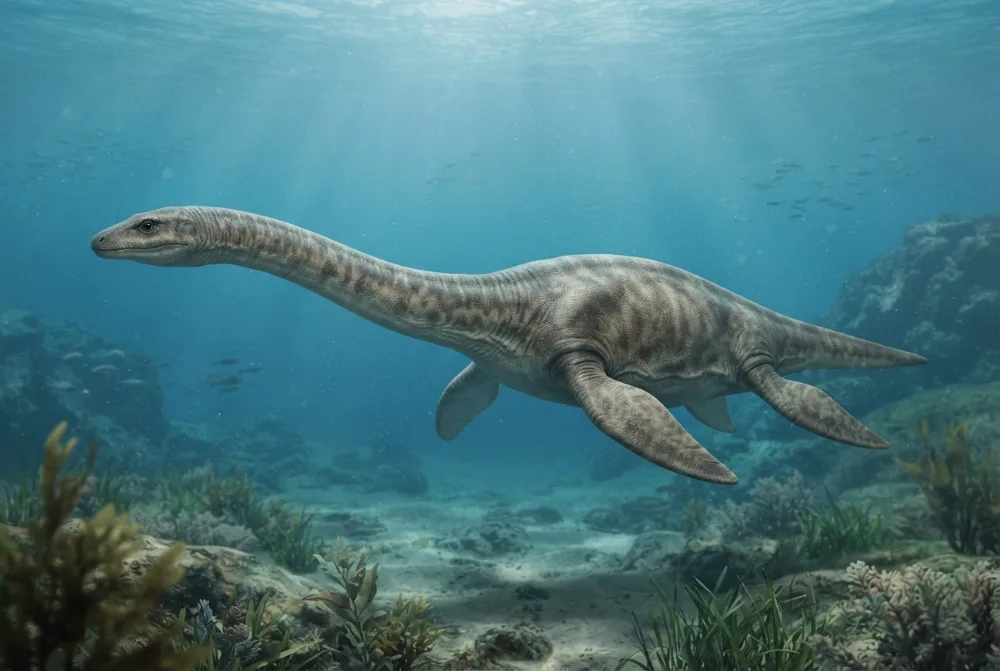
Argentinonectes was a huge, long-necked marine reptile that swam in the seas near Antarctica 66 million years ago. It had four flipper-like legs and a stiff tail that may have had a fin on the end. This plesiosaur is the most complete one ever found in Argentina!1
Yabayeho ryari?
Yanganaga ite?
Yari ndende ite?
 ndende nk'imodoka 2 ziparitse ku murongo🍌ndende nk'imineke 50 ikurikiranye🏊yashoboraga koga uburebure bwa pisine nini (50 m) mu masegonda 7,8
Argentinonectes yanganaga ite ugereranyije NAWE?
Ni imibare gusa ibarirwa muri mushakisha yawe. Nta kintu kibikwa cyangwa cyoherezwa ahandi.
Yihutaga ite?


Utuntu dushimishije
The fossil was found under 50 cm (20 inches) of water in Lake Argentino, making it tricky to dig out.1
Its rib cage and belly bones were very stiff, which helped it dive without its lungs collapsing.1
Shark teeth and scratches on its bones show that sharks ate the dead plesiosaur's body.1
The tail had eight tightly locked vertebrae at the tip, probably supporting a small tail fin.1
Its forelimbs were about 1.8 metres (5.9 feet) long, and the hindlimbs were a bit shorter at 1.3 metres (4.3 feet).1
The skeleton is missing the skull and most of the neck, possibly because they floated away after death.1
Ibibazo bibazwa cyane kuri Argentinonectes
?How big was Argentinonectes?
It was about 7 to 9 metres (23 to 30 feet) long. That is roughly as long as a school bus.1
?What did Argentinonectes eat?
Scientists do not know for sure because the skull is missing. But like other plesiosaurs, it probably ate fish and squid.1
?When did Argentinonectes live?
It lived at the very end of the Cretaceous Period, about 66 million years ago.1
?Is Argentinonectes a dinosaur?
No, it is a plesiosaur, a marine reptile that swam in the ocean. It is not a dinosaur.1
Gusenya ibinyoma
Ibivugwa: Some people think all plesiosaurs were slow and clumsy on land.
Ukuri: Argentinonectes and other plesiosaurs were fully aquatic and never came onto land. They were fast swimmers in the ocean.1
Ku bazobereye muri dinozore
- Izina rya siyansi
- Argentinonectes
- Yiswe na
- Novas et al. 20263
- Itsinda
- Plesiyozore
- Umuryango / ishami
- Elasmosauridae3
- Ishyirwa mu byiciro
- Plesiosauria > Elasmosauridae > Sauropterygia3
- Imyaka y'amabuye
- imyaka miliyoni 72 kugeza 66 (Maastrichtian)3
- Inzego z'amabuye
- Calafate3
- Ibihugu
- Arijantine3
- Ibisigazwa byanditswe
- 1 muri The Paleobiology Database3
- Ivumburwa
- The fossil was found in 2009 in Lake Argentino, Argentina, and was named Argentinonectes calafatensis by Fernando Novas and colleagues in 2026.1
- Biracyagibwaho impaka
- Scientists are not sure why the skull and neck are missing. They may have been eroded by waves or detached when the body bloated and floated.1
Aho amakuru yakuwe
- Argentinonectes (en.wikipedia.org)
- PBDB Taxon (paleobiodb.org)
- Argentinonectes in The Paleobiology Database (CC BY 4.0): imyaka, ahantu, inzego z'amabuye, ishyirwa mu byiciro.
Buri kintu kiri kuri uru rupapuro gifite nimero yerekana aho cyakuwe. Niba hari icyo twibeshye, tubabarire, turi abakunzi ba dinozore, ntituri ikinyamakuru cya siyansi. Tubwire kuri [email protected] tuzagikosora.
 Rex arashonje! Dino Wiki ni umushinga wa papa umwe yakoreye umuhungu we ukunda dinozore, ni ubuntu, nta matangazo kandi nta bigukurikirana. Abantu bakuru bashobora guha Rex akantu ko kurya kugira ngo Dino Wiki ikomeze kuboneka kuri interineti.Gaburira Rex
 Elasmosaurus
 Pliosaurus
 Plesiosaurus
 Cimoliasaurus
 Colymbosaurus
 Trinacromerum
 Tyrannosaurus
 Triceratops
 Velociraptor
 Spinosaurus
 Ankylosaurus
 Parasaurolophus