 Uri dinozore iyihe? Umukino w'ibibazo
 Intambara ya dinozore
 Isiganwa rya dinozore
 Imikino mito ya dinozore
 Alubumu ya sitikeri
 Intonde za TOP za dinozore
 Ntungura!
Yabayeho ryari?

Yanganaga ite?
Yari ndende ite?
Ubutumburuke bwayo bwanganaga iki?
igereranya
Yari iremereye ite?

 ndende nk'injangwe 3 zo mu rugo zikurikiranye🍌ndende nk'imineke 8 ikurikiranyeiremereye nk'injangwe 11 zo mu rugo🍉iremereye nk'imbuto 9 za watermelon🧸iremereye nk'abana 2,5 bo mu ishuri ry'incuke🎒iremereye nk'abanyeshuri 1,5🏃yashoboraga kwiruka metero 100 mu masegonda 10 (umuntu wihuta kurusha abandi akenera 9,6)
Bagaceratops yanganaga ite ugereranyije NAWE?
Ni imibare gusa ibarirwa muri mushakisha yawe. Nta kintu kibikwa cyangwa cyoherezwa ahandi.
Yihutaga ite?


Utuntu dushimishije
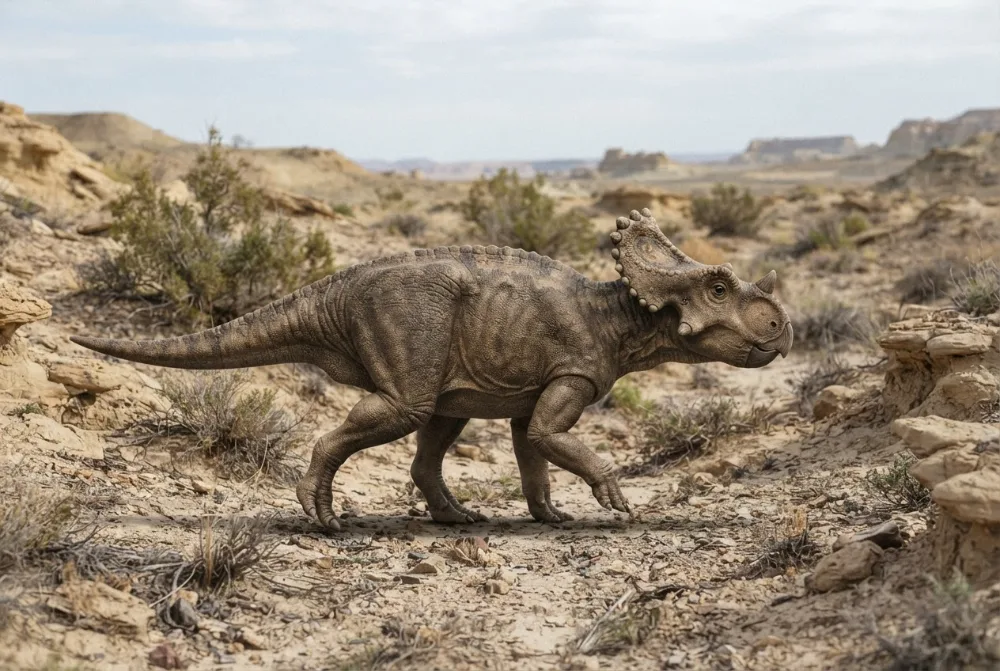
Bagaceratops had no teeth at the front of its upper jaw, unlike its relative Protoceratops.1
It lived about 72 to 71 million years ago, near the end of the age of dinosaurs.1
Scientists once thought that fossils of Bagaceratops were several different dinosaurs, like Gobiceratops and Magnirostris, but now they think those are just Bagaceratops.1
Bagaceratops had a small frill on its head, much smaller than the frills of later horned dinosaurs.1
Its skull was more triangular than that of its close cousin Protoceratops.1
Ibibazo bibazwa cyane kuri Bagaceratops
?How big was Bagaceratops?
Bagaceratops was about 1 to 1.5 metres (3.3 to 4.9 feet) long and weighed around 22 to 45 kilograms (49 to 99 pounds). It was one of the smallest horned dinosaurs.12
?What did Bagaceratops eat?
Bagaceratops was an herbivore, meaning it ate plants. It used its parrot-like beak to chomp on plants and had about ten grinding teeth per jaw to chew them.12
?Where did Bagaceratops live?
Bagaceratops lived in Asia, in what is now the Gobi Desert in Mongolia. Its fossils have been found in the Barun Goyot Formation and Bayan Mandahu Formation.12
?When did Bagaceratops live?
Bagaceratops lived during the Late Cretaceous Period, about 72 to 71 million years ago. That was near the very end of the age of dinosaurs.12
?Did Bagaceratops have horns?
Bagaceratops did not have large horns like Triceratops. Its name means 'small-horned face,' and it had a small frill on its head but no big horns.1
Ku bazobereye muri dinozore
- Izina rya siyansi
- Bagaceratops
- Yiswe na
- Maryanska and Osmólska 19753
- Itsinda
- Dinozore zifite amahembe
- Umuryango / ishami
- Protoceratopsidae3
- Ishyirwa mu byiciro
- Ornithischia > Ceratopsia3
- Imyaka y'amabuye
- imyaka miliyoni 84 kugeza 66 (Campanian / Maastrichtian)3
- Inzego z'amabuye
- Baruungoyot, Djadokhta, Bayan Mandahu3
- Ibihugu
- Mongoliya, Ubushinwa3
- Ibisigazwa byanditswe
- 18 muri The Paleobiology Database3
- Izwi kandi ku izina rya
- Gobiceratops, Lamaceratops, Magnirostris, Platyceratops (amazina ya kera ubu abarwa nk'inyamaswa imwe)3
- Ivumburwa
- Bagaceratops was named in 1975 by Polish paleontologists Teresa Maryańska and Halszka Osmólska, based on fossils found in the Gobi Desert during the Polish-Mongolian expeditions.12
- Biracyagibwaho impaka
- Scientists are still debating whether some other ceratopsians, like Breviceratops, are really a separate genus or just Bagaceratops.1
Aho amakuru yakuwe
- Bagaceratops (en.wikipedia.org)
- Bagaceratops | Natural History Museum (nhm.ac.uk)
- Bagaceratops in The Paleobiology Database (CC BY 4.0): imyaka, ahantu, inzego z'amabuye, ishyirwa mu byiciro.
Buri kintu kiri kuri uru rupapuro gifite nimero yerekana aho cyakuwe. Niba hari icyo twibeshye, tubabarire, turi abakunzi ba dinozore, ntituri ikinyamakuru cya siyansi. Tubwire kuri [email protected] tuzagikosora.
 Rex arashonje! Dino Wiki ni umushinga wa papa umwe yakoreye umuhungu we ukunda dinozore, ni ubuntu, nta matangazo kandi nta bigukurikirana. Abantu bakuru bashobora guha Rex akantu ko kurya kugira ngo Dino Wiki ikomeze kuboneka kuri interineti.Gaburira Rex
 Triceratops
 Protoceratops
 Ojoceratops
 Tatankaceratops
 Psittacosaurus
 Centrosaurus
 Tyrannosaurus
 Velociraptor
 Spinosaurus
 Ankylosaurus
 Parasaurolophus
 Pteranodon