 Uri dinozore iyihe? Umukino w'ibibazo
 Intambara ya dinozore
 Isiganwa rya dinozore
 Imikino mito ya dinozore
 Alubumu ya sitikeri
 Intonde za TOP za dinozore
 Ntungura!
Beg
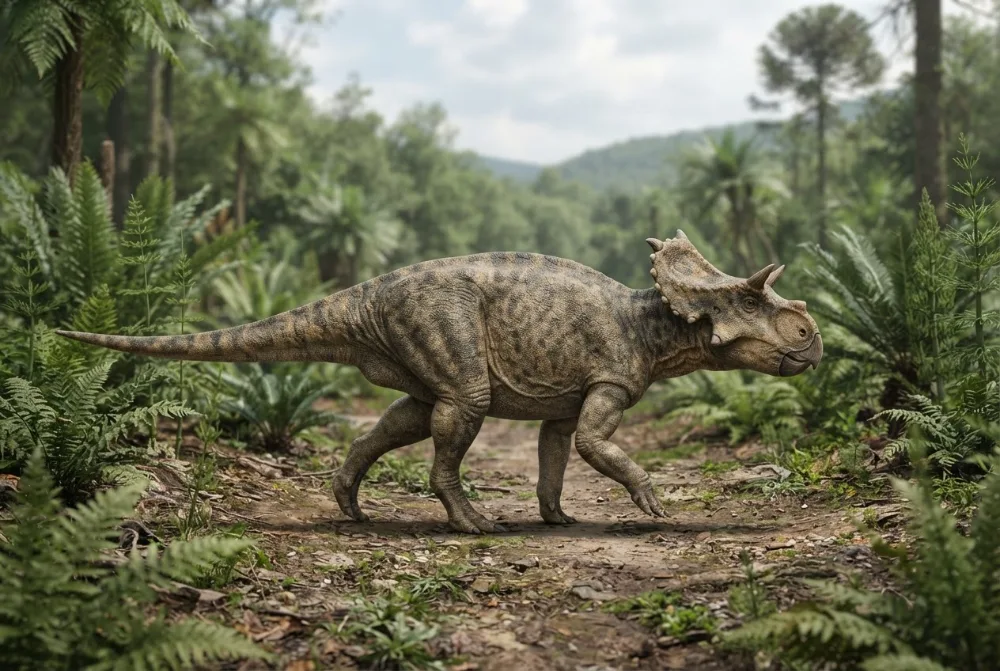
Beg was a small, plant-eating dinosaur that lived in what is now Mongolia. It had a beak and cheek teeth for chewing tough plants, and its skull had bumpy, armor-like bones. Beg is one of the earliest horned dinosaurs ever found in Mongolia.12
Yabayeho ryari?
Yihutaga ite?


Utuntu dushimishije
Beg is the oldest known neoceratopsian dinosaur from Mongolia. Before its discovery, neoceratopsians were only known from younger, Late Cretaceous rocks in that region.1
The only fossil of Beg is a partial skull and a few other bones, including a rib and part of a shoulder blade. It was found by a joint Mongolian-American expedition in 2015.1
Beg had a unique skull with five equally spaced bumps on the side of its lower jaw. These bumps may have been covered by a horny sheath.1
Beg lived around 100 million years ago, right at the boundary between the Early and Late Cretaceous. Its age is estimated between 113 and 94 million years old.1
The name Beg comes from a Mongolian war god, Beg-tse, who is often shown with armor and bumpy skin, similar to the rough bones on Beg's skull.1
Beg had four large, cylindrical teeth in its upper jaw (premaxilla), which is a primitive feature not seen in later horned dinosaurs.1
Ku bazobereye muri dinozore
- Izina rya siyansi
- Beg
- Yiswe na
- Yu et al. 20202
- Itsinda
- Dinozore zifite amahembe
- Umuryango / ishami
- Neoceratopsia2
- Ishyirwa mu byiciro
- Ornithischia > Ceratopsia2
- Imyaka y'amabuye
- imyaka miliyoni 106 kugeza 94 (Albian / Cenomanian)2
- Inzego z'amabuye
- Ulaanoosh2
- Ibihugu
- Mongoliya2
- Ibisigazwa byanditswe
- 1 muri The Paleobiology Database2
- Ivumburwa
- Beg was named in 2020 by Yu and colleagues based on a partial skeleton found in 2015 during a joint Mongolian Academy of Sciences and American Museum of Natural History expedition near Tsogt-Ovoo, Mongolia.12
- Biracyagibwaho impaka
- Scientists are not sure exactly how big Beg was because only a partial skull and a few other bones have been found. They also debate its exact age because the rocks where it was found are difficult to date.1
Aho amakuru yakuwe
- A neoceratopsian dinosaur from the early Cretaceous of Mongolia and the early evolution of ceratopsia (pmc.ncbi.nlm.nih.gov)
- Beg in The Paleobiology Database (CC BY 4.0): imyaka, ahantu, inzego z'amabuye, ishyirwa mu byiciro.
Buri kintu kiri kuri uru rupapuro gifite nimero yerekana aho cyakuwe. Niba hari icyo twibeshye, tubabarire, turi abakunzi ba dinozore, ntituri ikinyamakuru cya siyansi. Tubwire kuri [email protected] tuzagikosora.
 Rex arashonje! Dino Wiki ni umushinga wa papa umwe yakoreye umuhungu we ukunda dinozore, ni ubuntu, nta matangazo kandi nta bigukurikirana. Abantu bakuru bashobora guha Rex akantu ko kurya kugira ngo Dino Wiki ikomeze kuboneka kuri interineti.Gaburira Rex
 Triceratops
 Protoceratops
 Ojoceratops
 Tatankaceratops
 Psittacosaurus
 Centrosaurus
 Tyrannosaurus
 Velociraptor
 Spinosaurus
 Ankylosaurus
 Parasaurolophus
 Pteranodon