 Uri dinozore iyihe? Umukino w'ibibazo
 Intambara ya dinozore
 Isiganwa rya dinozore
 Imikino mito ya dinozore
 Alubumu ya sitikeri
 Intonde za TOP za dinozore
 Ntungura!
Yabayeho ryari?

Yanganaga ite?
Yari ndende ite?
Ubutumburuke bwayo bwanganaga iki?
Yari iremereye ite?
 ndende nk'imodoka 2 ziparitse ku murongo🍌ndende nk'imineke 56 ikurikiranye
 iremereye nk'inzovu 1,5🍉iremereye nk'imbuto 2000 za watermelon🎒iremereye nk'ibyumba 12 by'amashuri byuzuye abana🐻❄️iremereye nk'idubu 22 zo mu rubura🏃yashoboraga kwiruka metero 100 mu masegonda 15 (umuntu wihuta kurusha abandi akenera 9,6)
Deinocheirus yanganaga ite ugereranyije NAWE?
Ni imibare gusa ibarirwa muri mushakisha yawe. Nta kintu kibikwa cyangwa cyoherezwa ahandi.
Yihutaga ite?


Utuntu dushimishije
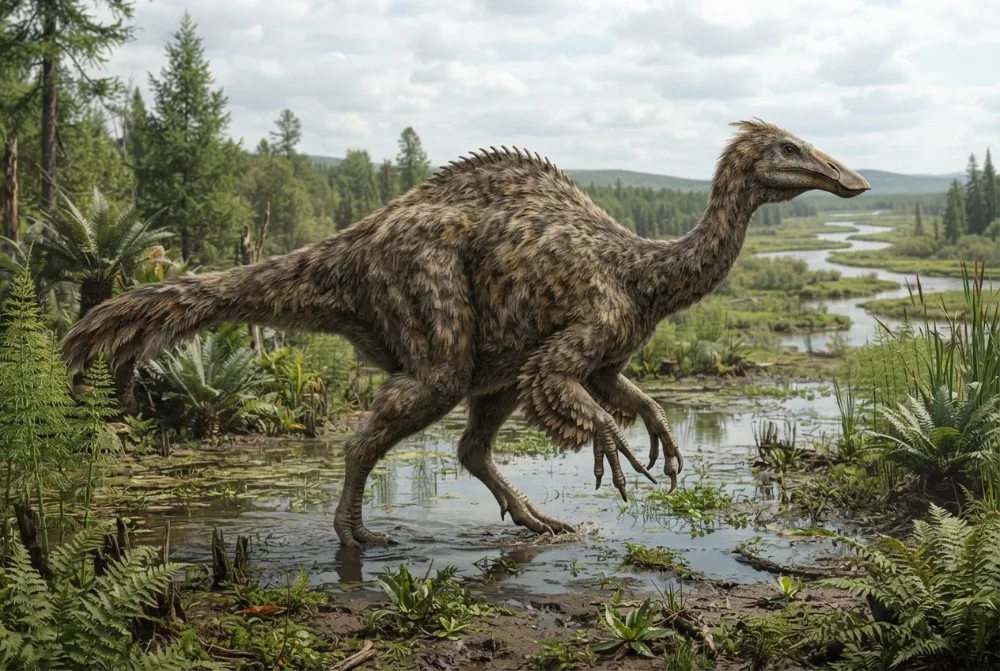
For a long time, scientists only had a pair of arm bones with huge claws to study Deinocheirus. They did not know what the rest of the dinosaur looked like until 2014.1
Deinocheirus had a large hump on its back, supported by its backbone. This made it look a bit like a camel.1
Its hands were huge and had long, sharp claws. The name Deinocheirus means 'terrible hand'.1
Deinocheirus lived during the Late Cretaceous period, about 70 to 66 million years ago.1
It was an omnivore, meaning it ate both plants and meat. Scientists think it used its beak to eat plants and small animals.15
Deinocheirus belonged to a group of dinosaurs called ornithomimosaurs, which are often called 'ostrich dinosaurs' because they looked a bit like ostriches.5
Ibibazo bibazwa cyane kuri Deinocheirus
?How big was Deinocheirus?
It was about 11 metres (36 feet) long and weighed around 6.5 tonnes (7.2 short tons). That is as long as a big bus.4
?What did Deinocheirus eat?
It was an omnivore, meaning it ate both plants and meat. It had a duck-like beak for cropping soft plants, and fish scales found with one specimen show it also ate fish.4
?Did Deinocheirus have feathers?
Yes, it probably had a fan of feathers on its tail. The tail ended in pygostyle-like vertebrae, which is a sign of feathers.4
?Why did Deinocheirus have such big claws?
Its huge, blunt claws were probably used for digging and gathering plants. The name Deinocheirus means 'terrible hand' because of those big claws.4
?Was Deinocheirus a dinosaur?
Yes, it was a dinosaur. It belonged to a group called ornithomimosaurs, which are often called 'ostrich dinosaurs'.41
?When did Deinocheirus live?
It lived during the Late Cretaceous period, about 70 to 66 million years ago.1
?Could Deinocheirus run fast?
No, it was not built for speed. It had short legs and a bulky body, so it moved slowly.4
?What hunted Deinocheirus?
Bite marks on its bones show that the tyrannosaurid Tarbosaurus probably attacked or scavenged it.4
Ku bazobereye muri dinozore
- Izina rya siyansi
- Deinocheirus
- Yiswe na
- Kielan-Jaworowska 19695
- Itsinda
- Dinozore zisa n'imbuni
- Umuryango / ishami
- Deinocheiridae5
- Ishyirwa mu byiciro
- Theropoda > Ornithomimosauria5
- Imyaka y'amabuye
- imyaka miliyoni 100 kugeza 66 (Cenomanian / Maastrichtian)5
- Inzego z'amabuye
- Nemegt, Baynshire5
- Ibihugu
- Mongoliya5
- Ibisigazwa byanditswe
- 5 muri The Paleobiology Database5
- Ivumburwa
- Deinocheirus was named by Polish paleontologist Zofia Kielan-Jaworowska in 1969. The first fossils were found in the Gobi Desert in Mongolia.51
Aho amakuru yakuwe
- Deinocheirus | Natural History Museum (nhm.ac.uk)
- PBDB Taxon (paleobiodb.org)
- Deinocheirus — size, diet & habitat | DinoLifePedia (dinolifepedia.com)
- Deinocheirus (en.wikipedia.org)
- Deinocheirus in The Paleobiology Database (CC BY 4.0): imyaka, ahantu, inzego z'amabuye, ishyirwa mu byiciro.
Buri kintu kiri kuri uru rupapuro gifite nimero yerekana aho cyakuwe. Niba hari icyo twibeshye, tubabarire, turi abakunzi ba dinozore, ntituri ikinyamakuru cya siyansi. Tubwire kuri [email protected] tuzagikosora.
 Rex arashonje! Dino Wiki ni umushinga wa papa umwe yakoreye umuhungu we ukunda dinozore, ni ubuntu, nta matangazo kandi nta bigukurikirana. Abantu bakuru bashobora guha Rex akantu ko kurya kugira ngo Dino Wiki ikomeze kuboneka kuri interineti.Gaburira Rex
 Gallimimus
 Ornithomimus
 Struthiomimus
 Dromiceiomimus
 Archaeornithomimus
 Anserimimus
 Tyrannosaurus
 Triceratops
 Velociraptor
 Spinosaurus
 Ankylosaurus
 Parasaurolophus