 Uri dinozore iyihe? Umukino w'ibibazo
 Intambara ya dinozore
 Isiganwa rya dinozore
 Imikino mito ya dinozore
 Alubumu ya sitikeri
 Intonde za TOP za dinozore
 Ntungura!
Euoplocephalus
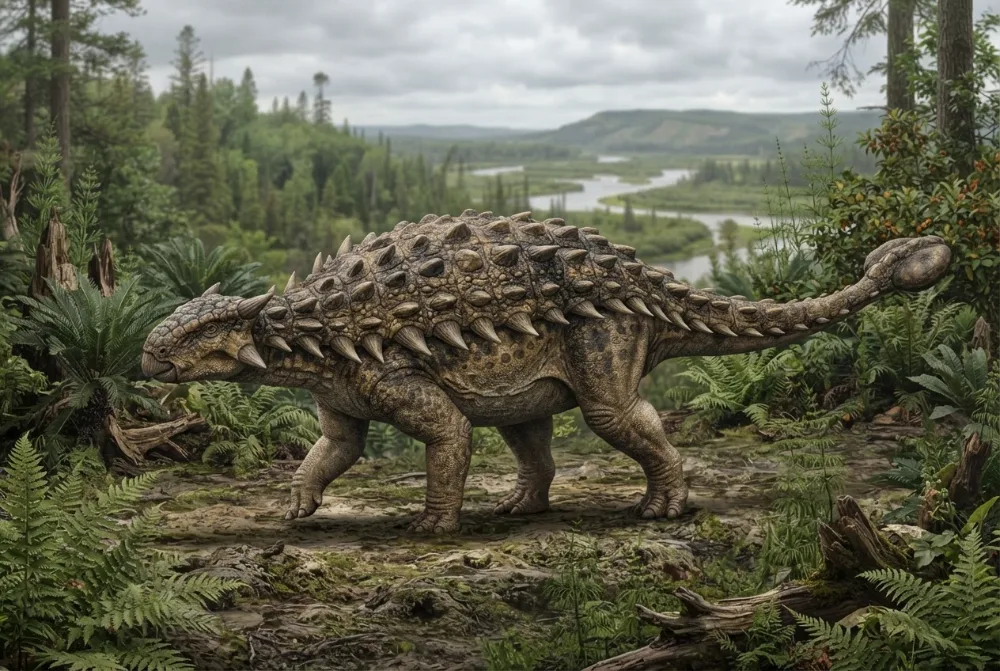
Euoplocephalus was a tank-like dinosaur covered in bony armour and a heavy club on its tail. It lived in what is now Canada and the USA during the Late Cretaceous period. This slow-moving plant-eater could defend itself from big predators like Albertosaurus.1
Yabayeho ryari?
Yanganaga ite?
Yari ndende ite?
Ubutumburuke bwayo bwanganaga iki?
Yari iremereye ite?

 ndende nk'imbwa 5 zikurikiranye🍌ndende nk'imineke 29 ikurikiranyeiremereye nk'imbwa 100🍉iremereye nk'imbuto 400 za watermelon🎒iremereye nk'ibyumba 2,5 by'amashuri byuzuye abana🐻❄️iremereye nk'idubu 4 zo mu rubura🏃yashoboraga kwiruka metero 100 mu masegonda 24 (umuntu wihuta kurusha abandi akenera 9,6)
Euoplocephalus yanganaga ite ugereranyije NAWE?
Ni imibare gusa ibarirwa muri mushakisha yawe. Nta kintu kibikwa cyangwa cyoherezwa ahandi.
Yihutaga ite?


Utuntu dushimishije
Euoplocephalus had a heavy club at the end of its tail made of bone. It could swing this club to fight off predators.1
Its body was covered in rows of bony plates called scutes. It also had two bone rings around its neck for extra protection.1
Euoplocephalus was about 5.3 metres (17 feet) long and weighed around 2 metric tons (2.2 short tons). That is as heavy as a small car.1
The first fossil was found in 1897 in Alberta, Canada. It was originally named Stereocephalus, but that name was already used for an insect, so it was changed to Euoplocephalus in 1910.1
Euoplocephalus lived between about 76 and 75 million years ago, during the late Campanian stage of the Late Cretaceous.1
Scientists once thought many different ankylosaur fossils all belonged to Euoplocephalus, but now they know most are separate species like Scolosaurus and Platypelta.1
Euoplocephalus had a short, drooping snout and a horny beak to bite off plants. Its teeth show it could chew tough plant material.1
Ibibazo bibazwa cyane kuri Euoplocephalus
?How big was Euoplocephalus?
About 5.3 metres (17 feet) long and 2 tonnes (2.2 short tons) in weight, as heavy as a small car.13
?What did Euoplocephalus eat?
It was a plant-eater. It used a horny beak to bite off plants and had small teeth to chew tough plant material.13
?Did Euoplocephalus have a tail club?
Yes, it had a heavy bony club at the end of its tail. It could swing this club to defend itself from predators like Albertosaurus.13
?Was Euoplocephalus bigger than Ankylosaurus?
No, Ankylosaurus was bigger. Among ankylosaurids, Euoplocephalus was exceeded in size only by Ankylosaurus and perhaps Tarchia and Cedarpelta.1
?When did Euoplocephalus live?
It lived during the Late Cretaceous period, about 76 to 70 million years ago.3
?Where was Euoplocephalus found?
Fossils have been found in Canada (Alberta) and the United States (Montana).13
?How fast could Euoplocephalus run?
Nobody knows for sure, but it was a slow-moving dinosaur with short, sturdy legs built for walking, not running.1
?What does the name Euoplocephalus mean?
It means 'well-armed head', from Greek words for 'well', 'armed', and 'head'.1
Gusenya ibinyoma
Ibivugwa: Euoplocephalus could roll into a ball like an armadillo to protect itself.
Ukuri: Euoplocephalus could not roll into a ball. It relied on its armour and tail club for defence.1
Ku bazobereye muri dinozore
- Izina rya siyansi
- Euoplocephalus
- Yiswe na
- Lambe 19104
- Itsinda
- Dinozore zifite igikingira
- Umuryango / ishami
- Ankylosauridae4
- Ishyirwa mu byiciro
- Ornithischia > Ankylosauria > Ankylosauridae > Thyreophora4
- Imyaka y'amabuye
- imyaka miliyoni 84 kugeza 66 (Campanian / Maastrichtian)4
- Inzego z'amabuye
- Dinosaur Park, Judith River, Two Medicine4
- Ibihugu
- Kanada, Amerika, Ubushinwa4
- Ibisigazwa byanditswe
- 18 muri The Paleobiology Database4
- Izwi kandi ku izina rya
- Stereocephalus (amazina ya kera ubu abarwa nk'inyamaswa imwe)4
- Ivumburwa
- Canadian paleontologist Lawrence Morris Lambe discovered the first Euoplocephalus fossil on 18 August 1897 in what is now Dinosaur Provincial Park, Alberta. He named it Stereocephalus in 1902, but changed the name to Euoplocephalus in 1910 because the old name was already taken.1
- Biracyagibwaho impaka
- Scientists still debate exactly which fossils belong to Euoplocephalus and which belong to other closely related ankylosaurs like Anodontosaurus and Scolosaurus.1
Aho amakuru yakuwe
- Euoplocephalus (en.wikipedia.org)
- PBDB Taxon (paleobiodb.org)
- Euoplocephalus | Natural History Museum (nhm.ac.uk)
- Euoplocephalus in The Paleobiology Database (CC BY 4.0): imyaka, ahantu, inzego z'amabuye, ishyirwa mu byiciro.
Buri kintu kiri kuri uru rupapuro gifite nimero yerekana aho cyakuwe. Niba hari icyo twibeshye, tubabarire, turi abakunzi ba dinozore, ntituri ikinyamakuru cya siyansi. Tubwire kuri [email protected] tuzagikosora.
 Rex arashonje! Dino Wiki ni umushinga wa papa umwe yakoreye umuhungu we ukunda dinozore, ni ubuntu, nta matangazo kandi nta bigukurikirana. Abantu bakuru bashobora guha Rex akantu ko kurya kugira ngo Dino Wiki ikomeze kuboneka kuri interineti.Gaburira Rex
 Ankylosaurus
 Sauropelta
 Pinacosaurus
 Scutellosaurus
 Struthiosaurus
 Edmontonia
 Tyrannosaurus
 Triceratops
 Velociraptor
 Spinosaurus
 Parasaurolophus
 Pteranodon