 Uri dinozore iyihe? Umukino w'ibibazo
 Intambara ya dinozore
 Isiganwa rya dinozore
 Imikino mito ya dinozore
 Alubumu ya sitikeri
 Intonde za TOP za dinozore
 Ntungura!
Globidens
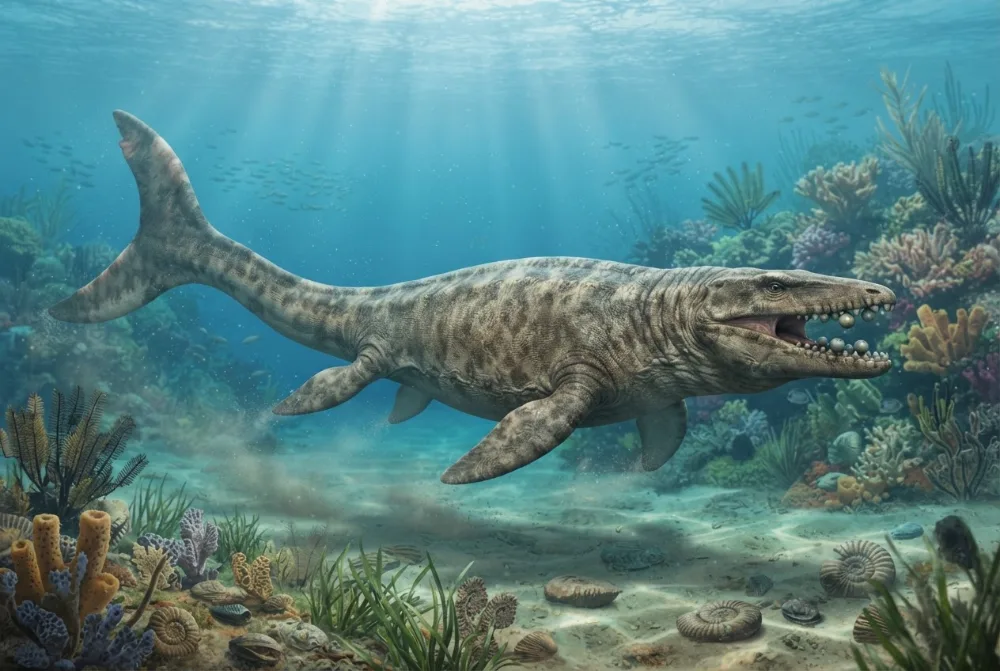
Globidens was a marine lizard that lived in the warm, shallow seas of the Late Cretaceous. It had strange, round teeth like little balls, perfect for crushing the hard shells of its prey. Unlike many other sea reptiles, Globidens was a shell-crushing specialist!1
Yabayeho ryari?
Yanganaga ite?
Yari ndende ite?
 ndende nk'imbwa 6 zikurikiranye🍌ndende nk'imineke 33 ikurikiranye🏊yashoboraga koga uburebure bwa pisine nini (50 m) mu masegonda 4,7
Globidens yanganaga ite ugereranyije NAWE?
Ni imibare gusa ibarirwa muri mushakisha yawe. Nta kintu kibikwa cyangwa cyoherezwa ahandi.
Yihutaga ite?


Utuntu dushimishije
Globidens had round, globe-shaped teeth that were different from the sharp teeth of most other mosasaurs.1
Scientists found stomach contents inside a Globidens fossil from South Dakota, showing it ate clams called inoceramids.1
Globidens lived about 84 to 66 million years ago, during the Late Cretaceous period.3
The first Globidens fossil was a partial skull and a neck bone found in Alabama, USA, and named in 1912 by Charles W. Gilmore.1
Globidens had a strong, robust skull and a powerful bite to crush the shells of its prey.1
Ibibazo bibazwa cyane kuri Globidens
?How big was Globidens?
Globidens was a medium-sized mosasaur, measuring about 5 to 6 metres (16 to 20 feet) long.1
?What did Globidens eat?
Globidens ate hard-shelled prey like turtles, ammonites, nautili, and bivalves. Stomach contents from a fossil found in South Dakota showed it ate clams called inoceramids.12
?Why did Globidens have round teeth?
Globidens had round, globe-shaped teeth that were perfect for crushing tough shells. Unlike most mosasaurs with sharp teeth for grabbing slippery prey, Globidens was a shell-crushing specialist.1
?Was Globidens a dinosaur?
No, Globidens was not a dinosaur. It was a marine lizard, a type of mosasaur that lived in the sea during the Late Cretaceous.1
?When did Globidens live?
Globidens lived during the Late Cretaceous period, about 84 to 66 million years ago.1
?Where have Globidens fossils been found?
Globidens fossils have been found in Angola, Brazil, Colombia, Morocco, Syria, and the United States.1
Ku bazobereye muri dinozore
- Izina rya siyansi
- Globidens
- Yiswe na
- Gilmore 19123
- Itsinda
- Mozazore
- Umuryango / ishami
- Mosasauridae3
- Ishyirwa mu byiciro
- Mosasauroidea3
- Imyaka y'amabuye
- imyaka miliyoni 90 kugeza 66 (Coniacian / Maastrichtian)3
- Inzego z'amabuye
- Pierre Shale, Wolfe City/Sprinkle, Phosphates3
- Ibihugu
- Amerika, Maroke, Siriya, Yorudaniya, Misiri, Angola3
- Ibisigazwa byanditswe
- 32 muri The Paleobiology Database3
- Ivumburwa
- Globidens was first described in 1912 by Charles W. Gilmore, based on an incomplete skull and a neck bone from Alabama, USA. The name means 'globe tooth' because of its round teeth.1
- Biracyagibwaho impaka
- Scientists are still debating exactly how many species of Globidens existed, as some fossils have been moved to other groups like Prognathodon.1
Aho amakuru yakuwe
- Globidens (en.wikipedia.org)
- Stomach contents of Globidens, a shell-crushing mosasaur (Squamata), from the Late Cretaceous Pierre Shale Group, Big Bend area of the Missouri River, central South Dakota (exa.ai)
- Globidens in The Paleobiology Database (CC BY 4.0): imyaka, ahantu, inzego z'amabuye, ishyirwa mu byiciro.
Buri kintu kiri kuri uru rupapuro gifite nimero yerekana aho cyakuwe. Niba hari icyo twibeshye, tubabarire, turi abakunzi ba dinozore, ntituri ikinyamakuru cya siyansi. Tubwire kuri [email protected] tuzagikosora.
 Rex arashonje! Dino Wiki ni umushinga wa papa umwe yakoreye umuhungu we ukunda dinozore, ni ubuntu, nta matangazo kandi nta bigukurikirana. Abantu bakuru bashobora guha Rex akantu ko kurya kugira ngo Dino Wiki ikomeze kuboneka kuri interineti.Gaburira Rex
 Mosasaurus
 Prognathodon
 Tylosaurus
 Platecarpus
 Clidastes
 Halisaurus
 Tyrannosaurus
 Triceratops
 Velociraptor
 Spinosaurus
 Ankylosaurus
 Parasaurolophus