 Uri dinozore iyihe? Umukino w'ibibazo
 Intambara ya dinozore
 Isiganwa rya dinozore
 Imikino mito ya dinozore
 Alubumu ya sitikeri
 Intonde za TOP za dinozore
 Ntungura!
Yabayeho ryari?

Yanganaga ite?
Yari ndende ite?
Ubutumburuke bwayo bwanganaga iki?
Ichthyornis yanganaga ite ugereranyije NAWE?
Ni imibare gusa ibarirwa muri mushakisha yawe. Nta kintu kibikwa cyangwa cyoherezwa ahandi.
Yihutaga ite?


Utuntu dushimishije
Ichthyornis was one of the first prehistoric birds discovered with teeth, and Charles Darwin said it was important for understanding evolution.1
Its backbone bones were shaped like a fish's, which is why it got the name 'fish bird'.1
The beak of Ichthyornis was made of several separate plates, like an albatross's beak, not a single piece like most modern birds.1
Ichthyornis lived between about 93 and 83.5 million years ago, during the Late Cretaceous Period.1
Over time, Ichthyornis grew larger: older fossils have a wing bone about 58 mm long, while younger ones have a wing bone about 71.5 mm long.1
Its teeth were curved backward and set in a groove, similar to those of marine reptiles like mosasaurs.1
Ichthyornis is one of the closest extinct relatives of modern birds, helping scientists learn how today's birds evolved.1
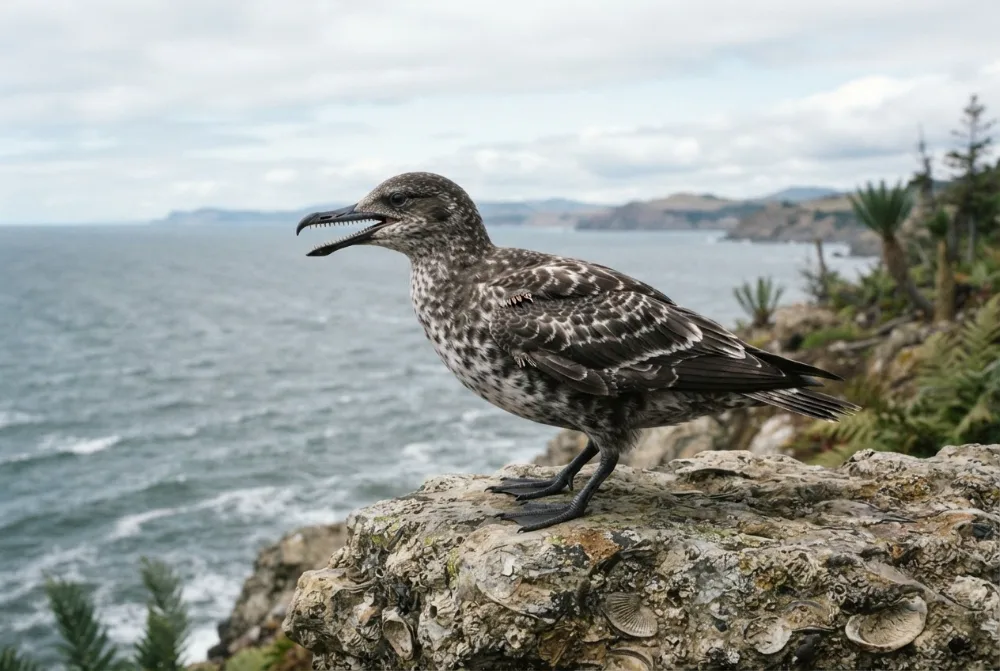
Ibibazo bibazwa cyane kuri Ichthyornis
?How big was Ichthyornis?
About 24 centimetres (9.4 inches) long, with a skeletal wingspan of around 43 centimetres (17 inches). That is about the size of a pigeon.1
?Did Ichthyornis have teeth?
Yes, it had sharp, backward-curved teeth in the middle part of its jaws. The tips of its jaws had no teeth and were covered by a beak.1
?Could Ichthyornis fly?
Yes, it was a strong flier. Its wings and breastbone looked very modern, similar to birds that fly well today.1
?What did Ichthyornis eat?
It probably ate fish and other small sea animals, like modern gulls and terns. Its teeth helped it grab slippery prey.2
?When did Ichthyornis live?
It lived during the Late Cretaceous Period, from about 93 million to 83.5 million years ago.1
?Where did Ichthyornis live?
It lived along the coasts of the huge inland sea that covered the middle of North America. Its fossils have been found in Kansas, Texas, Alberta, and other places.1
?Is Ichthyornis a dinosaur?
Yes, birds evolved from dinosaurs, so Ichthyornis is a type of dinosaur called an avialan. But it is not a non-avian dinosaur like T. rex.1
Gusenya ibinyoma
Ibivugwa: Ichthyornis is sometimes thought to be a dinosaur like T. rex.
Ukuri: Ichthyornis is a bird, not a non-avian dinosaur. It belongs to the group Avialae, which includes modern birds and their extinct relatives.1
Ku bazobereye muri dinozore
- Izina rya siyansi
- Ichthyornis
- Yiswe na
- Marsh 18724
- Itsinda
- Inyoni za mbere
- Umuryango / ishami
- Ichthyornithes4
- Ishyirwa mu byiciro
- Theropoda > Avialae4
- Imyaka y'amabuye
- imyaka miliyoni 100 kugeza 72 (Cenomanian / Campanian)4
- Inzego z'amabuye
- Niobrara, Mooreville Chalk, Belle Fourche4
- Ibihugu
- Amerika, Kanada, Uzubekisitani, Megizike4
- Ibisigazwa byanditswe
- 33 muri The Paleobiology Database4
- Izwi kandi ku izina rya
- Angelinornis, Colonosaurus, Plegadornis (amazina ya kera ubu abarwa nk'inyamaswa imwe)4
- Ivumburwa
- Ichthyornis was named by American paleontologist Othniel Charles Marsh in 1872. At first, Marsh thought the toothed jaws belonged to a marine reptile, but later in 1873 he realized they were part of the bird.12
- Biracyagibwaho impaka
- Scientists still debate whether the species should be called Ichthyornis dispar or Ichthyornis anceps, because of naming rules.1
Aho amakuru yakuwe
- Ichthyornis (en.wikipedia.org)
- Ichthyornis | Cretaceous period, seabird, toothed beak (britannica.com)
- A New Specimen of the Late Cretaceous Bird, cf.Ichthyornissp., from the Cenomanian of Central Kansas, with Comments on the Size Distribution ofIchthyornisin North America (exa.ai)
- Ichthyornis in The Paleobiology Database (CC BY 4.0): imyaka, ahantu, inzego z'amabuye, ishyirwa mu byiciro.
Buri kintu kiri kuri uru rupapuro gifite nimero yerekana aho cyakuwe. Niba hari icyo twibeshye, tubabarire, turi abakunzi ba dinozore, ntituri ikinyamakuru cya siyansi. Tubwire kuri [email protected] tuzagikosora.
 Rex arashonje! Dino Wiki ni umushinga wa papa umwe yakoreye umuhungu we ukunda dinozore, ni ubuntu, nta matangazo kandi nta bigukurikirana. Abantu bakuru bashobora guha Rex akantu ko kurya kugira ngo Dino Wiki ikomeze kuboneka kuri interineti.Gaburira Rex
 Archaeopteryx
 Hesperornis
 Baptornis
 Jurapteryx
 Gobipteryx
 Martinavis
 Tyrannosaurus
 Triceratops
 Velociraptor
 Spinosaurus
 Ankylosaurus
 Parasaurolophus