 Uri dinozore iyihe? Umukino w'ibibazo
 Intambara ya dinozore
 Isiganwa rya dinozore
 Imikino mito ya dinozore
 Alubumu ya sitikeri
 Intonde za TOP za dinozore
 Ntungura!
Kawanectes
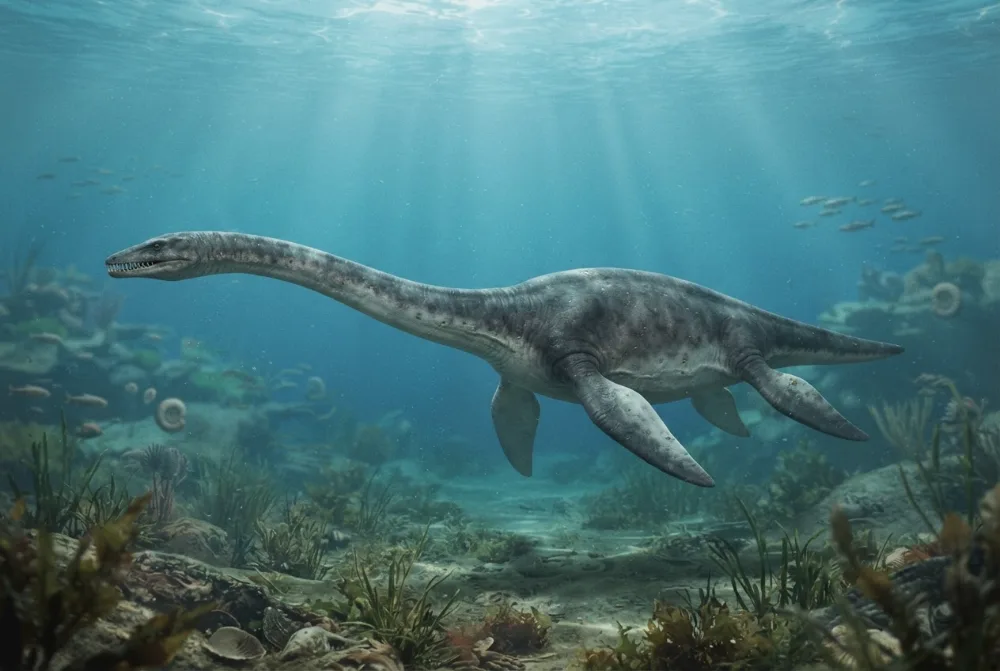
Kawanectes was a small marine reptile with a long neck that lived in the seas of Patagonia near the end of the Age of Dinosaurs. It was an elasmosaurid plesiosaur, but much smaller than its giant relatives, only about as long as a small car.1
Yabayeho ryari?
Yanganaga ite?
Yari ndende ite?
 ndende nk'imbwa 4 zikurikiranye🍌ndende nk'imineke 23 ikurikiranye🏊yashoboraga koga uburebure bwa pisine nini (50 m) mu masegonda 6,2
Kawanectes yanganaga ite ugereranyije NAWE?
Ni imibare gusa ibarirwa muri mushakisha yawe. Nta kintu kibikwa cyangwa cyoherezwa ahandi.
Yihutaga ite?


Utuntu dushimishije
Kawanectes is one of the smallest elasmosaurids ever found, with an adult body length of only 3.8 to 4.2 metres (12 to 14 feet).1
Its name comes from the Kawas Sea, an ancient ocean that covered Patagonia during the Late Cretaceous.1
One specimen of Kawanectes was found with 389 gastroliths, or stomach stones, which may have helped it digest food or control buoyancy.1
Kawanectes had a high humerus-to-femur length ratio of about 1.2, meaning its upper arm bone was longer than its thigh bone, which is unusual among elasmosaurids.1
Scientists think Kawanectes may have been sexually dimorphic, with females possibly larger than males.1
Kawanectes lived in a marginal marine environment, probably an estuary, not the open ocean, and it was smaller than open-ocean plesiosaurs.1
Ibibazo bibazwa cyane kuri Kawanectes
?How big was Kawanectes?
Kawanectes was about 3.8 to 4.2 metres (12 to 14 feet) long as an adult, which is small for an elasmosaurid.12
?What did Kawanectes eat?
Kawanectes likely ate small marine animals, and its jaw shape suggests it could snap its jaws shut quickly for fast bites, but not with a strong bite force.2
?Where did Kawanectes live?
Kawanectes lived in the seas of Patagonia, in what is now Argentina, during the Late Cretaceous, in a coastal or estuarine environment.12
?Was Kawanectes a dinosaur?
No, Kawanectes was a plesiosaur, a marine reptile, not a dinosaur.1
Ku bazobereye muri dinozore
- Izina rya siyansi
- Kawanectes
- Yiswe na
- O'Gorman 20163
- Itsinda
- Plesiyozore
- Umuryango / ishami
- Elasmosauridae3
- Ishyirwa mu byiciro
- Plesiosauria > Elasmosauridae > Sauropterygia3
- Imyaka y'amabuye
- imyaka miliyoni 72 kugeza 66 (Maastrichtian)3
- Inzego z'amabuye
- La Colonia, Allen3
- Ibihugu
- Arijantine3
- Ibisigazwa byanditswe
- 8 muri The Paleobiology Database3
- Ivumburwa
- Kawanectes was first named as a species of Trinacromerum in 1985 by Gasparini and Goñi, but in 2016 José P. O'Gorman gave it its own genus, Kawanectes, based on new fossils.1
- Biracyagibwaho impaka
- Scientists are not sure exactly how many neck and tail vertebrae Kawanectes had, because the known fossils are incomplete.1
Aho amakuru yakuwe
- Kawanectes (en.wikipedia.org)
- First record of Kawanectes lafquenianum (Plesiosauria, Elasmosauridae) from the La Colonia Formation of Argentina, with comments on the mandibular morphology of elasmosaurids: Alcheringa: An Australasian Journal of Palaeontology: Vol 44 , No 1 - Get Access (tandfonline.com)
- Kawanectes in The Paleobiology Database (CC BY 4.0): imyaka, ahantu, inzego z'amabuye, ishyirwa mu byiciro.
Buri kintu kiri kuri uru rupapuro gifite nimero yerekana aho cyakuwe. Niba hari icyo twibeshye, tubabarire, turi abakunzi ba dinozore, ntituri ikinyamakuru cya siyansi. Tubwire kuri [email protected] tuzagikosora.
 Rex arashonje! Dino Wiki ni umushinga wa papa umwe yakoreye umuhungu we ukunda dinozore, ni ubuntu, nta matangazo kandi nta bigukurikirana. Abantu bakuru bashobora guha Rex akantu ko kurya kugira ngo Dino Wiki ikomeze kuboneka kuri interineti.Gaburira Rex
 Elasmosaurus
 Pliosaurus
 Plesiosaurus
 Cimoliasaurus
 Colymbosaurus
 Trinacromerum
 Tyrannosaurus
 Triceratops
 Velociraptor
 Spinosaurus
 Ankylosaurus
 Parasaurolophus