 Uri dinozore iyihe? Umukino w'ibibazo
 Intambara ya dinozore
 Isiganwa rya dinozore
 Imikino mito ya dinozore
 Alubumu ya sitikeri
 Intonde za TOP za dinozore
 Ntungura!
Latenivenatrix
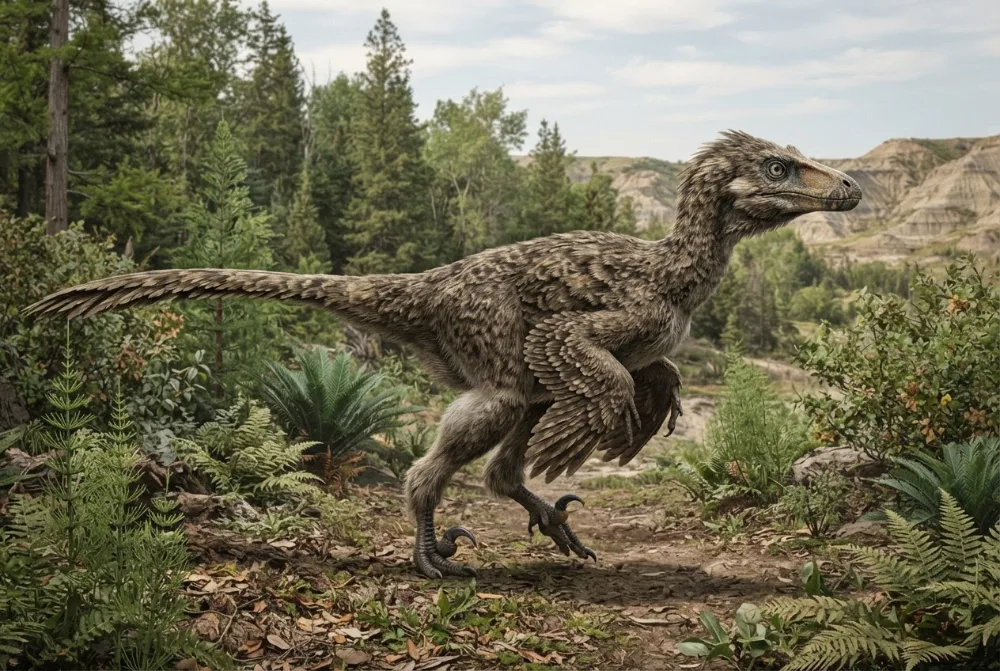
Latenivenatrix was a large, bird-like dinosaur that lived in what is now Canada. It was one of the biggest troodontids ever found, and it probably ate both plants and meat. Scientists are still debating whether it was really its own species or just a different name for another dinosaur called Stenonychosaurus.14
Yabayeho ryari?
Yanganaga ite?
Yari ndende ite?
Ubutumburuke bwayo bwanganaga iki?
 ndende nk'imbwa 4 zikurikiranye🍌ndende nk'imineke 19 ikurikiranye🏃yashoboraga kwiruka metero 100 mu masegonda 7,1 (umuntu wihuta kurusha abandi akenera 9,6)
Latenivenatrix yanganaga ite ugereranyije NAWE?
Ni imibare gusa ibarirwa muri mushakisha yawe. Nta kintu kibikwa cyangwa cyoherezwa ahandi.
Yihutaga ite?


Utuntu dushimishije
Latenivenatrix is the largest known troodontid, reaching up to 3.5 meters (11.5 feet) in length.1
Its name means 'hiding huntress' in Latin, because it was a stealthy predator.1
The first fossil of Latenivenatrix was found in 1968 by Irene Vanderloh in Alberta, Canada.1
Some scientists think Latenivenatrix might actually be the same species as Stenonychosaurus, not a separate dinosaur.1
Latenivenatrix had a special pelvis with a pubis bone that was tilted backward at a 17-degree angle.1
Ibibazo bibazwa cyane kuri Latenivenatrix
?How big was Latenivenatrix?
It was about 3 to 3.5 metres (9.8 to 11.5 ft) long, making it the largest known troodontid. Its skull was about 45 centimetres (18 in) long.1
?What did Latenivenatrix eat?
It was probably a semi-omnivore, meaning it ate both plants and meat. It was a bird-like dinosaur that likely hunted small prey and also ate plants.1
?Is Latenivenatrix a dinosaur?
Yes, it is a dinosaur. It belongs to a group of bird-like dinosaurs called troodontids.1
?When did Latenivenatrix live?
It lived about 75.5 million years ago during the Cretaceous Period. Its fossils were found in Alberta, Canada.1
?What does the name Latenivenatrix mean?
It means 'hiding huntress' in Latin, because it was a stealthy predator.3
?Could Latenivenatrix fly?
No, it could not fly. As a troodontid, it probably lost the ability to fly and was a biped that walked on two legs.1
Gusenya ibinyoma
Ibivugwa: Latenivenatrix is definitely a unique dinosaur species.
Ukuri: Some scientists argue that Latenivenatrix is actually a junior synonym of Stenonychosaurus, meaning it may not be a separate species.1
Ku bazobereye muri dinozore
- Izina rya siyansi
- Latenivenatrix
- Yiswe na
- van der Reest and Currie 20174
- Itsinda
- Raputori
- Umuryango / ishami
- Troodontidae4
- Ishyirwa mu byiciro
- Theropoda > Troodontidae4
- Imyaka y'amabuye
- imyaka miliyoni 84 kugeza 72 (Campanian)4
- Inzego z'amabuye
- Dinosaur Park4
- Ibihugu
- Kanada4
- Ibisigazwa byanditswe
- 4 muri The Paleobiology Database4
- Ivumburwa
- Latenivenatrix was named in 2017 by paleontologists Aaron van der Reest and Philip Currie. The type specimen was originally collected in 1968 and had been assigned to other troodontids before being recognized as a new genus.14
- Biracyagibwaho impaka
- Scientists still debate whether Latenivenatrix is a valid genus or just a synonym of Stenonychosaurus.1
Aho amakuru yakuwe
- Latenivenatrix (en.wikipedia.org)
- Two New Cretaceous Dinosaur Species Discovered in Canada | Sci.News (sci.news)
- Paleo Profile: The Hiding Hunter | Scientific American (scientificamerican.com)
- Latenivenatrix in The Paleobiology Database (CC BY 4.0): imyaka, ahantu, inzego z'amabuye, ishyirwa mu byiciro.
Buri kintu kiri kuri uru rupapuro gifite nimero yerekana aho cyakuwe. Niba hari icyo twibeshye, tubabarire, turi abakunzi ba dinozore, ntituri ikinyamakuru cya siyansi. Tubwire kuri [email protected] tuzagikosora.
 Rex arashonje! Dino Wiki ni umushinga wa papa umwe yakoreye umuhungu we ukunda dinozore, ni ubuntu, nta matangazo kandi nta bigukurikirana. Abantu bakuru bashobora guha Rex akantu ko kurya kugira ngo Dino Wiki ikomeze kuboneka kuri interineti.Gaburira Rex
 Velociraptor
 Microraptor
 Deinonychus
 Asiamericana
 Richardoestesia
 Saurornitholestes
 Tyrannosaurus
 Triceratops
 Spinosaurus
 Ankylosaurus
 Parasaurolophus
 Pteranodon