 Uri dinozore iyihe? Umukino w'ibibazo
 Intambara ya dinozore
 Isiganwa rya dinozore
 Imikino mito ya dinozore
 Alubumu ya sitikeri
 Intonde za TOP za dinozore
 Ntungura!
Martinectes
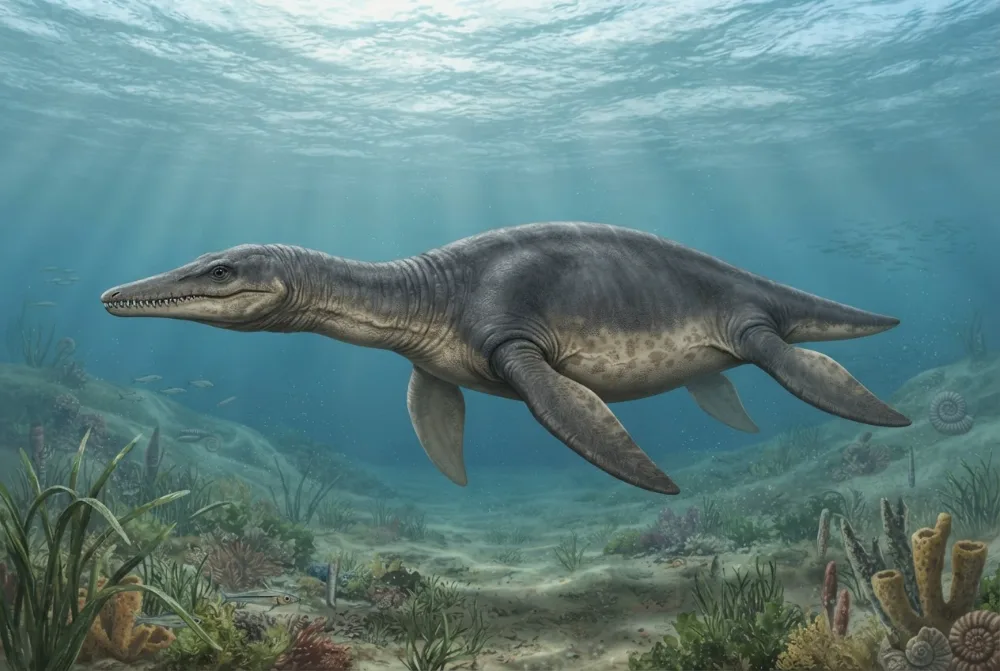
Martinectes was a small, fast-swimming marine reptile that lived in the shallow seas of North America during the time of the dinosaurs. It had a short neck, a long snout, and four big flippers that helped it chase after fish and squid.1
Yabayeho ryari?
Yanganaga ite?
Yari ndende ite?
Yari iremereye ite?
 ndende nk'imbwa 2,5 zikurikiranye🍌ndende nk'imineke 14 ikurikiranye🍉iremereye nk'imbuto 250 za watermelon🧸iremereye nk'abana 67 bo mu ishuri ry'incuke🎒iremereye nk'abanyeshuri 40🐻❄️iremereye nk'idubu 3 zo mu rubura🏊yashoboraga koga uburebure bwa pisine nini (50 m) mu masegonda 6,9
Martinectes yanganaga ite ugereranyije NAWE?
Ni imibare gusa ibarirwa muri mushakisha yawe. Nta kintu kibikwa cyangwa cyoherezwa ahandi.
Yihutaga ite?


Utuntu dushimishije
Martinectes was one of the smallest adult polycotylid plesiosaurs ever found, measuring only about 2.3 to 2.6 metres long.1
It had large eyes with a bony ledge above them, which may have shaded its eyes from sunlight while hunting near the water's surface.1
Martinectes lived about 80 million years ago in the Western Interior Seaway, a huge ocean that split North America in two.1
Its name means 'Martin's swimmer', honoring the person who helped discover its fossils.1
Martinectes was originally thought to be a species of Dolichorhynchops, but scientists gave it its own genus in 2024.1
It had unusually wide bones in its spine and a very short back part of its skull, which helped scientists tell it apart from other plesiosaurs.1
Ibibazo bibazwa cyane kuri Martinectes
?How big was Martinectes?
Martinectes was a large polycotylid plesiosaur, measuring at least around 5 metres (16 ft) long. Some estimates suggest it could reach up to 6 to 7 metres (20 to 23 ft), while a 2026 estimate put it at about 4.95 metres (16.2 ft) long.2
?Was Martinectes a dinosaur?
No, Martinectes was a plesiosaur, a marine reptile that lived in the seas during the time of the dinosaurs. It was not a dinosaur.2
?What did Martinectes eat?
Martinectes likely chased after fish and squid, using its long snout and four big flippers to swim fast. Its small teeth and narrow jaws suggest it ate small, slippery prey.2
Ku bazobereye muri dinozore
- Izina rya siyansi
- Martinectes
- Yiswe na
- Clark et al. 20243
- Itsinda
- Plesiyozore
- Umuryango / ishami
- Polycotylidae3
- Ishyirwa mu byiciro
- Plesiosauria > Sauropterygia3
- Imyaka y'amabuye
- imyaka miliyoni 84 kugeza 72 (Campanian)3
- Inzego z'amabuye
- Pierre Shale, Taylor Marl3
- Ibihugu
- Amerika3
- Ibisigazwa byanditswe
- 3 muri The Paleobiology Database3
- Ivumburwa
- Martinectes was named in 2024 by Robert O. Clark, F. Robin O'Keefe, and Sara E. Slack. They studied fossils that had been found in Wyoming and South Dakota, USA, and realized they belonged to a new genus.31
- Biracyagibwaho impaka
- Scientists are still debating exactly how Martinectes used its unusual eye ledges and wide skull for hunting.1
Aho amakuru yakuwe
- A new genus of small polycotylid plesiosaur from the Upper Cretaceous of the Western Interior Seaway and a clarification of the genus Dolichorhynchops (sciencedirect.com)
- Martinectes (en.wikipedia.org)
- Martinectes in The Paleobiology Database (CC BY 4.0): imyaka, ahantu, inzego z'amabuye, ishyirwa mu byiciro.
Buri kintu kiri kuri uru rupapuro gifite nimero yerekana aho cyakuwe. Niba hari icyo twibeshye, tubabarire, turi abakunzi ba dinozore, ntituri ikinyamakuru cya siyansi. Tubwire kuri [email protected] tuzagikosora.
 Rex arashonje! Dino Wiki ni umushinga wa papa umwe yakoreye umuhungu we ukunda dinozore, ni ubuntu, nta matangazo kandi nta bigukurikirana. Abantu bakuru bashobora guha Rex akantu ko kurya kugira ngo Dino Wiki ikomeze kuboneka kuri interineti.Gaburira Rex
 Elasmosaurus
 Pliosaurus
 Plesiosaurus
 Cimoliasaurus
 Colymbosaurus
 Trinacromerum
 Tyrannosaurus
 Triceratops
 Velociraptor
 Spinosaurus
 Ankylosaurus
 Parasaurolophus