 Uri dinozore iyihe? Umukino w'ibibazo
 Intambara ya dinozore
 Isiganwa rya dinozore
 Imikino mito ya dinozore
 Alubumu ya sitikeri
 Intonde za TOP za dinozore
 Ntungura!
Yabayeho ryari?

Yanganaga ite?
Yari ndende ite?
Ubutumburuke bwayo bwanganaga iki?
Yari iremereye ite?
 ndende nk'imodoka 2,5 ziparitse ku murongo🍌ndende nk'imineke 67 ikurikiranye
 iremereye nk'inzovu🍉iremereye nk'imbuto 1000 za watermelon🎒iremereye nk'ibyumba 6 by'amashuri byuzuye abana🐻❄️iremereye nk'idubu 11 zo mu rubura🏃yashoboraga kwiruka metero 100 mu masegonda 15 (umuntu wihuta kurusha abandi akenera 9,6)
Saurolophus yanganaga ite ugereranyije NAWE?
Ni imibare gusa ibarirwa muri mushakisha yawe. Nta kintu kibikwa cyangwa cyoherezwa ahandi.
Yihutaga ite?


Utuntu dushimishije
Saurolophus is one of the few dinosaurs known from both North America and Asia, which suggests they could cross land bridges.1
The first nearly complete dinosaur skeleton ever found in Canada was a Saurolophus, discovered in 1911.1
A huge bonebed in Mongolia called Dragon's Tomb contains at least 21 Saurolophus individuals, showing they lived in groups.1
Its teeth were packed into dental batteries, with hundreds of teeth that were constantly replaced, so it could chew tough plants.1
Saurolophus could reach food up to about 4 meters (13 feet) above the ground, thanks to its long neck and body.1
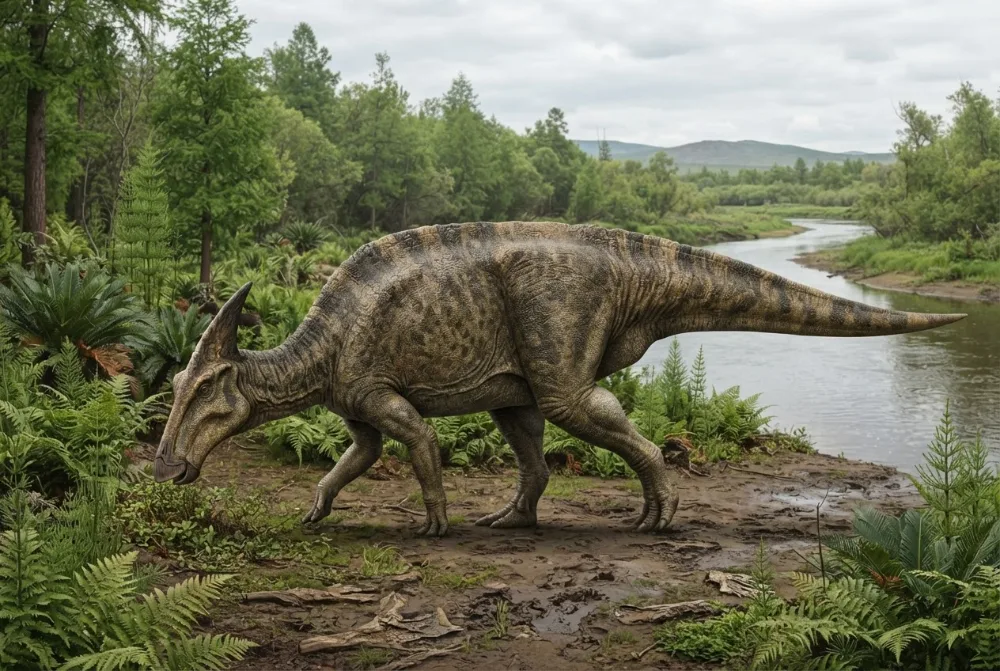
The crest on its head was a solid spike, not a hollow tube like in some other duck-billed dinosaurs.1
Ibibazo bibazwa cyane kuri Saurolophus
?How big was Saurolophus?
Saurolophus osborni was about 8.2 to 8.5 meters (27 to 28 feet) long, while the larger Mongolian species S. angustirostris reached about 12 to 13 meters (39 to 43 feet) long and weighed up to 11 tonnes (12 short tons).12
?What did Saurolophus eat?
Saurolophus was a herbivore, eating plants like conifer needles, twigs, and seeds. It had a toothless beak and hundreds of cheek teeth for grinding tough plant material.13
?Did Saurolophus have a crest?
Yes, Saurolophus had a distinctive spike-like crest on its head, made of nasal bones, which pointed up and back. It may have been used for display or heat regulation.1
?Could Saurolophus swim?
The sources do not say Saurolophus could swim. It was a land dinosaur that could walk on two legs or all fours, but no swimming adaptations are mentioned.13
?When did Saurolophus live?
Saurolophus lived during the Late Cretaceous, about 71.5 to 66 million years ago.12
?Where was Saurolophus found?
Saurolophus fossils have been found in North America (Canada, USA) and Asia (Mongolia, China). It is one of the few dinosaurs known from multiple continents.12
?Was Saurolophus a dinosaur?
Yes, Saurolophus was a dinosaur, specifically a hadrosaurid (duck-billed) dinosaur. It was an ornithopod, a plant-eating dinosaur.12
?Did Saurolophus live in herds?
Yes, evidence from a bonebed called Dragon's Tomb in Mongolia suggests Saurolophus lived in groups, with at least 21 individuals found together.1
Gusenya ibinyoma
Ibivugwa: Some people think Saurolophus could swim in the ocean.
Ukuri: It lived near rivers and lakes, but it was a land animal that walked and ate plants on land.1
Ku bazobereye muri dinozore
- Izina rya siyansi
- Saurolophus
- Yiswe na
- Brown 19124
- Itsinda
- Iminwa y'imbata
- Umuryango / ishami
- Hadrosauridae4
- Ishyirwa mu byiciro
- Ornithischia > Ornithopoda > Iguanodontia > Hadrosauridae4
- Imyaka y'amabuye
- imyaka miliyoni 84 kugeza 66 (Campanian / Maastrichtian)4
- Inzego z'amabuye
- Nemegt, Horseshoe Canyon, Almond4
- Ibihugu
- Mongoliya, Kanada, Amerika4
- Ibisigazwa byanditswe
- 38 muri The Paleobiology Database4
- Ivumburwa
- Barnum Brown named Saurolophus in 1912 from a nearly complete skeleton found in Alberta, Canada, in 1911.1
- Biracyagibwaho impaka
- Scientists still debate whether some fossils from California and Wyoming belong to Saurolophus or to a separate genus.1
Aho amakuru yakuwe
- Saurolophus (en.wikipedia.org)
- Saurolophus | Natural History Museum (nhm.ac.uk)
- Saurolophus- Enchanted Learning Software (web.archive.org)
- Saurolophus in The Paleobiology Database (CC BY 4.0): imyaka, ahantu, inzego z'amabuye, ishyirwa mu byiciro.
Buri kintu kiri kuri uru rupapuro gifite nimero yerekana aho cyakuwe. Niba hari icyo twibeshye, tubabarire, turi abakunzi ba dinozore, ntituri ikinyamakuru cya siyansi. Tubwire kuri [email protected] tuzagikosora.
 Rex arashonje! Dino Wiki ni umushinga wa papa umwe yakoreye umuhungu we ukunda dinozore, ni ubuntu, nta matangazo kandi nta bigukurikirana. Abantu bakuru bashobora guha Rex akantu ko kurya kugira ngo Dino Wiki ikomeze kuboneka kuri interineti.Gaburira Rex
 Parasaurolophus
 Edmontosaurus
 Hypacrosaurus
 Corythosaurus
 Kritosaurus
 Gryposaurus
 Tyrannosaurus
 Triceratops
 Velociraptor
 Spinosaurus
 Ankylosaurus
 Pteranodon