 Uri dinozore iyihe? Umukino w'ibibazo
 Intambara ya dinozore
 Isiganwa rya dinozore
 Imikino mito ya dinozore
 Alubumu ya sitikeri
 Intonde za TOP za dinozore
 Ntungura!
Shri
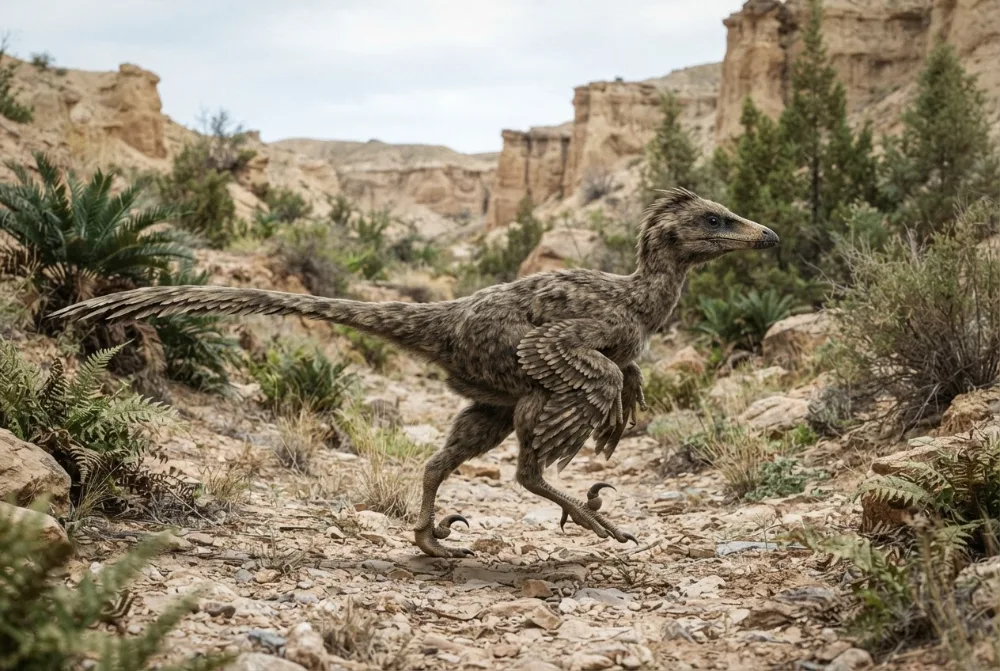
Shri devi was a small, fast, feathered raptor that hunted in the Late Cretaceous deserts of Mongolia. It was a close cousin of Velociraptor, but with its own special features. Imagine a turkey-sized dinosaur with sharp claws and a long tail, sneaking through the sand dunes!21
Yabayeho ryari?
Yanganaga ite?
Yari ndende ite?
Ubutumburuke bwayo bwanganaga iki?
Yari iremereye ite?
 ndende nk'injangwe 4 zo mu rugo zikurikiranye🍌ndende nk'imineke 11 ikurikiranye🍉iremereye nk'imbuto 4 za watermelon🏃yashoboraga kwiruka metero 100 mu masegonda 9 (umuntu wihuta kurusha abandi akenera 9,6)
Shri yanganaga ite ugereranyije NAWE?
Ni imibare gusa ibarirwa muri mushakisha yawe. Nta kintu kibikwa cyangwa cyoherezwa ahandi.
Yihutaga ite?


Utuntu dushimishije
Shri devi is known from a partial skeleton that includes the right hind limb, pelvis, and vertebrae, which were found partially articulated.1
It lived about 83 to 72 million years ago, during the Campanian age of the Late Cretaceous.2
Shri devi is the first unequivocal dromaeosaurid dinosaur named from the Barun Goyot Formation.1
It had a weak fourth trochanter, a feature shared with other dromaeosaurids, but different from Velociraptor mongoliensis.1
The fossil was collected in July 1991 during a joint Mongolian Academy of Sciences and American Museum of Natural History expedition to the Gobi Desert.1
Shri devi had special bumps on its neck vertebrae instead of raised epipophyses, which helps scientists tell it apart from other raptors.1
Gusenya ibinyoma
Ibivugwa: Some people think Shri devi was a type of bird because it had feathers and was small.
Ukuri: Shri devi was a dinosaur, not a bird. It was a dromaeosaurid, a group of feathered theropods that includes Velociraptor, and it could not fly.2
Ku bazobereye muri dinozore
- Izina rya siyansi
- Shri
- Yiswe na
- Turner et al. 20212
- Itsinda
- Raputori
- Umuryango / ishami
- Dromaeosauridae2
- Ishyirwa mu byiciro
- Theropoda > Dromaeosauridae2
- Imyaka y'amabuye
- imyaka miliyoni 84 kugeza 72 (Campanian)2
- Inzego z'amabuye
- Baruungoyot2
- Ibihugu
- Mongoliya2
- Ibisigazwa byanditswe
- 2 muri The Paleobiology Database2
- Ivumburwa
- Shri devi was named in 2021 by Alan H. Turner, Shaena Montanari, and Mark A. Norell. The fossil was found in 1991 by Mark A. Norell and others during an expedition to the Gobi Desert in Mongolia.1
- Biracyagibwaho impaka
- Scientists are still debating exactly how Shri devi is related to other dromaeosaurids, especially because the fossil is incomplete and some features are shared with Velociraptor.1
Aho amakuru yakuwe
- Volume 2020 Issue 3965 | American Museum Novitates (bioone.org)
- Shri in The Paleobiology Database (CC BY 4.0): imyaka, ahantu, inzego z'amabuye, ishyirwa mu byiciro.
Buri kintu kiri kuri uru rupapuro gifite nimero yerekana aho cyakuwe. Niba hari icyo twibeshye, tubabarire, turi abakunzi ba dinozore, ntituri ikinyamakuru cya siyansi. Tubwire kuri [email protected] tuzagikosora.
 Rex arashonje! Dino Wiki ni umushinga wa papa umwe yakoreye umuhungu we ukunda dinozore, ni ubuntu, nta matangazo kandi nta bigukurikirana. Abantu bakuru bashobora guha Rex akantu ko kurya kugira ngo Dino Wiki ikomeze kuboneka kuri interineti.Gaburira Rex
 Velociraptor
 Microraptor
 Deinonychus
 Asiamericana
 Richardoestesia
 Saurornitholestes
 Tyrannosaurus
 Triceratops
 Spinosaurus
 Ankylosaurus
 Parasaurolophus
 Pteranodon