 Uri dinozore iyihe? Umukino w'ibibazo
 Intambara ya dinozore
 Isiganwa rya dinozore
 Imikino mito ya dinozore
 Alubumu ya sitikeri
 Intonde za TOP za dinozore
 Ntungura!
Traskasaura
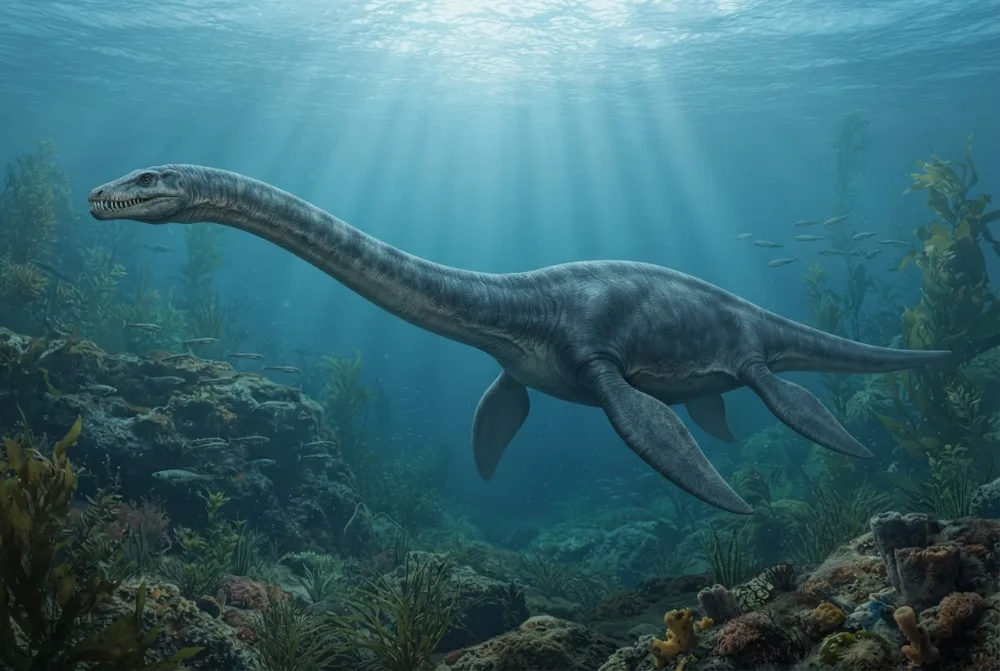
Traskasaura was a long-necked marine reptile that lived in the ocean around Vancouver Island, Canada, about 85 million years ago. It was a fierce predator with strong, sharp teeth that could crush the shells of its prey. This ancient sea monster is the official fossil of British Columbia!12
Yabayeho ryari?
Yanganaga ite?
Yari ndende ite?
 ndende nk'imodoka 2,5 ziparitse ku murongo🍌ndende nk'imineke 67 ikurikiranye🏊yashoboraga koga uburebure bwa pisine nini (50 m) mu masegonda 9
Traskasaura yanganaga ite ugereranyije NAWE?
Ni imibare gusa ibarirwa muri mushakisha yawe. Nta kintu kibikwa cyangwa cyoherezwa ahandi.
Yihutaga ite?


Utuntu dushimishije
Traskasaura had a very long neck with at least 50 bones, making it one of the longest-necked elasmosaurs.2
This marine reptile could swim downwards to dive on its prey from above, a hunting style that was unusual for elasmosaurs.2
The first Traskasaura fossil was found in 1988 by Michael Trask and his daughter Heather along the Puntledge River.1
Traskasaura was named the official Provincial Fossil of British Columbia in 2023, even before it got its scientific name.12
Scientists think Traskasaura had a strange mix of features from both early elasmosaurs and a later group called aristonectines.1
Three Traskasaura specimens have been found, including a nearly complete adult skeleton and a well-preserved juvenile.1
Ibibazo bibazwa cyane kuri Traskasaura
?How big was Traskasaura?
About 12 metres (39 feet) long. That is roughly as long as a large bus.2
?What did Traskasaura eat?
It likely ate ammonites, shelled sea creatures that lived in the same ocean. Its strong, sharp teeth were perfect for crushing their shells.2
?Is Traskasaura a dinosaur?
No, it is a plesiosaur, a type of marine reptile that lived in the sea. It is not a dinosaur.1
Ku bazobereye muri dinozore
- Izina rya siyansi
- Traskasaura
- Yiswe na
- O’Keefe et al. 20253
- Itsinda
- Plesiyozore
- Umuryango / ishami
- Elasmosauridae3
- Ishyirwa mu byiciro
- Plesiosauria > Elasmosauridae > Sauropterygia3
- Imyaka y'amabuye
- imyaka miliyoni 86 kugeza 84 (Santonian)3
- Inzego z'amabuye
- Haslam3
- Ibihugu
- Kanada3
- Ibisigazwa byanditswe
- 3 muri The Paleobiology Database3
- Ivumburwa
- The first Traskasaura skeleton was discovered in 1988 by Michael Trask and his daughter Heather on the bank of the Puntledge River near Courtenay, British Columbia. It was officially named Traskasaura sandrae in 2025 by paleontologist F. Robin O'Keefe and colleagues.1
- Biracyagibwaho impaka
- Scientists debate whether Traskasaura was a very early aristonectine or if its similar features evolved separately.1
Aho amakuru yakuwe
- Traskasaura (en.wikipedia.org)
- Mystery of “very odd” elasmosaur finally solved: one of North America’s most famous fossils identified as new species - Taylor & Francis Newsroom (newsroom.taylorandfrancisgroup.com)
- Traskasaura in The Paleobiology Database (CC BY 4.0): imyaka, ahantu, inzego z'amabuye, ishyirwa mu byiciro.
Buri kintu kiri kuri uru rupapuro gifite nimero yerekana aho cyakuwe. Niba hari icyo twibeshye, tubabarire, turi abakunzi ba dinozore, ntituri ikinyamakuru cya siyansi. Tubwire kuri [email protected] tuzagikosora.
 Rex arashonje! Dino Wiki ni umushinga wa papa umwe yakoreye umuhungu we ukunda dinozore, ni ubuntu, nta matangazo kandi nta bigukurikirana. Abantu bakuru bashobora guha Rex akantu ko kurya kugira ngo Dino Wiki ikomeze kuboneka kuri interineti.Gaburira Rex
 Elasmosaurus
 Pliosaurus
 Plesiosaurus
 Cimoliasaurus
 Colymbosaurus
 Trinacromerum
 Tyrannosaurus
 Triceratops
 Velociraptor
 Spinosaurus
 Ankylosaurus
 Parasaurolophus