 Uri dhino ripi? Kwizi
 Hondo yemadhino
 Mujaho wemadhino
 Mitambo midiki yemadhino
 Arubhamu yemasitika
 Rondedzero dzeTOP dzemadhino
 Ndishamise!
Rairarama rini?

Raiva hombe sei?
Raiva refu zvakadii?
Raiva rakakwirira zvakadii?
fungidziro
Rairema zvakadii?
Ambopteryx raiva hombe sei kana richienzaniswa NEWE?
Masvomhu chete mubrowser yako. Hapana chinochengetwa kana kutumirwa kupi zvako.
Raimhanya zvakadii?


Zvinonakidza
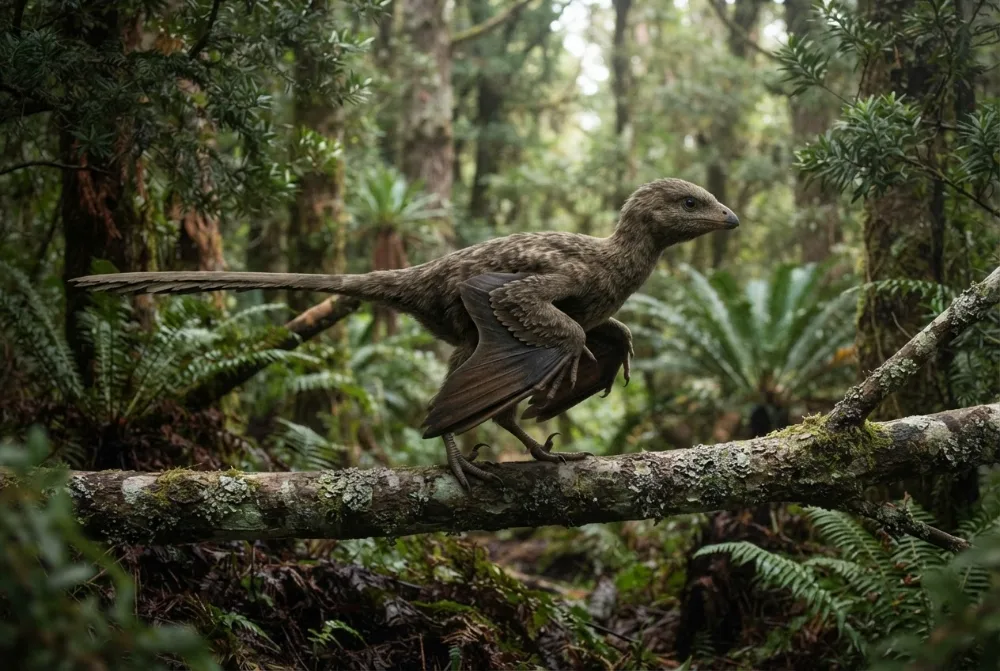
Ambopteryx had a long, rod-like bone sticking out from its wrist that helped support a wing membrane, just like in pterosaurs and bats.2
Its forelimbs were 1.3 times longer than its hindlimbs, which is unusual for a dinosaur.1
Ambopteryx had a short tail that ended in a fused pygostyle, a feature also seen in modern birds.1
This dinosaur was about the size of a modern pigeon, measuring only 32 cm (about 1 foot) long.1
The name Ambopteryx means 'both wing' because its wing was like a pterosaur's but it was a dinosaur.1
Fossilized feathers were found around its head, neck, and shoulders, showing it had a fluffy coat.1
Mibvunzo inonyanya kubvunzwa nezve Ambopteryx
?How big was Ambopteryx?
About 32 centimetres (13 inches) long and weighed around 306 grams (10.8 ounces), roughly the size of a modern pigeon.4
?What did Ambopteryx eat?
It was probably omnivorous. Its stomach contained gastroliths (gizzard stones) and bone fragments, suggesting it ate both plants and meat.45
?Could Ambopteryx fly?
It could probably glide between trees, like a flying squirrel. Scientists are still studying how well it could truly fly.5
?Did Ambopteryx have feathers?
Yes, it had dense layers of feathers on its head, neck, and shoulders, along with bat-like membranous wings.42
Mubvisi wengano
Ngano: Some people think Ambopteryx could fly like a bird.
Chokwadi: It probably could not flap its wings to fly. Instead, it likely glided from tree to tree using its skin wings.2
Zvevanyanzvi vemadhino
- Zita resainzi
- Ambopteryx
- Akaripa zita:
- Wang et al. 20196
- Boka
- Madhino anodya nyama
- Mhuri / boka
- Scansoriopterygidae6
- Kurongwa kwemhuka
- Theropoda6
- Zera rematombo
- makore mamiriyoni 162 kusvika 143 (Oxfordian / Tithonian)6
- Nyika
- China6
- Zvinyorwa zvemafosiri
- 1 mu The Paleobiology Database6
- Kuwanikwa
- Ambopteryx was named in 2019 by Wang and colleagues. The only known fossil was found near Wubaiding Village in Liaoning, China, in rocks about 163 million years old.1
- Zvichiri kupokanwa
- Scientists are not sure exactly how Ambopteryx moved through the air. It may have glided, but some think it could also climb trees.2
Kunobva chokwadi
- Ambopteryx longibrachium Wang & O'Connor & Xu & Zhou 2019, gen. et sp. nov. (zenodo.org)
- A new Jurassic scansoriopterygid and the loss of membranous wings in theropod dinosaurs | Nature (nature.com)
- PBDB Taxon (paleobiodb.org)
- Ambopteryx (en.wikipedia.org)
- Ambopteryx, new species of bat-wing dinosaur, discovered in China | National Geographic (nationalgeographic.com)
- Ambopteryx in The Paleobiology Database (CC BY 4.0): zera, nzvimbo, mapoka ematombo, kurongwa kwemhuka.
Chokwadi chega chega papeji ino chine nhamba inoratidza kwachakabva. Kana takakanganisa chimwe chinhu, ruregerero, tiri vanoda madhino, kwete magazini yesainzi. Tiudze pa [email protected] tichazvigadzirisa.
 Rex ane nzara! Dino Wiki ipurojekiti yababa yemwanakomana wavo anoda madhino, mahara, pasina kushambadza uye pasina zvinokutevera. Vakuru vanogona kupa Rex chekudyadya kuti vabatsire kuchengeta saiti iri pamhepo.Fudza Rex
 Allosaurus
 Carnotaurus
 Dilophosaurus
 Giganotosaurus
 Compsognathus
 Paronychodon
 Brachiosaurus
 Diplodocus
 Brontosaurus
 Camarasaurus
 Morosaurus
 Apatosaurus