 Uri dhino ripi? Kwizi
 Hondo yemadhino
 Mujaho wemadhino
 Mitambo midiki yemadhino
 Arubhamu yemasitika
 Rondedzero dzeTOP dzemadhino
 Ndishamise!
Rairarama rini?

Raiva hombe sei?
Raiva refu zvakadii?
Raiva rakakwirira zvakadii?
Rairema zvakadii?
 kureba sekatsi dzemumba 4 kubva pamhino kusvika kumuswe🍌kureba semabhanana 11 akatevedzana🍌kurema semabhanana 120🏃raigona kumhanya mamita 100 mumasekonzi 12 (munhu anomhanya kupfuura vose anoda 9.6)
Buriolestes raiva hombe sei kana richienzaniswa NEWE?
Masvomhu chete mubrowser yako. Hapana chinochengetwa kana kutumirwa kupi zvako.
Raimhanya zvakadii?


Zvinonakidza
Buriolestes is one of the oldest known dinosaurs, living about 233 million years ago during the Late Triassic.13
Even though Buriolestes was a meat-eater, it belonged to the sauropodomorph group, which later gave rise to giant plant-eaters like Diplodocus.12
Its fossils were found right next to a lagerpetid called Ixalerpeton, showing that early dinosaurs lived alongside their dinosaur-like cousins.12
Buriolestes had a downturned jaw tip and a long crest on its upper arm bone, traits that later sauropodomorphs also had.1
The name Buriolestes means 'Buriol robber', after the Buriol family who owned the land where it was found.1
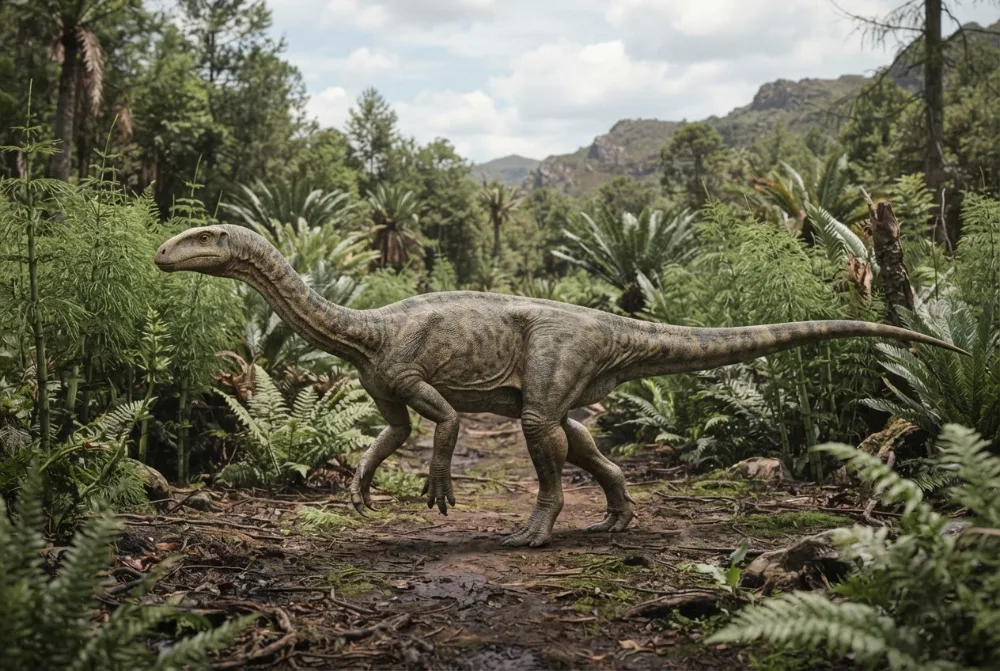
Mibvunzo inonyanya kubvunzwa nezve Buriolestes
?What did Buriolestes eat?
Buriolestes was a carnivore, likely preying on small vertebrates and soft invertebrates. Its curved, serrated teeth were well-suited for slicing meat.12
?How big was Buriolestes?
Buriolestes was small, with one robust individual weighing over 7 kg (15.4 lb) and others weighing between 6.4 and 7.2 kg (14 to 16 lb). Its femur was about 135 mm long.2
?When did Buriolestes live?
Buriolestes lived about 233 million years ago during the Late Triassic, in the Carnian epoch. It is one of the oldest known dinosaurs.1
?Was Buriolestes a dinosaur?
Yes, Buriolestes was a dinosaur, specifically an early sauropodomorph. It was a meat-eater but belonged to the group that later gave rise to giant plant-eaters like Diplodocus.1
?Where was Buriolestes found?
Buriolestes was found in the Buriol ravine in São João do Polêsine, Brazil, in the Santa Maria Formation. The holotype was discovered in 2009.1
Zvevanyanzvi vemadhino
- Zita resainzi
- Buriolestes
- Akaripa zita:
- Cabreira et al. 20164
- Boka
- Madhino emitsipa mirefu
- Mhuri / boka
- Sauropodomorpha4
- Kurongwa kwemhuka
- Sauropodomorpha4
- Zera rematombo
- makore mamiriyoni 237 kusvika 227 (Carnian)4
- Mapoka ematombo
- Santa Maria4
- Nyika
- Brazil4
- Zvinyorwa zvemafosiri
- 1 mu The Paleobiology Database4
- Kuwanikwa
- Buriolestes was discovered in 2009 in a ravine in Brazil and named in 2016 by paleontologist Cabreira and his team. The species name honors paleontologist Cesar Schultz.1
- Zvichiri kupokanwa
- Scientists are still debating whether the smaller bones found with the main Buriolestes skeleton belong to a juvenile or a different dinosaur.1
Kunobva chokwadi
- Buriolestes (en.wikipedia.org)
- A Unique Late Triassic Dinosauromorph Assemblage Reveals Dinosaur Ancestral Anatomy and Diet: Current Biology (cell.com)
- PBDB Taxon (paleobiodb.org)
- Buriolestes in The Paleobiology Database (CC BY 4.0): zera, nzvimbo, mapoka ematombo, kurongwa kwemhuka.
Chokwadi chega chega papeji ino chine nhamba inoratidza kwachakabva. Kana takakanganisa chimwe chinhu, ruregerero, tiri vanoda madhino, kwete magazini yesainzi. Tiudze pa [email protected] tichazvigadzirisa.
 Rex ane nzara! Dino Wiki ipurojekiti yababa yemwanakomana wavo anoda madhino, mahara, pasina kushambadza uye pasina zvinokutevera. Vakuru vanogona kupa Rex chekudyadya kuti vabatsire kuchengeta saiti iri pamhepo.Fudza Rex
 Brachiosaurus
 Diplodocus
 Brontosaurus
 Argentinosaurus
 Camarasaurus
 Morosaurus
 Nothosaurus
 Coelophysis
 Podokesaurus
 Simosaurus
 Eudimorphodon
 Herrerasaurus