 Uri dhino ripi? Kwizi
 Hondo yemadhino
 Mujaho wemadhino
 Mitambo midiki yemadhino
 Arubhamu yemasitika
 Rondedzero dzeTOP dzemadhino
 Ndishamise!
Rairarama rini?

Raiva hombe sei?
Raiva refu zvakadii?
Raiva rakakwirira zvakadii?
Rairema zvakadii?
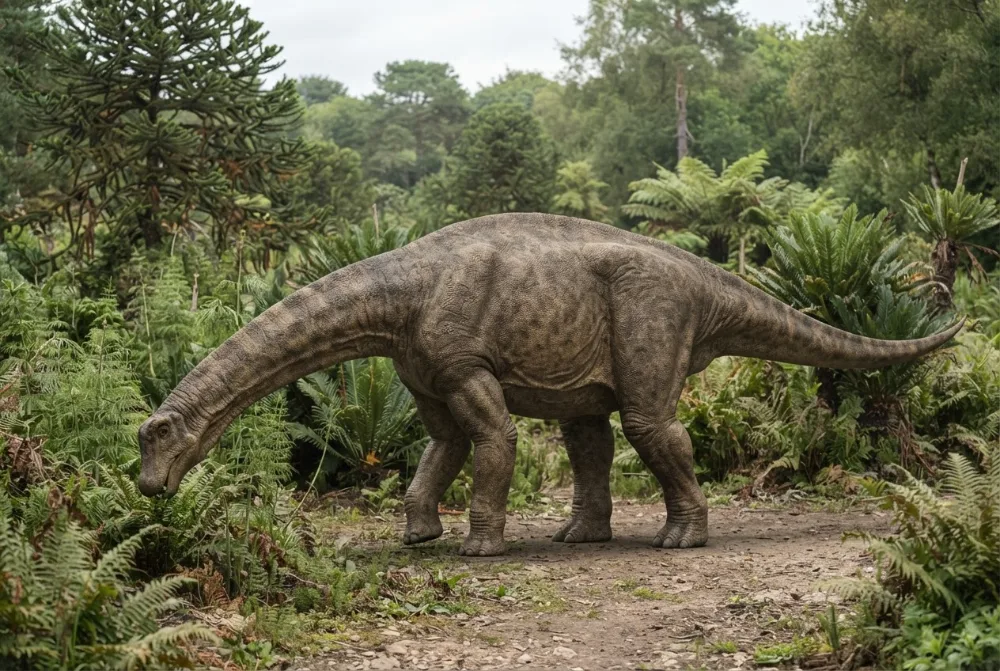
 kureba semotokari 2 dzakamiswa dzakatevedzana🍌kureba semabhanana 56 akatevedzana
 kurema seimbwa 190🍉kurema semanwiwa 760🎒kurema semakirasi 5 akazara evana vechikoro🐻❄️kurema semabere echando 8🏃raigona kumhanya mamita 100 mumasekonzi 18 (munhu anomhanya kupfuura vose anoda 9.6)
Camelotia raiva hombe sei kana richienzaniswa NEWE?
Masvomhu chete mubrowser yako. Hapana chinochengetwa kana kutumirwa kupi zvako.
Raimhanya zvakadii?


Zvinonakidza
Camelotia lived about 205 to 201 million years ago, during the Rhaetian stage of the Late Triassic.3
Its thigh bone (femur) is about 1 metre (3.3 feet) long, which helped scientists guess its size.1
Camelotia is named after Camelot, the legendary castle of King Arthur, because its fossils were found in Somerset, near where the stories take place.1
It was one of the largest sauropodomorphs from the Triassic, weighing about 3.8 tonnes (8,400 pounds).1
Scientists think Camelotia walked on all four legs, like later sauropods, because its relatives were becoming more quadrupedal.1
The first fossils of Camelotia were discovered in 1894 in a quarry in Wedmore, but they were not named until 1985.1
Some large dinosaur footprints found in Wales might have been made by Camelotia, but scientists are not sure.1
Mibvunzo inonyanya kubvunzwa nezve Camelotia
?How big was Camelotia?
Camelotia was about 8 to 10 metres long and weighed around 3.8 tonnes. That is about as long as a school bus.1
?What did Camelotia eat?
Camelotia was a plant-eater. Its teeth were leaf-shaped and serrated, perfect for eating plants.1
?Did Camelotia walk on two legs or four?
Scientists think Camelotia walked on all four legs, like later sauropods. Its relatives were becoming more quadrupedal.1
?Where was Camelotia found?
Camelotia's fossils were found in a quarry in Wedmore, Somerset, England. That is near the legendary castle of King Arthur, Camelot.1
Mubvisi wengano
Ngano: Camelotia was a meat-eater because its teeth were found near its bones.
Chokwadi: The teeth found with Camelotia actually belong to a different dinosaur, a theropod called Newtonsaurus. Camelotia itself was a plant-eater.1
Zvevanyanzvi vemadhino
- Zita resainzi
- Camelotia
- Akaripa zita:
- Galton 19853
- Boka
- Madhino emitsipa mirefu
- Mhuri / boka
- Sauropodiformes3
- Kurongwa kwemhuka
- Sauropodomorpha3
- Zera rematombo
- makore mamiriyoni 206 kusvika 201 (Rhaetian)3
- Mapoka ematombo
- Westbury3
- Nyika
- United Kingdom3
- Zvinyorwa zvemafosiri
- 2 mu The Paleobiology Database3
- Kuwanikwa
- The first fossils were found in 1894 in a quarry near Wedmore, England. They were named Camelotia borealis by Peter M. Galton in 1985.1
- Zvichiri kupokanwa
- Scientists are not sure exactly where Camelotia fits on the dinosaur family tree. Some think it is a close relative of Melanorosaurus, while others think it is a very early sauropod.1
Kunobva chokwadi
- Camelotia (en.wikipedia.org)
- Camelotia - Justapedia (justapedia.org)
- Camelotia in The Paleobiology Database (CC BY 4.0): zera, nzvimbo, mapoka ematombo, kurongwa kwemhuka.
Chokwadi chega chega papeji ino chine nhamba inoratidza kwachakabva. Kana takakanganisa chimwe chinhu, ruregerero, tiri vanoda madhino, kwete magazini yesainzi. Tiudze pa [email protected] tichazvigadzirisa.
 Rex ane nzara! Dino Wiki ipurojekiti yababa yemwanakomana wavo anoda madhino, mahara, pasina kushambadza uye pasina zvinokutevera. Vakuru vanogona kupa Rex chekudyadya kuti vabatsire kuchengeta saiti iri pamhepo.Fudza Rex
 Brachiosaurus
 Diplodocus
 Brontosaurus
 Argentinosaurus
 Camarasaurus
 Morosaurus
 Nothosaurus
 Coelophysis
 Podokesaurus
 Simosaurus
 Eudimorphodon
 Herrerasaurus